Vagaceratops

Description
Source: Wikipédia
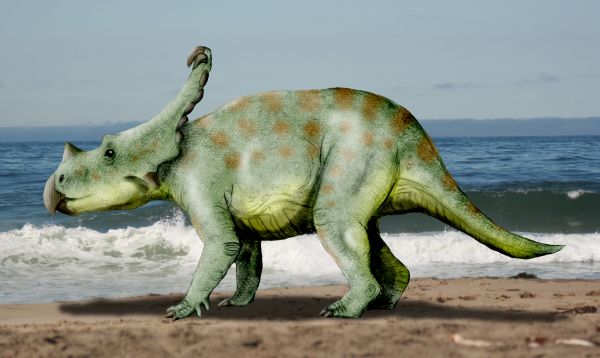
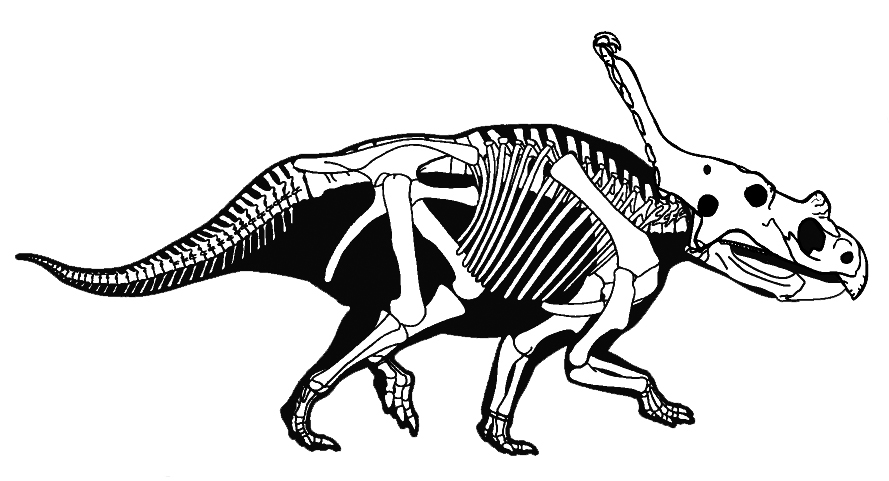
Vagaceratops est un genre fossile de dinosaures herbivores de la super-famille des Ceratopsia. Il s'agit d'un cératopsien chasmosauriné qui vivait pendant l'époque du Crétacé supérieur à la fin du (Campanien), il y a environ entre 75,5 Ma (millions d'années), dans la région correspondant aujourd'hui au nord de l'Alberta.
Ses fossiles ont été découverts dans la partie supérieure de la Formation de Dinosaur Park.
Une seule espèce est rattachée au genre, Vagaceratops irvinensis, décrite à l'origine sous le nom de Chasmosaurus irvinensis par Holmes et al. en 2001 ; puis rattachée au genre Vagaceratops par Scott D. Sampson (en) et al. en 2010.
Information(s)
Source: The Paleobiology Database
- Attibution: Sampson 201039514
- Statut: Valide
- Nom commun:
- Longueur (en m): ?
- Largeur (en m): ?
- Hauteur (en m): ?
- Poids (en m): de ? à ?
- Environnement de découverte: terrestrial
- Mode de vie: terrestrial
- Mode de locomotion: actively mobile
- Vision: ?
- Alimentation: herbivore
- Mode de reprodution: oviparous, dispersal=direct/internal,mobile
- Classification: Chasmosaurinae >> Ceratopsidae >> Ceratopsia >> Marginocephalia >> Cerapoda >> Genasauria >> Ornithischia >> Dinosauria
- Période: Campanian (de -83.60 Ma à -72.20 Ma)
- Espèce(s):
- Vagaceratops irvinensis (Valide)6978
- Mercuriceratops gemini (Synonyme subjectif de Vagaceratops irvinensis)51303
- Pentaceratops aquilonius (Synonyme subjectif de Vagaceratops irvinensis)59189
- Specimen(s):
Pas de spécimen dans la base de donnée.
- Autre(s) Taxon(s) trouvés dans la litterature:
- Chasmosaurus irvinensis n. recombined as Vagaceratops irvinensis
- Chasmosaurus irvinensis recombined as Vagaceratops irvinensis
- Vagaceratops irvinensis
- Découverte(s): 7 occcurrences
Ouvrir - Fermer - Historique des modifications:
 Canada
 États-Unis
Pas de modification récente.
Publication(s)
La base comprend 4 publication(s).
Source: The Paleobiology Database
- ↑1 A. A. Farke, M. J. Ryan, and P. M. Barrett, D. H. Tanke, D. R. Braman, M. A. Loewen, M. R. Graham. 2011. A new centrosaurine from the Late Cretaceous of Alberta, Canada, and the evolution of parietal ornamentation in horned dinosaurs. Acta Palaeontologica Polonica 56(4):691-702 (https://doi.org/10.4202/app.2010.0121)
- ↑1 2 3 4 R. B. Holmes, C. A. Forster, and M. J. Ryan, K. M. Shepherd. 2001. A new species of Chasmosaurus (Dinosauria: Ceratopsia) from the Dinosaur Park Formation of southern Alberta. Canadian Journal of Earth Sciences 38:1423-1438 (https://doi.org/10.1139/e01-036)
- ↑1 2 3 M. J. Ryan, D. C. Evans, and P. J. Currie, M. A. Lowman. 2014. A new chasmosaurine from northern Laramidia expands fill disparity in ceratopsid dinosaurs. Naturwissenchaften 101:505-512 (https://doi.org/10.1007/s00114-014-1183-1)
- ↑1 2 3 N. R. Longrich. 2014. The horned dinosaurs Pentaceratops and Kosmoceratops from the upper Campanian of Alberta and implications for dinosaur biogeography. Cretaceous Research 51:292-308 (https://doi.org/10.1016/j.cretres.2014.06.011)
Galerie d'images
Source: Wikimédia