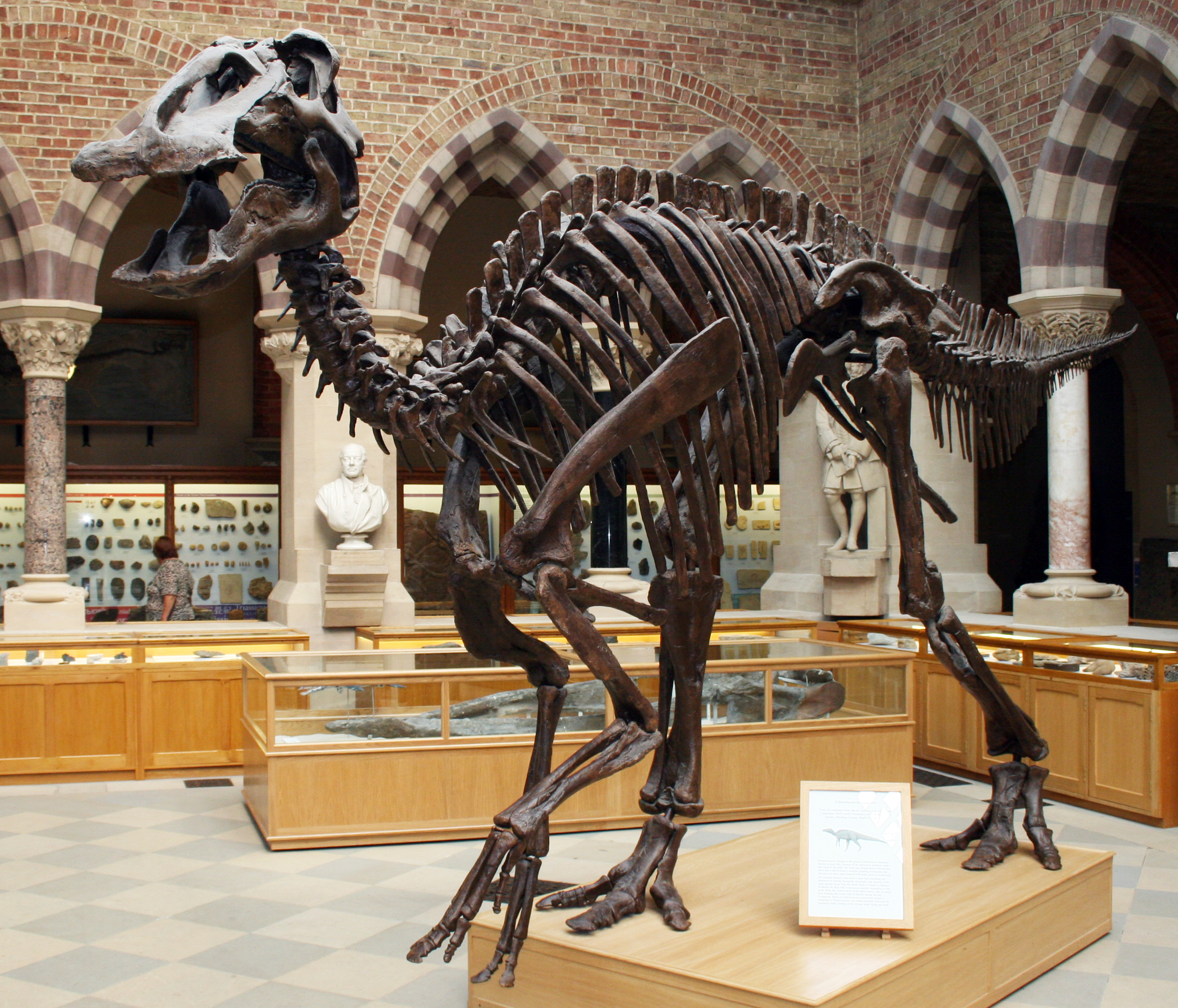
Classification
Dinosauria
Clade non classé
›
Ornithischia
Clade non classé
›
Neornithischia
Clade non classé
›
Pyrodontia
Clade non classé
›
Cerapoda
Clade non classé
›
Ornithopoda
Sous-ordre
›
Iguanodontia
Infraordre
›
Euiguanodontia
Clade non classé
›
Dryomorpha
Clade non classé
›
Ankylopollexia
Clade non classé
›
Styracosterna
Clade non classé
›
Hadrosauriformes
Clade non classé
›
Hadrosauroidea
Clade non classé
›
Hadrosauridae
Famille
›
Hadrosaurinae
Sous-famille
›
Brachylophosaurini
Clade non classé
Sites de découverte 29 sites géolocalisés
Répartition
Principaux pays
Formations géologiques
Distribution temporelle
Maastrichtien
(72.2–66 Ma)
4
Campanien
(83.6–72.2 Ma)
25
Images 1
Bibliographie
Description originale
T. A. Gates, J. R. Horner, and R. R. Hanna, C. R. Nelson. 2011. New unadorned hadrosaurine hadrosaurid (Dinosauria, Ornithopoda) from the Campanian of North America. Journal of Vertebrate Paleontology 31(4):798-811
DOI ↗
Bibliographie (26)
R. R. Rogers, J. R. Horner, and J. Ramezani, E. M. Roberts, D. J. Varricchio. 2024. Updating the Upper Cretaceous (Campanian) Two Medicine Formation of Montana: lithostratigraphic revisions, new CA-ID-TIMS U-Pb ages, and a calibrated framework for dinosaur occurrences. GSA Bulletin
DOI ↗
A. T. McDonald, D. G. Wolfe, and E. A. Freedman Fowler, T. A. Gates. 2021. A new brachylophosaurin (Dinosauria: Hadrosauridae) from the Upper Cretaceous Menefee Formation of New Mexico. PeerJ 9:e11084:1-28
DOI ↗
E. A. Freedman Fowler and J. R. Horner. 2015. A new brachylophosaurin hadrosaur (Dinosauria: Ornithischia) with an intermediate nasal crest from the Campanian Judith River Formation of northcentral Montana. PLoS One 10(11):e0141304
DOI ↗
J. G. Schmitt, F. D. Jackson, and R. R. Hanna. 2014. Debris flow origin of an unusual Late Cretaceous hadrosaur bonebed in the Two Medicine Formation of western Montana. Hadrosaurs
N. L. Murphy, K. Carpenter, and D. Trexler. 2013. New evidence for predation by a large tyrannosaurid. Tyrannosaurid Paleobiology
T. A. Gates, J. R. Horner, and R. R. Hanna, C. R. Nelson. 2011. New unadorned hadrosaurine hadrosaurid (Dinosauria, Ornithopoda) from the Campanian of North America. Journal of Vertebrate Paleontology 31(4):798-811
DOI ↗
P. Godefroit, S. Hai, and T. Yu, P. Lauters. 2008. New hadrosaurid dinosaurs from the uppermost Cretaceous of northeastern China. Acta Palaeontologica Polonica 53(1):47-74
DOI ↗
N. L. Murphy, D. Trexler, and M. Thompson. 2002. Exceptional soft-tissue preservation in a mummified ornithopod dinosaur from the Campanian Judith River Formation. Journal of Vertebrate Paleontology 22(3 (suppl.)):91A
J. R. Horner, J. G. Schmitt, and F. Jackson, R. Hanna. 2001. Bones and rocks of the Upper Cretaceous Two Medicine-Judith River clastic wedge complex, Montana. In C. L. Hill (ed), Society of Vertebrate Paleontology, 61st Annual Meeting, Bozeman. Guidebook for the Field Trips: Mesozoic and Cenozoic Paleontology in the Western Plains and Rocky Mountains, Museum of the Rockies Occasional Paper 3:3-13
M. J. Ryan and A. P. Russell. 2001. Dinosaurs of Alberta (exclusive of Aves). Mesozoic Vertebrate Life
D. A. Burnham, K. L. Derstler, and P. J. Currie, R. T. Bakker, Z. Zhou, J. H. Ostrom. 2000. Remarkable new birdlike dinosaur (Theropoda: Maniraptora) from the Upper Cretaceous of Montana. University of Kansas Paleontological Contributions 13:1-14
A. Prieto-Marquéz. 2000. On the postcrania of Brachylophosaurus goodwini (Dinosauria: Ornithopoda): implications for hadrosaur morphology. Journal of Vertebrate Paleontology 20(3 (suppl.)):63A
L. A. Nessov. 1995. Dinozavri severnoi Yevrazii: Novye dannye o sostave kompleksov, ekologii i paleobiogeografii [Dinosaurs of northern Eurasia: new data about assemblages, ecology, and paleobiogeography]. Institute for Scientific Research on the Earth's Crust, St. Petersburg State University, St. Petersburg
W. B. Gallagher. 1993. The Cretaceous/Tertiary mass extinction event in the North Atlantic coastal plain. The Mosasaur 5:75-154
D. J. Varricchio. 1993. Taphonomy of Jack's Birthday site, a diverse dinosaur bone bed. Journal of Vertebrate Paleontology 13(3, suppl.):61A
B. S. Grandstaff, D. C. Parris, and R. K. Denton, Jr, W. B. Gallagher. 1992. Alphadon (Marsupialia) and Multituberculata (Allotheria) in the Cretaceous of eastern North America. Journal of Vertebrate Paleontology 12(2):217-222
DOI ↗
K. F. Hirsch and B. Quinn. 1990. Eggs and eggshell fragments from the Upper Cretaceous Two Medicine Formation of Montana. Journal of Vertebrate Paleontology 10(4):491-511
DOI ↗
J. R. Horner. 1988. A new hadrosaur (Reptilia, Ornithischia) from the Upper Cretaceous Judith River Formation of Montana. Journal of Vertebrate Paleontology 8(3):314-321
DOI ↗
W. B. Gallagher, D. C. Parris, and E. E. Spamer. 1986. Paleontology, biostratigraphy, and depositional environments of the Cretaceous-Tertiary transition in the New Jersey coastal plain. The Mosasaur 3:1-35
P. J. Currie. 1980. Mesozoic vertebrate life in Alberta and British Columbia. Mesozoic Vertebrate Life 1:27-40
J. R. Horner and R. Makela. 1979. Nest of juveniles provides evidence of family structure among dinosaurs. Nature 282:296-298
DOI ↗
H. W. Miller. 1966. Cretaceous vertebrate fauna from Phoebus Landing, North Carolina. The Journal of the Elisha Mitchell Scientific Society 82(2):93
C. M. Sternberg. 1953. A mew hadrosaur from the Oldman Formation of Alberta: discussion of nomenclature. National Museum of Canada Bulletin 128:1-12
E. D. Cope. 1875. On the transition beds of the Saskatchewan district. Proceedings of the Academy of Natural Sciences of Philadelphia 27:2-3
J. Leidy. 1866. [The specimen of a large phalanx of an extinct reptile]. Proceedings of the Academy of Natural Sciences of Philadelphia 1866:9
J. Leidy. 1858. [On the bones of a huge herbivorous saurian near Haddonfield]. Proceedings of the Academy of Natural Sciences of Philadelphia 10:215-218