Classification
Dinosauria
Clade non classé
›
Theropoda
Clade non classé
›
Neotheropoda
Clade non classé
›
Averostra
Clade non classé
›
Tetanurae
Clade non classé
›
Coelurosauria
Clade non classé
›
Ornithomimipodidae
Famille
›
Columbosauripus
Genre
Sites de découverte 14 sites géolocalisés
Répartition
Principaux pays
Formations géologiques
Distribution temporelle
Cénomanien
(100.5–93.9 Ma)
5
Albien
(113.2–100.5 Ma)
5
Valanginien
(137.05–132.6 Ma)
3
Tithonien
(149.2–143.1 Ma)
1
Espèces (2)
Columbosauripus amouraensis
106 Ma
Columbosauripus ungulatus
137 Ma
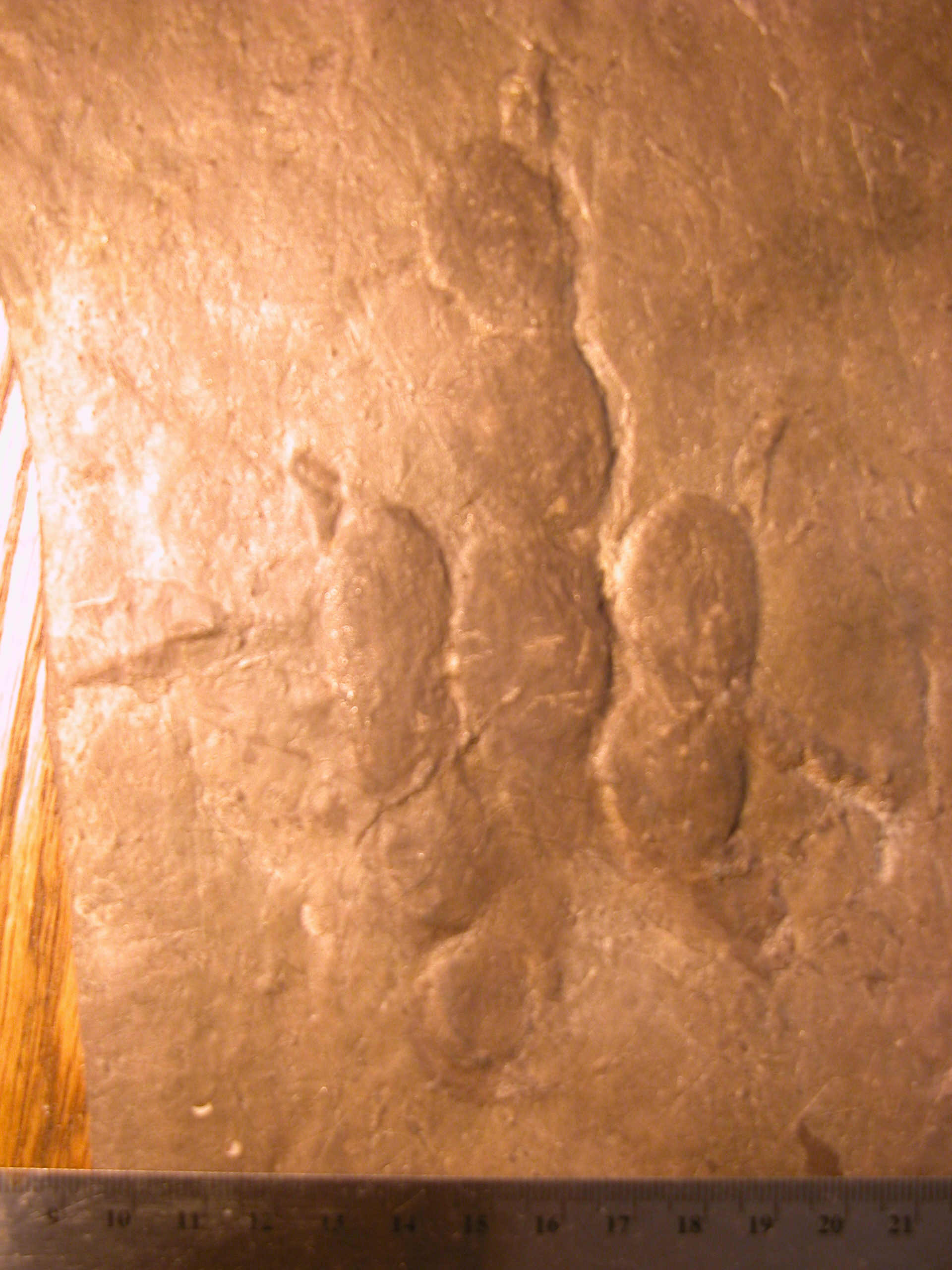
Images 1
Bibliographie
Description originale
C. M. Sternberg. 1932. Dinosaur tracks from Peace River, British Columbia. National Museum of Canada Bulletin 68:59-85
DOI ↗
Bibliographie (9)
G. Leonardi and I. d. S. Carvalho. 2021. Dinosaur Tracks from Brazil: A Lost World of Gondwana
DOI ↗
M. Bessedik, C. Mammeri, and L. Belkebir, M. Mahboubi. 2020. Les empreintes de pieds tri et tetradactyles de dinosaures (Rhétien-Hettangien à Cénomanien) de l’Atlas saharien (Algérie) [Tri- and tetradactyl dinosaur footprints (Rhaetian–Hettangian to Cenomanian) from the Saharan Atlas (Algeria)]. Mémoire du service géologique de l’Algérie 21:29-50
R. T. McCrea, L. G. Buckley, and A. G. Plint, P. J. Currie, J. W. Haggart, C. W. Helm, S. G. Pemberton. 2014. A review of vertebrate track-bearing formations from the Mesozoic and earliest Cenozoic of western Canada with a description of a new theropod ichnospecies and reassignment of an avian ichnogenus. Fossil Footprints of Western North America. New Mexico Museum of Natural History and Science Bulletin 62:5-94
R. A. Gangloff, K. C. May, and J. E. Storer. 2004. An early Late Cretaceous dinosaur tracksite in central Yukon Territory, Canada. Ichnos 11:299-309
DOI ↗
R. T. McCrea. 2000. Dinosaur footprints in the Lower Cretaceous (Albian) Gates Formation of Alberta, Canada: their use in palaeobiology and palaeoenvironmental interpretation. Y.-N. Lee (ed.), 2000 International Dinosaur Symposium for Kosong County in Korea. Paleontological Society of Korea Special Publication 4:169-178
P. J. Currie. 1983. Hadrosaur trackways from the Lower Cretaceous of Canada. Acta Palaeontologica Polonica 28(1-2):63-73
J. E. Storer. 1975. Dinosaur tracks, Columbosauripus ungulatus (Saurischia: Coelurosauria), from the Dunvegan Formation (Cenomanian) of northeastern British Columbia. Canadian Journal of Earth Sciences 12:1805-1807
DOI ↗
H. Haubold. 1971. Handbuch der Paläoherpetologie / Encyclopedia of Paleoherpetology. Part 18. Ichnia Amphibiorum et Reptiliorum Fossilium.
DOI ↗
C. M. Sternberg. 1932. Dinosaur tracks from Peace River, British Columbia. National Museum of Canada Bulletin 68:59-85
DOI ↗