


Classification
Mosasauridae
Famille
›
Halisaurinae
Clade non classé
›
Halisaurini
Clade non classé
›
Halisaurus
Genre
Sites de découverte 30 sites géolocalisés
Répartition
Principaux pays
Formations géologiques
Distribution temporelle
Maastrichtien
(72.2–66 Ma)
23
Campanien
(83.6–72.2 Ma)
7
Espèces (4)
Halisaurus arambourgi
72 Ma
Halisaurus hebae
72 Ma
Synonymes (1)
Baptosaurus
nomen dubium Halisaurus
Actualités 1
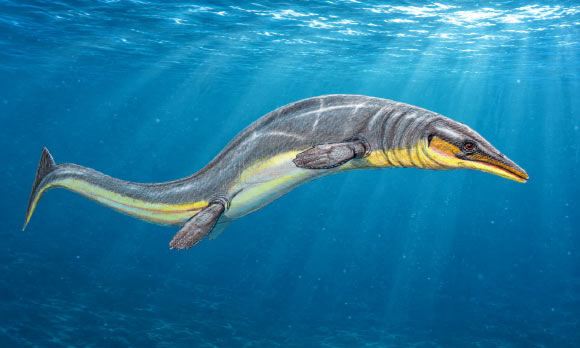
Images 8
Bibliographie
Description originale
J. J., Jr. Sepkoski. 2002. A compendium of fossil marine animal genera. Bulletins of American Paleontology 363:1-560
Bibliographie (22)
R. A. Otero. 2025. Review of two marine vertebrate assemblages from the Arauco Basin (central Chile) reveals diversity changes throughout the Maastrichtian. Cretaceous Research 166(78):105996
DOI ↗
T. Rempert, B. Martens, and A. Vinkeles Melchers. 2024. Mosasaurs (Squamata: Mosasauridae) from the Late Cretaceous (Late Maastrichtian) of North Carolina, USA. Proceedings of the Zoological Institute RAS 328(3):384-391
DOI ↗
A. A. Shaker, N. R. Longrich, and A. Strougo, A. Asan, N. Bardet, M. K. Mousa, A. A. Tantawy, G. A. Abu El-Kheir. 2023. A new species of Halisaurus (Mosasauridae: Halisaurinae) from the lower Maastrichtian (Upper Cretaceous) of the Western Desert, Egypt. Cretaceous Research 154:105719
DOI ↗
P. Jiménez-Huidobro, R. A. Otero, and S. Soto-Acuña, M. W. Caldwell. 2019. Reassessment of cf. Plotosaurus from the upper Maastrichtian of Chile, with comments on the South American distribution of halisaurine mosasaurs. Cretaceous Research 103:104162:1-9
DOI ↗
M. S. Fernández and M. Talevi. 2015. An halisaurine (Squamata: Mosasauridae) from the Late Cretaceous of Patagonia, with a preserved tympanic disc: Insights into the mosasaur middle ear. Comptes Rendus Palevol 14:483-493
DOI ↗
H. Cappetta, N. Bardet, and X. Pereda Suberbiola, S. Adnet, D. Akkrim, M. Amalik, A. Benabdallah. 2014. Marine vertebrate faunas from the Maastrichtian phosphates of Benguérir (Ganntour Basin, Morocco): Biostratigraphy, palaeobiogeography and palaeoecology. Palaeogeography, Palaeoclimatology, Palaeoecology 409:217-238
DOI ↗
O. Mateus, M. J. Polcyn, and L. L. Jacobs, R. Arujo, A. S. Schulp, J. Marinheiro, B. Pereira, D. P. Vineyard. 2012. Cretaceous amniotes from Angola: dinosaurs, pterosaurs, mosasaurs, plesiosaurs, turtles. Actas de V Jornadas Internacionales sobre Paleontologia de Dinosaurios y su Entorno, Salas de los Infantes, Burgos
M. J. Polcyn, J. Lindgren, and N. Bardet, D. Cornelissen, L. Verding, A. S. Schulp. 2012. Description of new specimens of Halisaurus arambourgi Bardet & Pereda Suberbiola, 2005 and the relationships of Halisaurinae. Bulletin de la Société Géologique de France 183(2):123-136
DOI ↗
J. Lindgren. 2007. First record of Halisaurus (Squamata: Mosasauridae) from the Pacific coast of North America. PaleoBios 27(2):40-47
N. Bardet, X. Pereda Suberbiola, and M. Iarochene, B. Bouya, M. Amaghaz. 2005. A new species of Halisaurus from the Late Cretaceous phosphates of Morocco, and the phylogenetical relationships of the Halisaurinae (Squamata: Mosasauridae). Zoological Journal of the Linnean Society 143:447-472
DOI ↗
N. Bardet and X. Pereda Suberbiola. 2002. Marine reptiles from the Late Cretaceous Phosphates of Jordan: palaeobiogeographical implications. Geodiversitas 24(4):831-839
W. B. Gallagher. 2002. Faunal changes across the Cretaceous-Tertiary (K-T) boundary in the Atlantic coastal plain of New Jersey: restructuring the marine community after the K-T mass-extinction event. Catastrophic Events and Mass Extinctions: Impacts and beyond. GSA Special Paper 356:291-301
DOI ↗
R. B. Holmes and H.-D. Sues. 2000. A partial skeleton of the basal mosasaur Halisaurus platyspondylus from the Severn Formation (Upper Cretaceous: Maastrichtian) of Maryland. Journal of Paleontology 74(2):309-316
DOI ↗
M. W. Caldwell and G. L. Bell, Jr. 1995. Halisaurus sp. (Mosasauridae) from the Upper Cretaceous (Santonian) of east-central Peru, and the taxonomic utility of mosasaur cervical vertebrae. Journal of Vertebrate Paleontology 15(3):532-544
DOI ↗
T. Lingham-Soliar. 1994. First record of mosasaurs from the Maastrichtian (Upper Cretaceous) of Zaire. Palaeontologische Zeitschrift 68(1/2):259-265
DOI ↗
W. B. Gallagher. 1993. The Cretaceous/Tertiary mass extinction event in the North Atlantic coastal plain. The Mosasaur 5:75-154
B. S. Grandstaff, D. C. Parris, and R. K. Denton, Jr, W. B. Gallagher. 1992. Alphadon (Marsupialia) and Multituberculata (Allotheria) in the Cretaceous of eastern North America. Journal of Vertebrate Paleontology 12(2):217-222
DOI ↗
T. Lingham-Soliar. 1991. Mosasaurs from the Upper Cretacous of Niger. Palaeontology 34(3):653-670
A. J. Robb. 1989. The Upper Cretaceous (Campanian, Black Creek Formation) fossil fish fauna of Phoebus Landing, Bladen County, North Carolina. The Mosasaur 4:75-92
D. Baird. 1986. Upper Cretaceous reptiles from the Severn Formation of Maryland. The Mosasaur 3:63-85
D. R. Schwimmer. 1986. Late Cretaceous fossils from the Blufftown Formation (Campanian) in western Georgia. The Mosasaur 3:109-123
D. Baird and G. R. Case. 1966. Rare marine reptiles from the Cretaceous of New Jersey. Journal of Paleontology 40(5):1211-1215