Clade non classé
Valide Éteint

Euichthyosauria

(Motani 1999)

Merriamosauria is an extinct clade of ichthyosaurs. It was named by Ryosuke Motani in his 1999 analysis of the relationships of ichthyopterygian marine reptiles and was defined in phylogenetic terms as a stem-based taxon including "the last common ancestor of Shastasaurus pacificus and Ichthyosaurus communis, and all of its descendants." The name honours John Campbell Merriam. Based on this definition, Merriamosauria includes most ichthyosaurs except for several Triassic groups such as the clade Mixosauria, the family Cymbospondylidae, and perhaps the family Toretocnemidae. Merriamosaurs are characterized by features in their pectoral girdles and limb bones, including an extensive connection between the scapula and the coracoid bone, the absence of the first metacarpal and the absence of a pisiform bone.

Résumé en anglais — version française non disponible.

Plage temporelle
Occurrences PBDB
0
Groupe
Ichtyosaures
Carnivore nektonic Marin
Euichthyosauria
cliquer pour agrandir
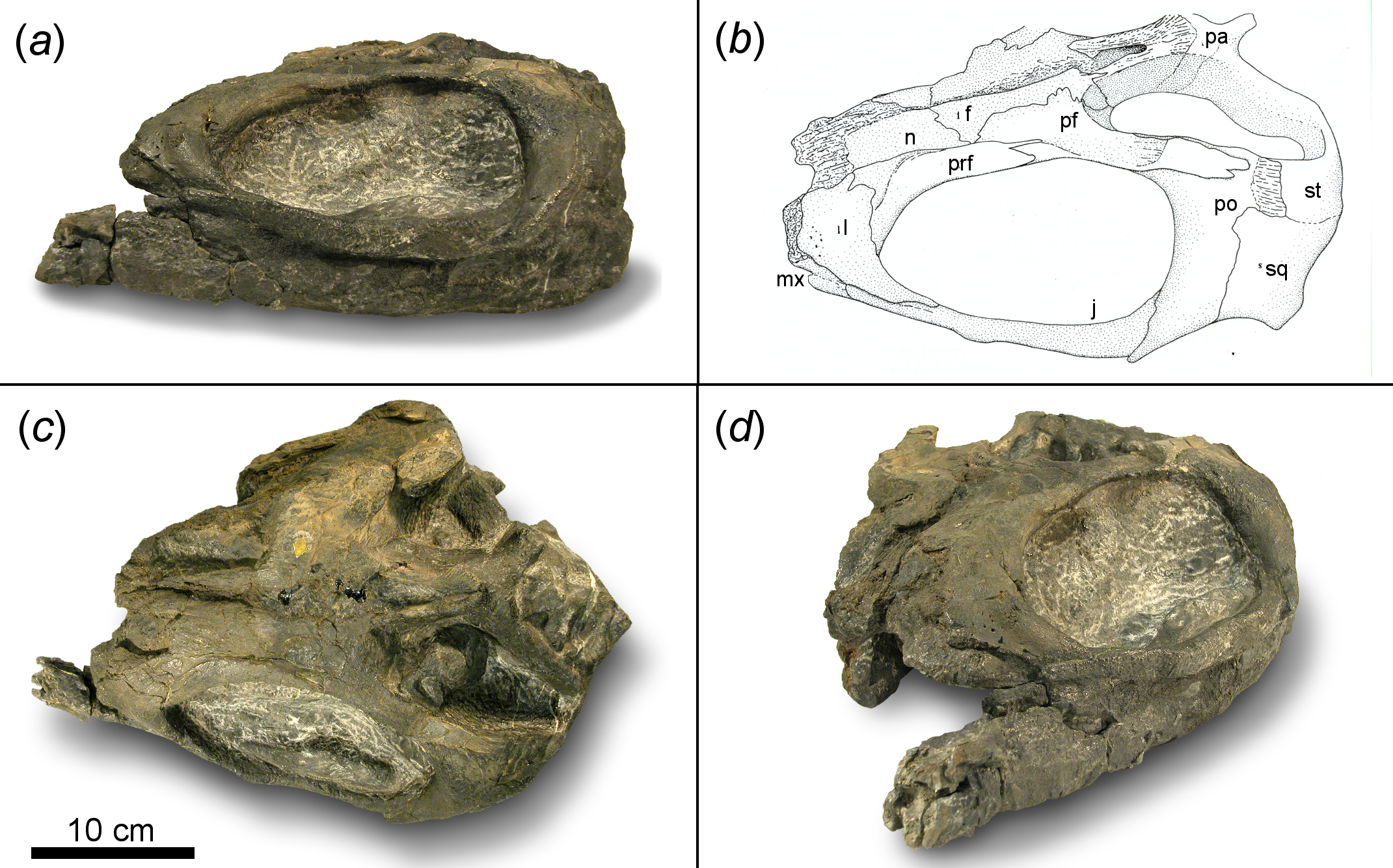
Partial skull of Shastasaurus pacificus (UCMP 9017) from the Late Triassic of California, USA, in (A) lateral, (B) dorsal, and (C) anterolateral view. Based on this skull, Shastasaurus has repeatedly been reconstructed with a long, tooth-bearing rostrum. However, note the slenderness of the lower jaw (B, C) and the strong anterior taper of the snout (B), both of which are more consistent with the abbreviated and toothless snout of Shastasaurus liangae comb. nov. than with the traditional long-snouted reconstruction of this skull (as, e.g., in references [22] and [23]). © P. Martin Sander1*, Xiaohong Chen2, Long Cheng2, Xiaofeng Wang2 · CC BY 2.5 · Wikimedia

Légende en anglais — traduction française non disponible.

PBDB Wikipedia
Classification
Ichthyosauria Clade non classé
Hueneosauria Clade non classé
Merriamosauria Clade non classé
Euichthyosauria Clade non classé
Images 1
Bibliographie
Description originale
R. Motani. 1999. Phylogeny of the Ichthyopterygia. Journal of Vertebrate Paleontology 19(3):473-496 DOI ↗