Genus
Valid Extinct

Canardia

Prieto-Marquez et al. 2013
Etymology Du Français ''canard'' une allusion au fait que cet animal appartient aux hadrosaures lesquels sont aussi connus sous le nom de dinosaures à bec de canard.

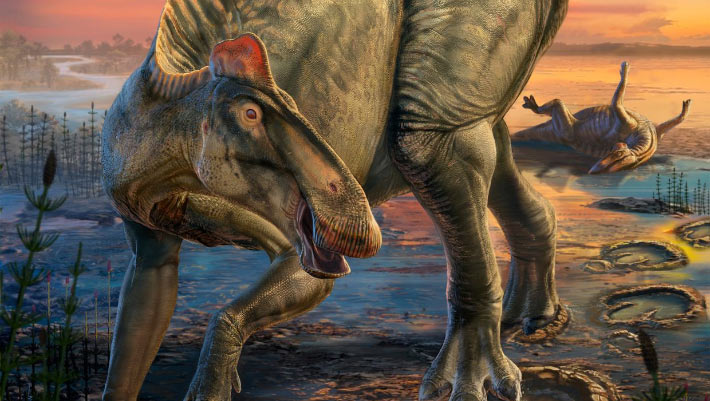
Canardia is an extinct genus of lambeosaurine dinosaur known from the Late Cretaceous Marnes d'Auzas Formation of Haute-Garonne department, in Occitanie region, southwestern France. The type species Canardia garonnensis was first described and named by Albert Prieto-Márquez, Fabio M. Dalla Vecchia, Rodrigo Gaete and Àngel Galobart in 2013. It is only known from juvenile specimens.

Temporal range
Triassic
Jurassic
Cretaceous
Paleogene
Neogene
252 201 145 66 0 Ma
PBDB occurrences
2
Group
Dinosaures
Herbivore Ground dwelling, gregarious Terrestrial
Canardia
click to enlarge
Canardia garonnensis, MDE-Ma3–16 (holotype), right maxilla. Maxilla in lateral (A), ventral (B), medial (C), and dorsal (D) views. © Albert Prieto-Márquez, Fabio M. Dalla Vecchia, Rodrigo Gaete, Àngel Galobart · CC BY 2.5 · Wikimedia
PBDB Wikipedia
Classification
Dinosauria Unranked clade
Ornithischia Unranked clade
Neornithischia Unranked clade
Pyrodontia Unranked clade
Cerapoda Unranked clade
Ornithopoda Suborder
Iguanodontia Infraorder
Euiguanodontia Unranked clade
Dryomorpha Unranked clade
Ankylopollexia Unranked clade
Styracosterna Unranked clade
Hadrosauriformes Unranked clade
Hadrosauroidea Unranked clade
Hadrosauridae Family
Lambeosaurinae Subfamily
Arenysaurini Unranked clade
Canardia Genus
Fossil sites 2 geolocated sites
Distribution
Top countries
🇫🇷 France
2
Geological formations
Marno-calcaires jaunes de Gensac
1
Marnes d'Auzas
1
Temporal distribution
Maastrichtian (72.2–66 Ma)
2
Species (1)
Canardia garonnensis 72 Ma
News 3
Corythosaurus: Beast of the Week
crest Canada Canardia Corythosaurus Dinosauria +6
This week we will take a look at a well known duckbill dinosaur.  Enter Corythosaurus!  Corythosaurus was a plant eater that belonged to the lambiosaurine group within the family, Hadrosauridae. (duckbills)  Lambiosaurine hadrosaurs typically had hollow crests on their heads and narrower beaks compared to other kinds hadrosaurs.  It was closely related to other lambiosaurine hadrosaurs such as Parasaurolophus, Hypacrosaurus, Lambeosaurus, and Velafrons.  It lived in what is now Alberta, Canada,
15/02/2026 prehistoricbeastoftheweek
Parasaurolophus: Beast of the Week
crest Cretaceous Late Cretaceous specimen Canardia +2
This week we will be taking a look at a very popular duck-billed dinosaur.  Say hello to Parasaurolophus!  Parasaurolophus was a plant eater that lived in what is now North America during the Late Cretaceous, about 77 to 73 million years ago.  Parasaurolophus measured about 30 feet (9.1 meters) long from beak to tail, but certain incomplete specimens show evidence of having been a bit larger.  Parasaurolophus is most well-known for its long, curved crest that grew from the back of its head, givi
21/12/2025 prehistoricbeastoftheweek
Edmontosaurus: Beast of the Week
Cretaceous Late Cretaceous Canardia Dinosauria Edmontosaurus +1
Today we are checking out one of the largest and most well studied of the duck-billed dinosaurs.  Enter Edmontosaurus!  Edmontosaurus annectens in watercolors by Christopher DiPiazza.Edmontosaurus was a hadrosaur ("duck-billed") dinosaur that could grow to at least 39 feet (12 meters) long from beak to tail that lived during the late Cretaceous period in what is now western North America.  There are currently two recognized species within the genus, Edmontosaurus regalis and Edmontosaurus annect
29/11/2025 prehistoricbeastoftheweek
Images 1
Bibliography
Original description
A. Prieto-Marquez, F. M. D. Vecchia, and R. Gaete, A. Galobart. 2013. Diversity, relationships, and biogeography of the lambeosaurine dinosaurs from the European archipelago, with description of the new aralosaurin Canardia garonnensis. PLoS One 8(7):e69835:1-44 DOI ↗
Bibliography (1)
A. Prieto-Marquez, F. M. D. Vecchia, and R. Gaete, A. Galobart. 2013. Diversity, relationships, and biogeography of the lambeosaurine dinosaurs from the European archipelago, with description of the new aralosaurin Canardia garonnensis. PLoS One 8(7):e69835:1-44 DOI ↗