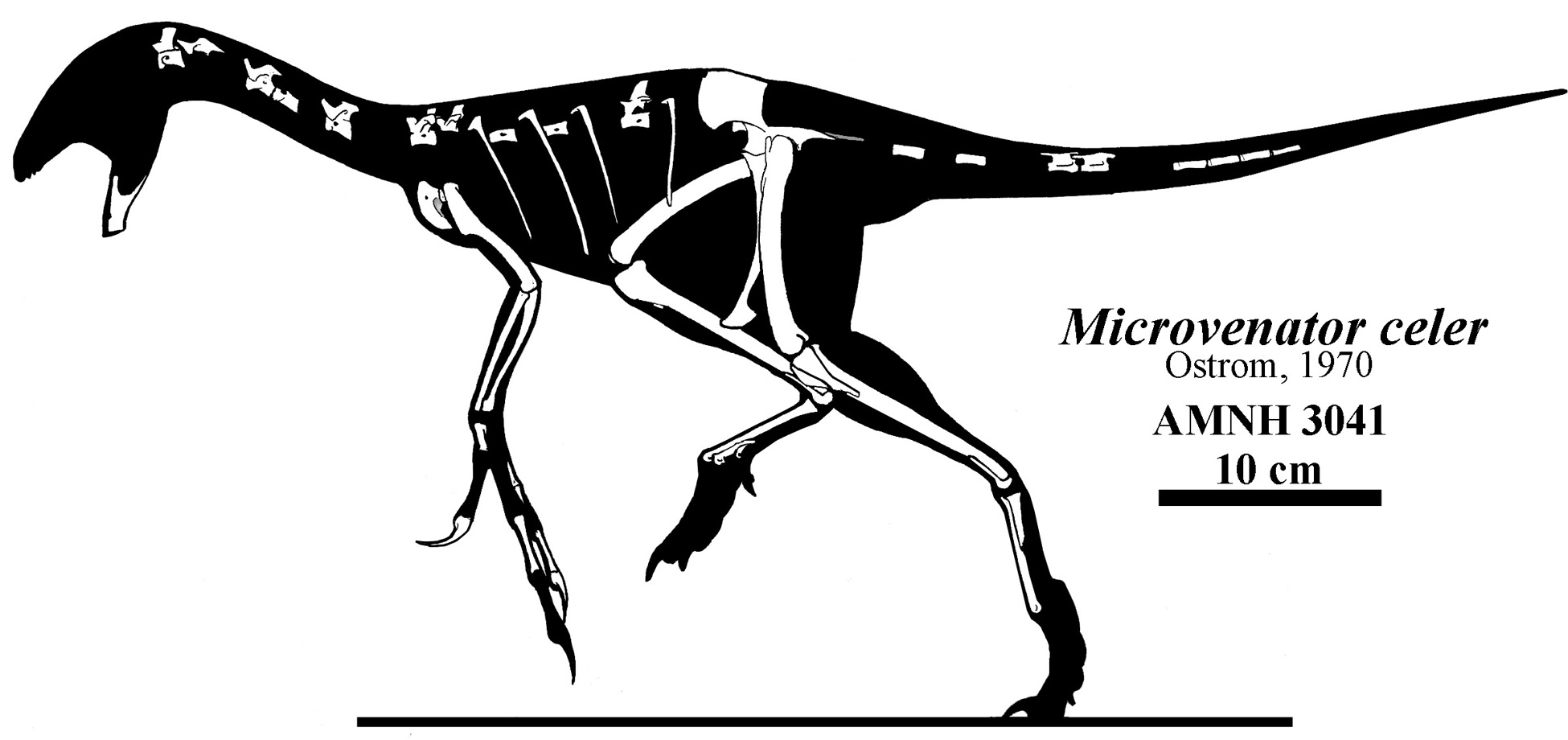
Classification
Dinosauria
Unranked clade
›
Theropoda
Unranked clade
›
Neotheropoda
Unranked clade
›
Averostra
Unranked clade
›
Tetanurae
Unranked clade
›
Coelurosauria
Unranked clade
›
Maniraptora
Unranked clade
›
Oviraptorosauria
Infraorder
›
Caenagnathidae
Family
›
Microvenator
Genus
Measurements
Length
0,9 m ⓘ
Microvenator celer
Mass
3 kg ⓘ
Microvenator celer
Fossil sites 4 geolocated sites
Distribution
Species (2)
Images 1
Bibliography
Original description
J. H. Ostrom. 1970. Stratigraphy and paleontology of the Cloverly Formation (Lower Cretaceous) of the Bighorn Basin area, Wyoming and Montana. Peabody Museum Bulletin 35:1-234
Bibliography (3)
M. P. J. Oreska, M. T. Carrano, and K. M. Dzikiewicz. 2013. Vertebrate paleontology of the Cloverly Formation (Lower Cretaceous), I: faunal composition, biogeographic relationships, and sampling. Journal of Vertebrate Paleontology 33(2):264-292
DOI ↗
W. D. Maxwell. 1993. Neonate dinosaur remains and dinosaur eggshell from the Lower Cretaceous Cloverly Formation, Montana. Journal of Vertebrate Paleontology 13(3, suppl.):49A
J. H. Ostrom. 1970. Stratigraphy and paleontology of the Cloverly Formation (Lower Cretaceous) of the Bighorn Basin area, Wyoming and Montana. Peabody Museum Bulletin 35:1-234