Classification
Dinosauria
Unranked clade
›
Theropoda
Unranked clade
›
Neotheropoda
Unranked clade
›
Averostra
Unranked clade
›
Tetanurae
Unranked clade
›
Coelurosauria
Unranked clade
›
Maniraptora
Unranked clade
›
Paraves
Unranked clade
›
Deinonychosauria
Infraorder
›
Dromaeosauridae
Family
›
Halszkaraptorinae
Subfamily
Fossil sites 4 geolocated sites
Distribution
Images 1
Bibliography
Original description
A. Cau, V. Beyrand, and D. F. A. E. Voeten, V. Fernandez, P. Tafforeau, K. Stein, R. Barsbold, K. Tsogtbaatar, P. J. Currie, P. Godefroit. 2017. Synchrotron scanning reveals amphibious ecomorphology in a new clade of bird-like dinosaurs. Nature
DOI ↗
Bibliography (4)
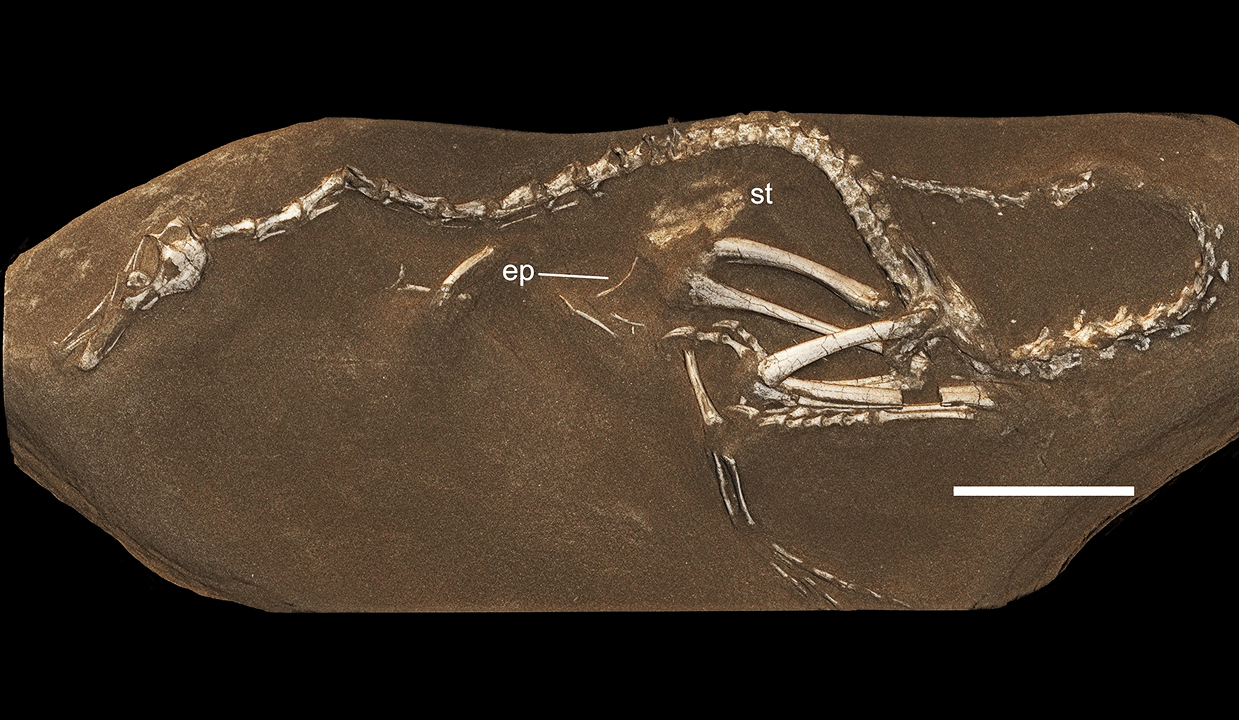
S. Lee, Y.-N. Lee, and P. J. Currie, R. Sissons, J.-Y. Park, S.-H. Kim, R. Barsbold, K. Tsogtbaatar. 2022. A non-avian dinosaur with a streamlined body exhibits potential adaptations for swimming. Communications Biology 5:1185:1-10
DOI ↗
A. Cau, V. Beyrand, and D. F. A. E. Voeten, V. Fernandez, P. Tafforeau, K. Stein, R. Barsbold, K. Tsogtbaatar, P. J. Currie, P. Godefroit. 2017. Synchrotron scanning reveals amphibious ecomorphology in a new clade of bird-like dinosaurs. Nature
DOI ↗
A. H. Turner, D. Pol, and J. A. Clarke, G. M. Erickson, M. A. Norell. 2007. A basal dromaeosaurid and size evolution preceding avian flight. Science 317:1378-1381
DOI ↗
H. Osmolska. 1982. Hulsanpes perlei n. g. n. sp. (Deinonychosauria, Saurischia, Dinosauria) from the Upper Cretaceous Barun Goyot Formation of Mongolia. Neues Jahrbuch für Geologie und Paläontologie Monatshefte 1982(7):440-448
DOI ↗