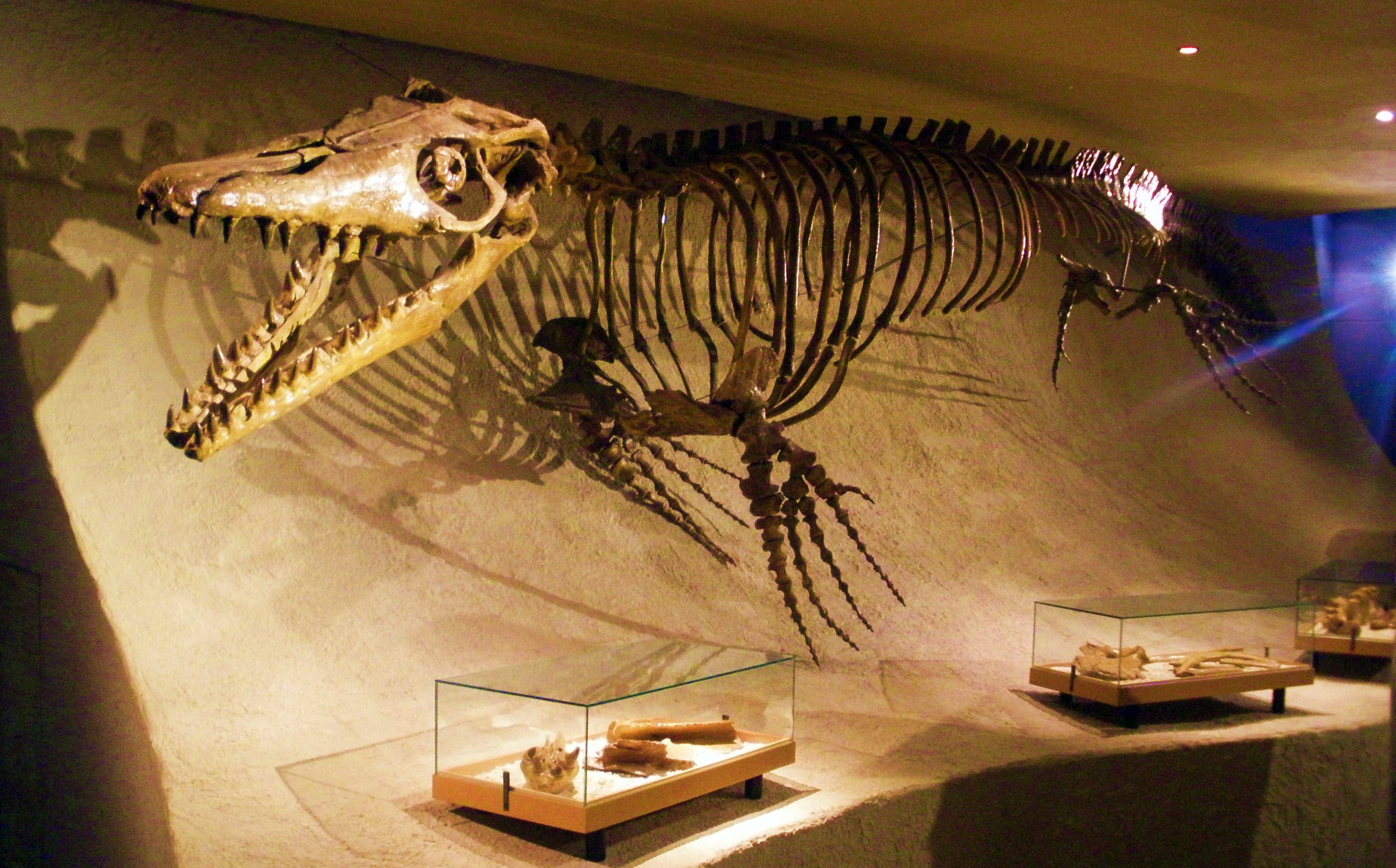
Classification
Measurements
Length
18 m ⓘ
Fossil sites 130 geolocated sites
Distribution
Top countries
Geological formations
Temporal distribution
Maastrichtian
(72.2–66 Ma)
70
Campanian
(83.6–72.2 Ma)
51
Santonian
(85.7–83.6 Ma)
3
Coniacian
(89.8–85.7 Ma)
2
Cenomanian
(100.5–93.9 Ma)
3
Albian
(113.2–100.5 Ma)
1
Species (41)
Amphekepubis johnsoni
90 Ma
Mosasaurus beaugei
84 Ma
Mosasaurus conodon
84 Ma
Mosasaurus dekayi
84 Ma
Mosasaurus depressus
84 Ma
Mosasaurus flemingi
84 Ma
Mosasaurus gaudryi
86 Ma
Mosasaurus gracilis
101 Ma
Mosasaurus hobetsuensis
72 Ma
Mosasaurus hoffmannii
84 Ma
Mosasaurus horridus
84 Ma
Mosasaurus lemonnieri
84 Ma
Mosasaurus lonzeensis
90 Ma
Mosasaurus missouriensis
84 Ma
Mosasaurus mokoroa
84 Ma
Mosasaurus reversus
nomen dubium, species not entered Mosasaurus
Nectoportheus validus
72 Ma
Synonyms (11)
Amphekepubis
subjective synonym of Mosasaurus
Baseodon
subjective synonym of Mosasaurus
Batrachiosaurus
subjective synonym of Mosasaurus
Batrachotherium
subjective synonym of Mosasaurus
Drepanodon
subjective synonym of Mosasaurus
Lesticodus
subjective synonym of Mosasaurus
Macrosaurus
subjective synonym of Mosasaurus
Mosasaurus impar
nomen dubium, species not entered Mosasaurus
Mosasaurus reversus
nomen dubium, species not entered Mosasaurus
Nectoportheus
subjective synonym of Mosasaurus
Pterycollosaurus
subjective synonym of Mosasaurus
News 6
tooth
Mosasaurus
09/08/2026 everythingdinosaur
tooth
Dinosauria
Mosasaurus
04/08/2026 everythingdinosaur

predator
Mosasaurus
new species
26/05/2026 sciencesetavenir
⚙ Auto-translated
predator
fossil
Mosasaurus
study
26/05/2026 futura-terre
⚙ Auto-translated
predator
Campanian
Cretaceous
Late Cretaceous
fossil
+3
26/05/2026 everythingdinosaur
predator
fossil
Mosasaurus
Tylosaurus
discovery
+1
23/05/2026 sciencedaily
Images 11
Bibliography
Original description
J. Parkinson. 1822. Outlines of Oryctology. An Introduction to the Study of Fossil Organic Remains; Especially of Those Found in the British Strata: Intended to Aid the Student in His Inquiries Respecting the Nature of Fossils
Bibliography (75)
Z. Boles, P. Ullmann, and I. Putnam, M. Ford, J. Deckhut. 2024. New vertebrate microfossils expand the chondrichthyan and actinopterygian fauna of the Maastrichtian-Danian Hornerstown Formation in New Jersey. Acta Palaeontologica Polonica 69:173-198
DOI ↗
T. Rempert, B. Martens, and A. Vinkeles Melchers. 2024. Mosasaurs (Squamata: Mosasauridae) from the Late Cretaceous (Late Maastrichtian) of North Carolina, USA. Proceedings of the Zoological Institute RAS 328(3):384-391
DOI ↗
L. W. Viñola-López, C. R. Borges-Sellén, and A. F. Arano-Ruiz, S. Quintero Vázquez, R. Rabassa Puerto, Y. Ceballos-Izquierdo. 2022. The first record of mosasaurs (Squamata: Mosasauridae) from the West Indies and its paleobiogeographical implications. Journal of South American Earth Sciences 119:103972
DOI ↗
J.-C. Corral, A. Berreteaga, and F. J. Poyato-Ariza, N. Bardet, H. Cappetta, M. Floquet, H. Astibia, A. Badiola, X. Pereda-Suberbiola. 2021. Stratigraphy, age, and vertebrate palaeontology of the latest Cretaceous Quintanilla la Ojada locality (Basque-Cantabrian Region, northern Spain): a synthesis. Comptes Rendus Palevol 20(7):91-117
DOI ↗
A. D. Gentry, J. A. Ebersole, and C. R. Kiernan. 2019. Asmodochelys parhami, a new fossil marine turtle from the Campanian Demopolis Chalk and the stratigraphic congruence of competing marine turtle phylogenies. Royal Society Open Science 6:191950:1-12
DOI ↗
P. González Ruiz, M. S. Fernández, and M. Talevi, J. M. Leardi, M. A. Reguero. 2019. A new Plotosaurini mosasaur skull from the upper Maastrichtian of Antarctica. Plotosaurini paleogeographic occurrences. Cretaceous Research 103:104166:1-11
DOI ↗
A. A. Farke and G. E. Phillips. 2017. The first reported ceratopsid dinosaur from eastern North America (Owl Creek Formation, Upper Cretaceous, Mississippi, USA). PeerJ 5:e3342
DOI ↗
T. L. Harrell, Jr. and J. E. Martin. 2015. A mosasaur from the Maastrichtian Fox Hills Formation of the northern Western Interior Seaway of the United States and the synonymy of Mosasaurus maximus with Mosasaurus hoffmanni (Reptilia: Mosasauridae). Netherlands Journal of Geosciences - Geologie en Mijnbouw 94(1):23-37
J. J. Hornung and M. Reich. 2015. Tylosaurine mosasaurs (Squamata) from the Late Cretaceous of northern Germany. Netherlands Journal of Geosciences 94(1):55-71
DOI ↗
T. Ikejiri and S. G. Lucas. 2015. Osteology and taxonomy of Mosasaurus conodon Cope 1881 from the Late Cretaceous of North America. Netherlands Journal of Geosciences —– Geologie en Mijnbouw 94(1):39-54
DOI ↗
W. R. Callahan, C. M. Mehling, and R. K. Denton Jr, D. C. Parris. 2014. Vertebrate Paleontology and Stratigraphy of the Late Cretaceous Holmdel Park Site, Monmouth County, New Jersey. Dakoterra 6:163-169
H. Cappetta, N. Bardet, and X. Pereda Suberbiola, S. Adnet, D. Akkrim, M. Amalik, A. Benabdallah. 2014. Marine vertebrate faunas from the Maastrichtian phosphates of Benguérir (Ganntour Basin, Morocco): Biostratigraphy, palaeobiogeography and palaeoecology. Palaeogeography, Palaeoclimatology, Palaeoecology 409:217-238
DOI ↗
F. Fanti, A. Cau, and A. Negri. 2014. A giant mosasaur (Reptilia, Squamata) with an unusually twisted dentition from the Argille Scagliose Complex (late Campanian) of Northern Italy. Cretaceous Research 49:91-104
DOI ↗
T. Konishi, M. G. Newbrey, and M. W. Caldwell. 2014. A small, exquisitely preserved specimen of Mosasaurus missouriensis (Squamata, Mosasauridae) from the upper Campanian of the Bearpaw Formation, western Canada, and the first stomach contents for the genus. Journal of Vertebrate Paleontology 34(4):802-819
DOI ↗
A. Palci, M. W. Caldwell, and C. A. Papazzoni, E. Forniciari. 2014. Mosasaurine mosasaurs (Squamata, Mosasauridae) from northern Italy. Journal of Vertebrate Paleontology 34(3):549-559
DOI ↗
N. Bardet, G. Martin, and J. C. Corral, X. Pereda Suberbiola, H. Astibia. 2013. New mosasaurid teeth (Reptilia: Squamata) from the Maastrichtian of Albaina (Laño quarry, Condado de Treviño). Spanish Journal of Palaeontology 28(1):69-77
DOI ↗
N. Bardet. 2012. The mosasaur collections of the Museum National d'Histoire Naturelle of Paris. Bulletin de la Societe Geologique de France 183(1):35-53
DOI ↗
O. Mateus, M. J. Polcyn, and L. L. Jacobs, R. Arujo, A. S. Schulp, J. Marinheiro, B. Pereira, D. P. Vineyard. 2012. Cretaceous amniotes from Angola: dinosaurs, pterosaurs, mosasaurs, plesiosaurs, turtles. Actas de V Jornadas Internacionales sobre Paleontologia de Dinosaurios y su Entorno, Salas de los Infantes, Burgos
J. C. Corral, N. Bardet, and X. Pereda-Suberbiola, J. A. Arz. 2011. Depredadores marinos (osteíctios, selacios y mosasaurios) en el Campaniense de la Cuenca Vasco-Cantábrica. Paleontologia i Evolució Memoria Especial 5:83-87
P. Godefroit and N. Motchurova-Dekova. 2010. Latest Cretaceous hadrosauroid (Dinosauria: Ornithopoda) remains from Bulgaria. Comptes Rendus Palevol 9(4):163-169
DOI ↗
M. T. W. Carter, R. O. Johnson, and J. A. Chamberlain, C. Mehling. 2008. A new vertebrate fauna from the Late Cretaceous (Maastrichtian) New Egypt Formation of New Jersey. Abstracts with Programs - Geological Society of America 40(2):78-79
M. Fernández, J. Martin, and S. Casadío. 2008. Mosasaurs (Reptilia) from the late Maastrichtian (Late Cretaceous) of northern Patagonia (Río Negro, Argentina). Journal of South American Earth Sciences 25(2):176-186
DOI ↗
J. W. Hoganson, J. M. Erickson, and F. D. Holland. 2007. Amphibian, reptilian, and avian remains from the Fox Hills Formation (Maastrichtian): shoreline and estuarine deposits of the Pierre Sea in south-central North Dakota. The Geology and Paleontology of the Late Cretaceous Marine Deposits of the Dakotas. Geological Society of America Special Paper 427:239-256
DOI ↗
J. W. M. Jagt, N. Motchurova-Dekova, and P. Ivanov, H. Capetta, A. S. Schulp. 2006. Latest Cretaceous mosasaurs and lamniform sharks from Labirinta cave, Vratsa district (northwest Bulgaria): a preliminary note. Annales Geologiques de la Peninsule Balkanique 67:51-63
DOI ↗
H. F. Kaddumi. 2006. A new genus and species of gigantic marine turtles (Chelonioidea: Cheloniidae) from the Maastrichtian of the Harrana Fauna-Jordan. PalArch Vertebrate Paleontology 2(1):1-14
J. E. Martin and J. A. Crame. 2006. Palaeobiological significance of high-latitude Late Cretaceous vertebrate fossils from the James Ross Basin, Antarctica. Cretaceous-Tertiary high-latitude palaeoenvironments: James Ross Basin, Antarctica 258(1):109-124
DOI ↗
W. B. Gallagher. 2005. Recent mosasaur discoveries from New Jersey and Delaware, USA: stratigraphy, taphonomy and implications for mosasaur extinction. Netherlands Journal of Geosciences 84(3):241-245
DOI ↗
W. B. Gallagher, C. E. Campbell, and J. W. Jagt, E. W. A. Mulder. 2005. Mosasaur (Reptilia, Squamata) material from the Cretaceous-Tertiary boundary interval in Missouri. Journal of Vertebrate Paleontology 25(2):473-475
DOI ↗
J. W. M. Jagt. 2005. Stratigraphic ranges of mosasaurs in Belgium and the Netherlands (Late Cretaceous) and cephalopod-based correlations with North America. Netherlands Journal of Geosciences — Geologie en Mijnbouw 84(3):283-301
DOI ↗
J. Lindgren and J. W. M. Jagt. 2005. Danish mosasaurs. Netherlands Journal of Geosciences — Geologie en Mijnbouw 84(3):315-320
DOI ↗
M. Tanimoto. 2005. Mosasaur remains from the Upper Cretaceous Izumi Group of southwest Japan. Netherlands Journal of Geosciences — Geologie en Mijnbouw 84(3):373-378
DOI ↗
A. O. Averianov and A. A. Yarkov. 2004. Carnivorous dinosaurs (Saurischia, Theropoda) from the Maastrichtian of the Volga-Don interfluve, Russia. Paleontological Journal 38(1):78-82
A. O. Averianov and A. A. Yarkov. 2004. On the occurrence of a giant flying reptile (Pterosauria) in the terminal Late Cretaceous of the Lower Volga Region. Paleontological Journal 38(6):669-671
N. Bardet, X. Pereda Suberbiola, and M. Iarochene, F. Bouyahyaoui, B. Bouya, M. Amaghzaz. 2004. Mosasaurus beaugei Arambourg, 1952 (Squamata, Mosasauridae) from the Late Cretaceous phosphates of Morocco. Geobios 37:315-324
DOI ↗
W. B. Gallagher, J. W. M. Jagt, and E. W. A. Mulder, A. S. Schulp. 2004. A new mosasaur specimen from Maastricht (the Netherlands), with a review of the Late Cretaceous–Early Paleogene marine faunas of New Jersey and Limburg. The Mosasaur 7:47-57
M. Machalski, J. W. M. Jagt, and R. W. Dortangs, E. W. A. Mulder, A. Radwański. 2003. Campanian and Maastrichtian mosasaurid reptiles from central Poland. Acta Palaeontologica Polonica 48(3):397-408
N. Bardet and C. Tunoglu. 2002. The first mosasaur (Squamata) from the Late Cretaceous of Turkey. Journal of Vertebrate Paleontology 22(3):712-715
DOI ↗
W. B. Gallagher. 2002. Faunal changes across the Cretaceous-Tertiary (K-T) boundary in the Atlantic coastal plain of New Jersey: restructuring the marine community after the K-T mass-extinction event. Catastrophic Events and Mass Extinctions: Impacts and beyond. GSA Special Paper 356:291-301
DOI ↗
N. Bardet, H. Cappetta, and X. Pereda Suberbiola, M. Mouty, A. K. Al Maleh, A. M. Ahmed, O. Khrata, N. Gannoum. 2000. The marine vertebrate faunas from the Late Cretaceous phosphates of Syria. Geological Magazine 137(3):269-290
DOI ↗
E. F. Hartstein, L. E. Decina, and R. F. Keil. 1999. A Late Cretaceous (Severn Formation) Vertebrate Assemblage from Bowie, Maryland. The Mosasaur 6:17-23
E. W. A. Mulder. 1999. Transatlantic latest Cretaceous mosasaurs (Reptilia, Lacertilia) from the Maastrichtian type area and New Jersey. Geologie en Mijnbouw 78:281-300
L. B. de Carvalho. 1996. A ocorrência de lagartos marinhos (Mosasauridae - Lepidosauria) e sua associação faunística no cretáceo da Bacia Pernambuco Paraíba, nordeste do Brasil.
R. Holmes. 1996. Pliopletecarpus primaevus (Mosasauridae) from the Bearpaw Formation (Campanian, Upper Cretaceous) of the North American Western Interior Seaway. Journal of Vertebrate Paleontology 16(4):673-687
DOI ↗
M. J. Benton and P. S. Spencer. 1995. Fossil Reptiles of Great Britain. Chapman & Hall, London
DOI ↗
T. Lingham-Soliar. 1995. Anatomy and Functional Morphology of the Largest Marine Reptile Known, Mosasaurus hoffmanni (Mosasauridae, Reptilia) from the Upper Cretaceous, Upper Maastrichtian of the Netherlands. Philosophical Transactions of the Royal Society of London B: Biological Sciences 347(1320):155-180
T. Lingham-Soliar. 1994. First record of mosasaurs from the Maastrichtian (Upper Cretaceous) of Zaire. Palaeontologische Zeitschrift 68(1/2):259-265
DOI ↗
W. B. Gallagher. 1993. The Cretaceous/Tertiary mass extinction event in the North Atlantic coastal plain. The Mosasaur 5:75-154
T. Lingham-Soliar. 1991. Mosasaurs from the Upper Cretacous of Niger. Palaeontology 34(3):653-670
J. Wiffen. 1990. New mosasaurs (Reptilia; Family Mosasauridae) from the Upper Cretaceous of North Island, New Zealand. New Zealand Journal of Geology and Geophysics 33(1):67-85
DOI ↗
D. Baird. 1986. Upper Cretaceous reptiles from the Severn Formation of Maryland. The Mosasaur 3:63-85
W. B. Gallagher, D. C. Parris, and E. E. Spamer. 1986. Paleontology, biostratigraphy, and depositional environments of the Cretaceous-Tertiary transition in the New Jersey coastal plain. The Mosasaur 3:1-35
E. M. Lauginiger. 1986. An Upper Cretaceous vertebrate assemblage from Big Brook, New Jersey. The Mosasaur 3:53-61
S. Suzuki. 1985. A new species of Mosasaurus (Reptilia, Squamata) from the Upper Cretaceous Hakobuchi Group in Central Hokkaido, Japan. Monograph of the Association for the Geological Collaboration in Japan 30:45-66
W. B. Gallagher. 1984. Paleoecology of the Delaware Valley region. Part II: Cretaceous to Quartenary. The Mosasaur 2:9-43
J. X. Corgan. 1976. Vertebrate fossils of Tennessee. State of Tennessee Department of Conservation Division of Geology Bulletin 77:1-100
S. P. Welles and D. R. Gregg. 1971. Late Cretaceous marine reptiles of New Zealand. Records of the Canterbury Museum 9(1):1-111
J. T. Thurmond. 1969. Notes on mosasaurs from Texas. The Texas Journal of Science 21(1):69-80
D. Baird and G. R. Case. 1966. Rare marine reptiles from the Cretaceous of New Jersey. Journal of Paleontology 40(5):1211-1215
H. W. Miller. 1966. Cretaceous vertebrate fauna from Phoebus Landing, North Carolina. The Journal of the Elisha Mitchell Scientific Society 82(2):93
D. A. Russell. 1964. The Skull of American Mosasaurs.
P. O. Persson. 1960. Reptiles from the Senonian (U Cret) of Scania (S Sweden). Arkiv for Mineralogi och Geologi 2(35):431-478
L. I. Price. 1957. A presença de Globidens no Cretácico Superior do Brasil. Boletim da Divisao de Geologia e Mineralogia, Rio de Janeiro 169:1-24
M. G. Mehl. 1930. A new genus of mosasaurs from Mexico, and notes on the pelvic girdle of Platecarpus. Denison University Bulletin, Journal of the Scientific Laboratories 29(10):383-400
L. Dollo. 1909. The fossil vertebrates of Belgium. Annals of the New York Academy of Science 19(4):99-119
DOI ↗
A. W. Rogers and E. H. L. Schwarz. 1902. General survey of the rocks in the southern parts of the Transkei and Pondoland, including a description of the Cretaceous rocks of eastern Pondoland. Annual Report of the Geological Commission, Cape of Good Hope 1901:25-46
S. W. Williston. 1895. New or little known extinct vertebrates. Kansas University Quarterly 3(3):165-176
H. Schröder. 1885. Saurierreste aus der baltischen oberen Kreide [Saurian remains from the Baltic Upper Cretaceous]. Jahrbuch der Königlich Preussischen geologischen Landesanstalt und Bergakademie zu Berlin 1884:293-333
E. D. Cope. 1881. A new Clidastes from New Jersey. American Naturalist 15:587-588
J. Hector. 1874. On the fossil Reptilia of New Zealand. Transactions and Proceedings of the Royal Society of New Zealand 6:333-358
E. D. Cope. 1870. Synopsis of the Extinct Batrachia, Reptilia and Aves of North America. Part II. Transactions of the American Philosophical Society, New Series 14:105-235
DOI ↗
O. C. Marsh. 1869. Notice of some new mosasauroid reptiles from the Greensand of New Jersey. American Journal of Science, second series 48(144):392-397
DOI ↗
P. Gervais. 1859. Zoologie et Paléontologie Françaises. Nouvelles Recherches sur les Animaux Vertébrés dont on Trouve les Ossements Enfouis dans le Sol de la France et sur leur Comparaison aves les Espèces Propres aux Autres Régions du Globe (Deuxième Edition) [French Zoology and Paleontology. New Research on Vertebrate Animals Whose Bones Are Found Buried in the Soil of France and their Comparison with Species Specific to Other Regions of the Globe (Second Edition)]
DOI ↗
G. A. Mantell. 1854. The Medals of Creation; or, First Lessions in Geology, and the Study of Organic Remains 2:447-930
DOI ↗
R. Owen. 1850. Descriptions of the fossils of the Chalk Formation. Description of the fossil reptiles of the Chalk Formation. The Geology and Fossils of the Tertiary and Cretaceous Formations of Sussex
F. S. Holmes. 1849. Notes on the geology of Charleston, SC. American Journal of Science 7:187-201