←

Égypte

Pays

5 image(s) · 11 Actualités

Galerie d'images

Spinosaurus aegyptiacus, a spinosaurid from the Middle Cretaceous of Egypt
Taxons Xiaosaurus

Spinosaurus aegyptiacus, a spinosaurid from the Middle Cretaceous of Egypt

Égypte Crétacé Penelopognathus Spinosauria +2
Spinosaurus aegyptiacus, a spinosaurid from the Middle Cretaceous of Egypt
Taxons Penelopognathus

Spinosaurus aegyptiacus, a spinosaurid from the Middle Cretaceous of Egypt

Égypte Crétacé Penelopognathus Spinosauria +2
Material of the dinosaur Bahariasaurus ingens (1-4, 7-18, 24-26) and indeterminate theropods (5-6, 19-23) from the Bahariya Formation of Egypt.
Taxons Bahariasaurus

Material of the dinosaur Bahariasaurus ingens (1-4, 7-18, 24-26) and indeterminate theropods (5-6, 19-23) from the Bahariya Formation of Egypt.

Égypte Bahariasaurus Dinosauria formation
Shetwemys, Plastral remains of the podocnemidid turtle S. fajumensis (Erymnochelyini). (a–b) NHMUK R3435, anterior plastral lobe, in ventral (a) and dorsal (b) views. (c–d) NHMUK R8441, plaster cast of the specimen CGM C8509, anterior plastral lobe, in ventral (c) and dorsal (d) views. (e–f) AMNH 5093, articulated epiplastra and entoplastron, in ventral (e) and dorsal (f) views. (g–h) SMNS 11233/6, anterior plastral lobe, in ventral (g) and dorsal (h) views. (i–j) NHMUK R3103, partial anterior plastral lobe, in ventral (i) and dorsal (j) views. (k–l) SMNS 11233/5, right hypoplastron, in ventral (k) and dorsal (l) views. (m–n) SMNS 11233/3, articulated left hypoplastron and xiphiplastron, in dorsal (m) and ventral (n) views, and detail of the outer ornamental pattern (o). Gebel Quatrani Formation, Fayum depression, Egypt, Lower Oligocene (Rupelian)

Shetwemys, Plastral remains of the podocnemidid turtle S. fajumensis (Erymnochelyini). (a–b) NHMUK R3435, anterior plastral lobe, in ventral (a) and dorsal (b) views. (c–d) NHMUK R8441, plaster cast of the specimen CGM C8509, anterior plastral lobe, in ventral (c) and dorsal (d) views. (e–f) AMNH 5093, articulated epiplastra and entoplastron, in ventral (e) and dorsal (f) views. (g–h) SMNS 11233/6, anterior plastral lobe, in ventral (g) and dorsal (h) views. (i–j) NHMUK R3103, partial anterior plastral lobe, in ventral (i) and dorsal (j) views. (k–l) SMNS 11233/5, right hypoplastron, in ventral (k) and dorsal (l) views. (m–n) SMNS 11233/3, articulated left hypoplastron and xiphiplastron, in dorsal (m) and ventral (n) views, and detail of the outer ornamental pattern (o). Gebel Quatrani Formation, Fayum depression, Egypt, Lower Oligocene (Rupelian)

Égypte Oligocène Rupélien moulage +3
Shetwemys, Shell remains of the podocnemidid turtle S. fajumensis (Erymnochelyini). (a–c) SMNS 11233/2, partial carapace, in dorsal (a), ventral (b), and left lateral (c) views. (d) Ventral view of the anterior lobe the holotype of the species, currently lost, based on the fig. 2C in plate 8 of Andrews (1903). (e–g) SMNS 12647, plastron, in ventral (e), dorsal (f), and left lateral (g) views. (g’) corresponds to an enlarged photograph of the posterior plastral lobe, in left lateral view, in which the thickness in the regions close to the hypo-xiphiplastral suture (in blue), between the pelvic scars (in green), and at the level of the anal notch (in red), have been represented by arrows (h–i), SMNS 12646, plastron, in ventral (h) and dorsal (i) views. Gebel Quatrani Formation, Fayum depression, Egypt, Lower Oligocene (Rupelian)

Shetwemys, Shell remains of the podocnemidid turtle S. fajumensis (Erymnochelyini). (a–c) SMNS 11233/2, partial carapace, in dorsal (a), ventral (b), and left lateral (c) views. (d) Ventral view of the anterior lobe the holotype of the species, currently lost, based on the fig. 2C in plate 8 of Andrews (1903). (e–g) SMNS 12647, plastron, in ventral (e), dorsal (f), and left lateral (g) views. (g’) corresponds to an enlarged photograph of the posterior plastral lobe, in left lateral view, in which the thickness in the regions close to the hypo-xiphiplastral suture (in blue), between the pelvic scars (in green), and at the level of the anal notch (in red), have been represented by arrows (h–i), SMNS 12646, plastron, in ventral (h) and dorsal (i) views. Gebel Quatrani Formation, Fayum depression, Egypt, Lower Oligocene (Rupelian)

Égypte Oligocène Rupélien holotype +2
Shetwemys, Shell remains of the podocnemidid turtle S. fajumensis (Erymnochelyini). (a–f) AMNH 5087, carapace and partial plastron, in dorsal (a), ventral (b), anterior (c), posterior (d), left lateral (e), and right lateral (f) views. (g–h) SMNS 11233/1, partial carapace, in dorsal (g) and ventral (h) views. Gebel Quatrani Formation, Fayum depression, Egypt, Lower Oligocene (Rupelian)

Shetwemys, Shell remains of the podocnemidid turtle S. fajumensis (Erymnochelyini). (a–f) AMNH 5087, carapace and partial plastron, in dorsal (a), ventral (b), anterior (c), posterior (d), left lateral (e), and right lateral (f) views. (g–h) SMNS 11233/1, partial carapace, in dorsal (g) and ventral (h) views. Gebel Quatrani Formation, Fayum depression, Egypt, Lower Oligocene (Rupelian)

Égypte Oligocène Rupélien formation +1

Actualités

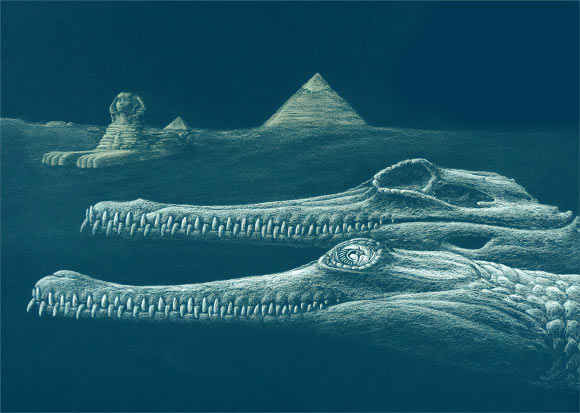
45-Million-Year-Old Crocodile Skull from Egypt Gets New Name: Herugavialis cairensis
Un crâne de crocodile vieux de 45 millions d'années d'Égypte reçoit un nouveau nom : Herugavialis cairensis
Égypte fossile tomographie crâne
Les tomodensitogrammes d'un fossile découvert près du Caire montrent que l'animal n'était pas un parent du faux gavial (Tomistoma schlegelii), comme l'ont longtemps pensé les paléontologues. Le crâne de crocodile vieux de 45 millions d'années d'Égypte obtient un nouveau nom : Herugavialis cairensis est apparu en premier sur Sci.News : Breaking Science News.
07/10/2026 sci-news ⚙ Traduction automatique
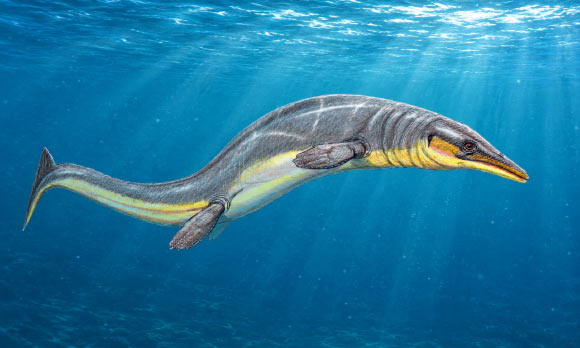
Paleontologists Uncover New Mosasaur Species in Egypt’s Western Desert
Des paléontologues découvrent de nouvelles espèces de mosasaures dans le désert occidental d’Égypte
Égypte Crétacé fossile Dinosauria Halisaurus
Les paléontologues ont décrit une espèce jusqu'alors inconnue de mosasaure – un groupe de reptiles marins disparus qui patrouillaient dans les mers du Crétacé aux côtés des dinosaures terrestres – sur la base de fossiles découverts dans l'oasis de Dakhla en Égypte. L’article Des paléontologues découvrent de nouvelles espèces de mosasaures dans le désert occidental égyptien est apparu en premier sur Sci.News : Breaking Science News.
16/09/2026 sci-news ⚙ Traduction automatique
16 momies et un chien révèlent un ordre caché dans une tombe égyptienne antique
Égypte
Une tombe dans la nécropole thébaine égyptienne révèle une histoire étonnamment organisée d’enterrement, de réutilisation et de changement de croyances s’étalant sur des centaines d’années. Les chercheurs ont trouvé 16 personnes momifiées, les restes d'au moins quatre autres et un chien momifié, avec des sépultures allant d'individus riches déposés dans des cercueils avec des amulettes et des marchandises importées à des corps ultérieurs soigneusement empilés dans des espaces de plus en plus fréquentés.
19/08/2026 sciencedaily-fossils ⚙ Traduction automatique
Un ancien fossile de singe en Egypte remet en question l'histoire des origines humaines
Égypte fossile origine humaine
Un singe fossile récemment identifié dans le nord de l’Égypte remodèle les idées sur l’endroit où les ancêtres des singes modernes ont émergé pour la première fois. Les analyses le placent plus près des singes vivants que n’importe quelle espèce connue d’Afrique de l’Est du même âge, désignant l’Afrique du Nord et le Moyen-Orient comme lieu de naissance possible et carrefour de la lignée des singes qui a finalement produit des gibbons, des orangs-outans, des gorilles, des chimpanzés et des humains.
24/07/2026 sciencedaily ⚙ Traduction automatique
Des archéologues ont découvert l'Iliade d'Homère dans une momie égyptienne vieille de 1 600 ans
Égypte découverte Homo sapiens
Une momie vieille de 1 600 ans découverte en Égypte a révélé quelque chose que les archéologues n’avaient jamais vu auparavant : un fragment de l’Iliade d’Homère utilisé lors de l’embaumement. Le papyrus a été identifié comme faisant partie du célèbre « Catalogue des navires », l’une des sections les plus connues de l’épopée antique. Les chercheurs affirment qu'il s'agit de la première preuve archéologique d'un texte littéraire grec intentionnellement incorporé dans le processus de momification, ajoutant ainsi un nouveau chapitre fascinant à l'histoire de la littérature et de l'Antiquité.
15/07/2026 sciencedaily-fossils ⚙ Traduction automatique
1 2 3