

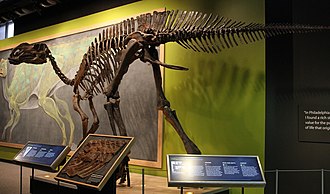
Classification
Dinosauria
Unranked clade
›
Ornithischia
Unranked clade
›
Neornithischia
Unranked clade
›
Pyrodontia
Unranked clade
›
Cerapoda
Unranked clade
›
Ornithopoda
Suborder
›
Iguanodontia
Infraorder
›
Euiguanodontia
Unranked clade
›
Dryomorpha
Unranked clade
›
Ankylopollexia
Unranked clade
›
Styracosterna
Unranked clade
›
Hadrosauriformes
Unranked clade
›
Hadrosauroidea
Unranked clade
›
Hadrosauridae
Family
›
Hadrosaurinae
Subfamily
›
Brachylophosaurini
Unranked clade
›
Hadrosaurus
Genus
Measurements
Length
7,4 m ⓘ
Hadrosaurus foulkii
9 m ⓘ
Mass
1 600 kg ⓘ
Hadrosaurus foulkii
Fossil sites 9 geolocated sites
Distribution
Top countries
Geological formations
Temporal distribution
Maastrichtian
(72.2–66 Ma)
3
Campanian
(83.6–72.2 Ma)
6
Species (1)
Hadrosaurus foulkii
84 Ma
Bibliography
Original description
J. Leidy. 1858. [On the bones of a huge herbivorous saurian near Haddonfield]. Proceedings of the Academy of Natural Sciences of Philadelphia 10:215-218
Bibliography (9)
L. A. Nessov. 1995. Dinozavri severnoi Yevrazii: Novye dannye o sostave kompleksov, ekologii i paleobiogeografii [Dinosaurs of northern Eurasia: new data about assemblages, ecology, and paleobiogeography]. Institute for Scientific Research on the Earth's Crust, St. Petersburg State University, St. Petersburg
W. B. Gallagher. 1993. The Cretaceous/Tertiary mass extinction event in the North Atlantic coastal plain. The Mosasaur 5:75-154
B. S. Grandstaff, D. C. Parris, and R. K. Denton, Jr, W. B. Gallagher. 1992. Alphadon (Marsupialia) and Multituberculata (Allotheria) in the Cretaceous of eastern North America. Journal of Vertebrate Paleontology 12(2):217-222
DOI ↗
W. B. Gallagher, D. C. Parris, and E. E. Spamer. 1986. Paleontology, biostratigraphy, and depositional environments of the Cretaceous-Tertiary transition in the New Jersey coastal plain. The Mosasaur 3:1-35
P. J. Currie. 1980. Mesozoic vertebrate life in Alberta and British Columbia. Mesozoic Vertebrate Life 1:27-40
H. W. Miller. 1966. Cretaceous vertebrate fauna from Phoebus Landing, North Carolina. The Journal of the Elisha Mitchell Scientific Society 82(2):93
E. D. Cope. 1875. On the transition beds of the Saskatchewan district. Proceedings of the Academy of Natural Sciences of Philadelphia 27:2-3
J. Leidy. 1866. [The specimen of a large phalanx of an extinct reptile]. Proceedings of the Academy of Natural Sciences of Philadelphia 1866:9
J. Leidy. 1858. [On the bones of a huge herbivorous saurian near Haddonfield]. Proceedings of the Academy of Natural Sciences of Philadelphia 10:215-218