


Classification
Sauropterygia
Suborder
›
Plesiosauria
Order
›
Pliosauroidea
Superfamily
›
Pliosauridae
Family
›
Thalassophonea
Unranked clade
›
Pliosaurus
Genus
Measurements
Length
12 m ⓘ
Fossil sites 57 geolocated sites
Distribution
Top countries
Geological formations
Temporal distribution
Maastrichtian
(72.2–66 Ma)
1
Albian
(113.2–100.5 Ma)
1
Aptian
(121.4–113.2 Ma)
2
Tithonian
(149.2–143.1 Ma)
13
Kimmeridgian
(154.8–149.2 Ma)
30
Oxfordian
(161.5–154.8 Ma)
6
Callovian
(165.3–161.5 Ma)
3
Aalenian
(174.7–170.9 Ma)
1
Species (18)
Plesiosaurus giganteus
nomen oblitum, species not entered Pliosaurus
Pliosaurus almanzaensis
145 Ma
Pliosaurus andrewsi
165 Ma
Pliosaurus brachydeirus
155 Ma
Pliosaurus carpenteri
152 Ma
Pliosaurus funkei
149 Ma
Pliosaurus gamma
155 Ma
Pliosaurus grandis
165 Ma
Pliosaurus grossouvrei
162 Ma
Pliosaurus kevani
155 Ma
Pliosaurus patagonicus
149 Ma
Pliosaurus rossicus
152 Ma
Pliosaurus westburyensis
152 Ma
Synonyms (7)
Cetiosaurus rigauxi
nomen dubium, species not entered Pliosaurus
Ischyrodon
subjective synonym of Pliosaurus
Plesiosaurus giganteus
nomen oblitum, species not entered Pliosaurus
Pliosaurus irgisensis
nomen dubium, species not entered Pliosaurus
Pliosaurus portentificus
nomen dubium, species not entered Pliosaurus
Spondylosaurus
subjective synonym of Pliosaurus
Stretosaurus
subjective synonym of Pliosaurus
News 2

France
Jurassic
Liopleurodon
Pliosaurus
22/07/2026 sci-news
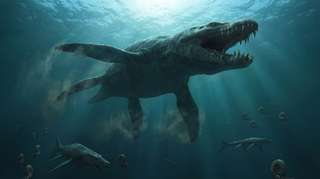
bone
tooth
vertebra
hunting
museum
+6
17/06/2026 futura-terre
⚙ Auto-translated
Images 7
Bibliography
Original description
R. Owen. 1841. Odontography; or, a Treatise on the Comparative Anatomy of the Teeth; Their Physiological Relations, Mode of Development, and Microscopic Structure, in the Vertebrate Animals. Part II. Dental System of Reptiles
DOI ↗
Bibliography (26)
J. P. O’Gorman, Z. Gasparini, and L. A. Spalletti. 2018. A new Pliosaurus species (Sauropterygia, Plesiosauria) from the Upper Jurassic of Patagonia: New insights on the Tithonian morphological disparity of mandibular symphyseal morphology. Journal of Paleontology 92(2):240-253
DOI ↗
Z. Gasparini and J. P. O'Gorman. 2014. A new species of Pliosaurus (Sauropterygia, Plesiosauria) from the Upper Jurassic of northwestern Patagonia, Argentina. Ameghiniana 51(4):269-283
DOI ↗
R. B. J. Benson, M. Evans, and A. S. Smith, J. Sassoon, S. Moore-Faye, H. F. Ketchum, R. Forrest. 2013. A giant pliosaurid skull from the Late Jurassic of England. PLoS ONE 8(5):e65989
DOI ↗
E. M. Knutsen, P. S. Druckenmiller, and J. H. Hurum. 2012. A new species of Pliosaurus (Sauropterygia: Plesiosauria) from the Middle Volgian of central Spitsbergen, Norway. Norwegian Journal of Geology 92:235-258
L. F. Noè, D. T. J. Smith, and D. I. Walton. 2004. A new species of Kimmeridgian pliosaur (Reptilia; Sauropterygia) and its bearing on the nomenclature of Liopleurodon macromerus. Proceedings of the Geologists' Association 115:13-24
DOI ↗
J. B. Delair. 1993. Reptilia from the Portland Stone (Upper Jurassic) of England: a preliminary survey of the material and the literature. Modern Geology 18:331-348
A. Vadet and J. M. Rose. 1986. Catalogue commente des types et figures de dinosauriens, ichthyosauriens, sauropterygiens, pterosauriens et cheloninens du Musée d'Histoire Naturelle de Boulogne-sur-Mer [Annotated catalogue of the type and figured specimens of dinosaurs, ichthyosaurs, sauropterygians, pterosaurs, and turtles from the Musée d'Histoire Naturelle of Boulogne-sur-Mer]. In E. Buffetaut, J. M. Rose, & A. Vadet (eds.), Vértébrés Fossiles du Boulonnais. Mémoires de la Société Académique du Boulonnais 1(2):85-97
P. M. Galton. 1983. Armored dinosaurs (Ornithischia: Ankylosauria) from the Middle and Upper Jurassic of Europe. Palaeontographica Abteilung A 182(1-3):1-25
R. L. Paton. 1975. A Catalogue of Fossil Vertebrates in the Royal Scottish Museum, Edinburgh. Part Four / Amphibia & Reptilia. Royal Scottish Museum Information Series. Geology 5
T. Maryanska. 1972. Aberrant pliosaurs from the Oxfordian of Poland. Prace Museum Ziemi 20:201-206
L. B. Halstead. 1971. Liopleurodon rossicus (Novozhilov)—a pliosaur from the Lower Volgian of the Moscow Basin. Palaeontology 14(4):566-570
M. Brunet. 1969. Note préliminaire sur une faune de vertébrés du Callovien des environs de Poitiers [Preliminary note on a vertebrate fauna from the Callovian of the environs of Poitiers]. Comptes Rendus Hebdomadaires des Séances de l'Académie des Sciences, Série D: Sciences Naturelles 268(22):2667-2670
J. B. Delair. 1960. The Mesozoic reptiles of Dorset. Part two. Proceedings of the Dorset Natural History and Archaeological Society 80:52-90
L. B. Tarlo. 1960. A review of Upper Jurassic pliosaurs. Bulletin of the British Museum (Natural History), Geology Series 14(5):147-189
N. I. Novozhilov. 1948. Two new pliosaurs from the lower Volgian tier of the Volga region (right bank). Doklady Akademii Nauk SSSR 60:115-118
K. Lambrecht. 1929. Neogaeornis wetzeli, n. g., n. s., der erste Kreidevogel der südlichen Hemisphäre [Neogaeornis wetzeli n. g. n. sp. the first Cretaceous bird from the Southern Hemisphere]. Paläontologische Zeitschrift 11:121-128
DOI ↗
G. von Arthaber. 1906. Beiträge zur Kenntnis der Organisation und der Anpassungserscheinungen des genus Metriorhynchus. Beiträge zur Paläontologie und Geologie Österreich-Ungarns und des Orients 19(4):287-320
R. Lydekker. 1889. Catalogue of the Fossil Reptilia and Amphibia, Part II. Containing the orders Ichthyopterygia and Sauropterygia
DOI ↗
W. Davies. 1876. On the exhumation and development of a large reptile (Omosaurus armatus), from the Kimmeridge Clay, Swindon, Wilts. Geological Magazine, new series, decade 2 3(5):193-197
DOI ↗
C. Barrois. 1875. Les reptiles du terrain crétacé du N.-E. du bassin de Paris [The reptiles of the Cretaceous terrain of the NE of the Paris Basin]. Bulletin Scientifique, Historique et Littéraire du Département du Nord et des Pays Voisins 7(4–5):73-83
H.-E. Sauvage. 1874. Mémoire sur les dinosauriens et les crocodiliens des terrains jurassiques de Boulogne-sur-Mer [Memoir on the dinosaurs and crocodilians of the Jurassic deposits of Boulogne-sur-mer]. Mémoires de la Société Géologique de France, série 2 10(2):1-57
J. Phillips. 1871. Geology of Oxford and the Valley of the Thames. Clarendon Press, Oxford
DOI ↗
H. G. Seeley. 1869. Index to the Fossil Remains of Aves, Ornithosauria, and Reptilia, from the Secondary System of Strata, Arranged in the Woodwardian Museum of the University of Cambridge. Deighton, Bell, and Co, Cambridge
DOI ↗
R. Owen. 1854. Descriptive catalogue of the Fossil organic remains of Reptilia and Pisces contained in the Museum of the Royal College of Surgeons of England. London
R. Owen. 1842. Report on British fossil reptiles, part II. Report of the British Association for the Advancement of Science 11:60-204
R. Owen. 1841. Odontography; or, a Treatise on the Comparative Anatomy of the Teeth; Their Physiological Relations, Mode of Development, and Microscopic Structure, in the Vertebrate Animals. Part II. Dental System of Reptiles
DOI ↗