News

Latest palaeontology news

All FR EN everythingdinosaur futura-terre palaeocast prehistoricbeastoftheweek sci-news sciencedaily sciencedaily-fossils sciencedaily-human-evo sciencedaily-paleo sciencesetavenir
Scientists say we’ve been looking in the wrong place for human origins
Egypt fossil evolution human origin
A fossil ape discovered in northern Egypt is reshaping the story of human evolution. The species, Masripithecus, lived about 17 to 18 million years ago and may sit very close to the ancestor of all modern apes. This finding challenges the long-standing focus on East Africa. Instead, it points to northern Africa and nearby regions as a possible birthplace of apes.
28/03/2026 sciencedaily-paleo
Scientists found a rhino in the Arctic and it changes everything
fossil dating new species
Scientists have uncovered a new species of rhinoceros in the Canadian High Arctic, revealing that rhinos once lived far farther north than expected. The fossil, dating back 23 million years, is unusually complete and has helped reshape ideas about how these animals migrated between continents. Evidence suggests rhinos crossed from Europe to North America more recently than scientists once thought.
24/03/2026 sciencedaily
This 67,800-year-old handprint is the oldest art ever found
claw Australia Indonesia discovery
Researchers have uncovered the world’s oldest known cave art—a 67,800-year-old hand stencil in Indonesia. The unusual, claw-like design hints at early symbolic thinking and possibly spiritual beliefs. This discovery also strengthens the case that humans reached Australia at least 65,000 years ago. It offers rare insight into the creative lives of some of our earliest ancestors.
22/03/2026 sciencedaily-human-evo
Ancient DNA reveals a farming shift that pushed a society to the brink
DNA Argentina study
A new study reveals that farming in Argentina’s Uspallata Valley was adopted by local hunter-gatherers rather than introduced by outside populations. Centuries later, a stressed group of maize-heavy farmers migrated into the region, facing climate instability, disease, and declining numbers. Despite these pressures, there’s no sign of violence—instead, families stayed connected across generations, using kinship networks to survive. The research shows how cooperation, not conflict, helped communi
22/03/2026 sciencedaily-paleo
This crocodile ran like a greyhound across prehistoric Britain 200 million years ago
United Kingdom Triassic fossil new species
A newly discovered Triassic reptile from the UK looked more like a racing greyhound than a crocodile, built for speed on land. With long legs and a lightweight body, it hunted small animals in a dry, upland environment millions of years ago. Scientists identified it as a new species after spotting key differences in its fossils. It’s also a tribute to an inspiring teacher who helped spark a future scientist’s curiosity.
21/03/2026 sciencedaily
Scientists recreated a dinosaur nest to solve a 70-million-year-old mystery
nest Dinosauria Oviraptor bird
Scientists recreated a life-size oviraptor nest to understand how these dinosaurs hatched their eggs. Their experiments showed the parent likely couldn’t heat all the eggs directly, meaning sunlight played a key role. This uneven heating could cause eggs in the same nest to hatch at different times. The results suggest oviraptors used a hybrid incubation method unlike modern birds.
19/03/2026 sciencedaily
These dinosaurs had wings but couldn’t fly
feather fossil Anchiornis Dinosauria bird
Some feathered dinosaurs may have briefly taken to the skies—only to give it up later. By studying rare fossils with preserved feathers, researchers uncovered a surprising clue hidden in molting patterns, revealing that Anchiornis likely couldn’t fly at all. Instead of the neat, symmetrical feather replacement seen in flying birds, these dinosaurs showed a messy, irregular molt—something only flightless animals exhibit.
18/03/2026 sciencedaily
Episode 173: Petrified Forest
United States Chinle Late Triassic Triassic formation
Petrified Forest National Park in northeastern Arizona, USA is a hub for Triassic palaeontology and has exposures representing 20 million years of the Late Triassic Chinle Formation. Visitors marvel at the colourful fossilised trees from which the park takes its name, but a whole host of animals called these swampy forests home 225 million years [&hellip
17/03/2026 palaeocast
Cosmic rays turned ancient sand into a geological time machine
Scientists at Curtin University have uncovered a new way to read the deep history of Earth’s landscapes using microscopic zircon crystals from ancient beach sands. These incredibly durable minerals trap traces of krypton gas created when cosmic rays strike them at Earth’s surface, effectively turning each crystal into a “cosmic clock.” By measuring that krypton, researchers can determine how long sediments lingered near the surface before burial, revealing how landscapes eroded, shifted, and sta
12/03/2026 sciencedaily-paleo
400 million-year-old fish fossils reveal how life began moving onto land
Australia China fossil formation skull
Scientists have uncovered new clues about some of Earth’s earliest fish, shedding light on the ancient origins of vertebrates that eventually moved onto land. By reanalyzing mysterious fossils from Australia’s famed Gogo Formation and studying a newly reconstructed 410-million-year-old lungfish skull from China, researchers are revealing how these primitive creatures evolved.
12/03/2026 sciencedaily
A massive asteroid hit the North Sea and triggered a 330-foot tsunami
feather
A long-running debate about the Silverpit Crater beneath the North Sea has finally been resolved. Scientists now confirm it formed when a roughly 160-meter asteroid struck the seabed about 43–46 million years ago. New seismic imaging and rare shocked minerals in rock samples provided the crucial proof. The impact would have sent a massive plume skyward and unleashed a tsunami over 100 meters (330 feet) high.
11/03/2026 sciencedaily-paleo
This 2-pound dinosaur is rewriting what scientists know about evolution
fossil Alnashetri Alvarezsauria Dinosauria bird evolution skeleton
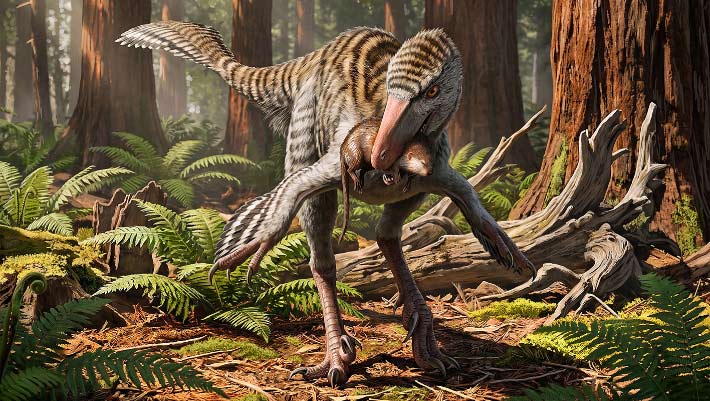
A nearly complete dinosaur skeleton discovered in Patagonia is helping scientists crack the mystery of alvarezsaurs, a bizarre group of bird-like dinosaurs. The fossil of Alnashetri cerropoliciensis reveals that these animals became tiny before developing their later specialized features, such as stubby arms and ant-eating adaptations. Weighing under two pounds, the dinosaur is one of the smallest known from South America.
10/03/2026 sciencedaily
Haolong: Beast of the Week
China Cretaceous Early Cretaceous juvenile specimen Dinosauria Haolong
 This week we'll be checking out a newly described dinosaur that is so unique, it completely changes what we think we knew about dinosaur skin!  Enter Haolong dongi!Haolong was a plant-eating dinosaur that lived in what is now Liaoning, China, during the Early Cretaceous period, about 112.5 million years ago.  The only specimen on record measures about 8 feet (2.45m) from beak to tail but was a juvenile when it died so the species likely grew larger.  The genus name translates from Chinese to "S
08/03/2026 prehistoricbeastoftheweek
Scientists stunned to find signs of ancient life in a place no one expected
Morocco
While exploring ancient seabeds in Morocco, scientists discovered strange wrinkle-like textures in deep-water sediments that shouldn’t have been there. These structures are usually made by sunlight-loving microbial mats in shallow waters. But the rocks formed far below the reach of light, suggesting a different explanation. Evidence points to chemosynthetic microbes—organisms powered by chemical reactions—creating the mats in the dark depths of an ancient ocean.
08/03/2026 sciencedaily-paleo
T. rex took 40 years to reach full size, study finds
bone growth predator specimen Tyrannosaurus study
Tyrannosaurus rex may have taken far longer to grow up than scientists once thought. By analyzing growth rings in fossilized leg bones from 17 tyrannosaur specimens and using new statistical methods, researchers found that the famous predator likely took about 40 years to reach its full size—around eight tons—rather than the previously estimated 25 years.
05/03/2026 sciencedaily
2700-year-old teeth reveal the hidden lives of Iron Age Italians
tooth feeding growth Italy
Iron Age teeth from southern Italy have become time capsules, preserving intimate details of childhood and diet. Growth lines in the enamel reveal moments of early-life stress, while hardened plaque holds microscopic remains of cereals, legumes, and fermented foods. The findings suggest a community with diverse food resources and strong Mediterranean connections. Even a small sample offers a striking glimpse into how people lived, grew, and ate nearly three millennia ago.
04/03/2026 sciencedaily
MIT study finds Earth’s first animals were likely ancient sea sponges
tracks discovery geology study
Scientists at MIT have found compelling chemical evidence that Earth’s earliest animals were likely ancient sea sponges. Hidden inside rocks over 541 million years old are rare molecular “fingerprints” that match compounds made by modern demosponges. After testing rocks, living sponges, and lab-made molecules, researchers confirmed the signals came from life — not geology. The discovery suggests sponges were thriving in the oceans well before most other animal groups appeared.
27/02/2026 sciencedaily-paleo
Scientists compared dinosaurs to mammals for decades but missed this key difference
predator juvenile Dinosauria mammals
Baby dinosaurs weren’t coddled like lion cubs or elephant calves—they were more like prehistoric latchkey kids. New research suggests that young dinosaurs quickly struck out on their own, forming kid-only groups and surviving without much parental help, while their massive parents lived entirely different lives. Because juveniles and adults ate different foods, faced different predators, and moved through different parts of the landscape, they may have functioned almost like separate species wit
27/02/2026 sciencedaily
Lost fossils reveal sea monsters that took over after Earth’s greatest extinction
predator Australia Madagascar fossil extinction
A lost cache of 250-million-year-old fossils from Australia has rewritten part of the story of life after Earth’s worst mass extinction. Instead of a single marine amphibian species, researchers uncovered evidence of a surprisingly diverse community of early ocean predators. One of these creatures had relatives stretching from the Arctic to Madagascar, showing that some of the first sea-going tetrapods spread across the globe with remarkable speed.
25/02/2026 sciencedaily
40,000-year-old signs show humans were recording information long before writing
study
More than 40,000 years ago, Ice Age humans were carving repeated patterns of dots, lines, and crosses into tools and small ivory figurines. A new computational study of more than 3,000 of these Paleolithic signs reveals that they were not random decorations but structured sequences with measurable complexity. Surprisingly, their information density rivals that of proto-cuneiform, the earliest known writing system that emerged around 3,000 B.C.E.
25/02/2026 sciencedaily-paleo
1 2 3 4 5 6 7 8 9 10 11 12 13 14 15