News

Latest palaeontology news

All FR EN everythingdinosaur futura-terre palaeocast prehistoricbeastoftheweek sci-news sciencedaily sciencedaily-fossils sciencedaily-human-evo sciencedaily-paleo sciencesetavenir

190-million-year-old “Sword Dragon” fossil rewrites ichthyosaur history
United Kingdom Jurassic fossil Ichthyosauria evolution skeleton
A newly identified ichthyosaur from the UK’s Jurassic Coast is rewriting part of the prehistoric playbook. Nicknamed the “Sword Dragon of Dorset,” the three-meter-long marine reptile lived during a poorly understood window of evolution when major ichthyosaur groups were disappearing and new ones emerging. Its beautifully preserved skeleton — complete with a blade-like snout and possible last meal — helps pinpoint when this dramatic transition occurred.
24/02/2026 sciencedaily
A giant blade-crested spinosaurus, the “hell heron,” discovered in the Sahara
crest predator Niger fossil Dinosauria Spinosauria
Deep in the heart of the Sahara, scientists have uncovered Spinosaurus mirabilis — a spectacular new predator crowned with a massive, scimitar-shaped crest that may once have blazed with color under the desert sun. Discovered in remote inland river deposits in Niger, the fossil rewrites what we thought we knew about spinosaur dinosaurs, suggesting they weren’t fully aquatic hunters but powerful waders stalking fish in forested waterways hundreds of miles from the sea.
23/02/2026 sciencedaily
Spinosaurus: Beast of the Week
Egypt Morocco Niger Cretaceous Late Cretaceous Dinosauria Spinosauria
Make way (lots of room...back up more...keep going...keep going...backbackbackback) for the mighty Spinosaurus Aegyptiacus! Spinosaurus was a meat-eating dinosaur that lived in what is now Africa, including Egypt, Morocco, and Niger during the late Cretaceous Period, about 97-95 million years ago.  It was a massive animal, the biggest known individuals possibly measuring 49 feet (about 15m) long from snout to tail as an adult, making it the longest meat-eating dinosaur known to science.  The gen
22/02/2026 prehistoricbeastoftheweek
Triceratops had a giant nose that may have cooled its massive head
fossil Triceratops CT-scan skull
Triceratops’ massive head may have been doing more than just showing off those famous horns. Using CT scans and 3D reconstructions of fossil skulls, researchers uncovered a surprisingly complex nasal system hidden inside its enormous snout. Instead of being just a supersized nose for smelling, it likely housed intricate networks of nerves and blood vessels—and even special structures that helped regulate heat and moisture.
22/02/2026 sciencedaily
Ancient DNA solves 5,500 year old burial mystery in Sweden
limb DNA Sweden discovery
Ancient DNA from a Stone Age burial site in Sweden shows that families 5,500 years ago were more complex than expected. Many individuals buried together were not immediate family, but second- or third-degree relatives. One grave held a young woman alongside two children who were siblings—yet she wasn’t their mother. The discoveries hint at tight-knit communities where extended kin mattered deeply.
19/02/2026 sciencedaily-human-evo
Ancient drought may have wiped out the real-life hobbits 61,000 years ago
extinction formation
A massive, centuries-long drought may have driven the extinction of the “hobbits” of Flores. Climate records preserved in cave formations show rainfall plummeted just as the small human species disappeared. At the same time, pygmy elephants they depended on declined sharply as rivers dried up. With food and water vanishing, the hobbits may have been pushed out—and into their final chapter.
19/02/2026 sciencedaily-human-evo
125 million-year-old dinosaur with never before seen hollow spikes discovered in China
China juvenile Dinosauria Iguanodontia
A 125-million-year-old dinosaur just rewrote what we thought we knew about prehistoric life. Scientists in China have uncovered an exceptionally preserved juvenile iguanodontian with fossilized skin so detailed that individual cells are still visible. Even more astonishing, the plant-eating dinosaur was covered in hollow, porcupine-like spikes—structures never before documented in any dinosaur.
18/02/2026 sciencedaily
Ancient DNA solves 12,000-year-old mystery of rare genetic growth disorder
bone DNA growth Italy discovery genetics
An Ice Age double burial in Italy has yielded a stunning genetic revelation. DNA from a mother and daughter who lived over 12,000 years ago shows that the younger had a rare inherited growth disorder, confirmed through mutations in a key bone-growth gene. Her mother carried a milder version of the same mutation. The finding not only solves a long-standing mystery but also proves that rare genetic diseases stretch far back into prehistory.
17/02/2026 sciencedaily
Corythosaurus: Beast of the Week
crest Canada Canardia Corythosaurus Dinosauria Hadrosauria Hadrosauridae Hypacrosaurus Lambeosauria Parasaurolophus Velafrons
This week we will take a look at a well known duckbill dinosaur.  Enter Corythosaurus!  Corythosaurus was a plant eater that belonged to the lambiosaurine group within the family, Hadrosauridae. (duckbills)  Lambiosaurine hadrosaurs typically had hollow crests on their heads and narrower beaks compared to other kinds hadrosaurs.  It was closely related to other lambiosaurine hadrosaurs such as Parasaurolophus, Hypacrosaurus, Lambeosaurus, and Velafrons.  It lived in what is now Alberta, Canada,
15/02/2026 prehistoricbeastoftheweek
Europe’s “untouched” wilderness was shaped by Neanderthals and hunter-gatherers
hunting
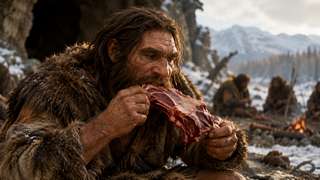
Long before agriculture, humans were transforming Europe’s wild landscapes. Advanced simulations show that hunting and fire use by Neanderthals and Mesolithic hunter-gatherers reshaped forests and grasslands in measurable ways. By reducing populations of giant herbivores, people indirectly altered how dense vegetation became. The findings challenge the idea that prehistoric Europe was an untouched natural world.
12/02/2026 sciencedaily-human-evo
This ancient animal was one of the first to eat plants on land
tooth fossil skull
Hundreds of millions of years ago, the first animals to crawl onto land were strict meat-eaters, even as plants had already taken over the landscape. Now scientists have uncovered a 307-million-year-old fossil that rewrites that story: one of the earliest known land vertebrates to start eating plants. The animal, named Tyrannoroter heberti, was a stocky, football-sized creature with a skull packed with specialized teeth designed for crushing and grinding vegetation.
11/02/2026 sciencedaily
Torvosaurus: Beast of the Week
bone predator Germany Portugal United States Jurassic Late Jurassic Dinosauria Torvosaurus
Today we are going to look at a huge Jurassic predatory dinosaur, Torvosaurus tanneri!  Torvosaurus lived about 150 million years ago during the Late Jurassic period. Its bones have been unearthed in Colorado, USA, Portugal, and possibly Germany (Europe and North America were not as vastly separated back then, remember, so a lot of the dinosaurs on each of them from that time shared recent ancestors).  From nose to tail it measured up to 36 feet (about 11m) and would have been among the largest,
08/02/2026 prehistoricbeastoftheweek
Ancient bones reveal chilling victory rituals after Europe’s earliest wars
bone tooth France
New evidence from Neolithic mass graves in northeastern France suggests that some of Europe’s earliest violent encounters were not random acts of brutality, but carefully staged displays of power. By analyzing chemical clues locked in ancient bones and teeth, researchers found that many victims were outsiders who suffered extreme, ritualized violence after conflict. Severed arms appear to have been taken from local enemies killed in battle, while captives from farther away were executed in a gri
08/02/2026 sciencedaily
These 773,000-year-old fossils may reveal our shared human ancestor
fossil evolution Homo sapiens
Fossils from a Moroccan cave have been dated with remarkable accuracy to about 773,000 years ago, thanks to a magnetic signature locked into the surrounding sediments. The hominin remains show a blend of ancient and more modern features, placing them near a pivotal branching point in human evolution. These individuals likely represent an African population close to the last common ancestor of Homo sapiens, Neandertals, and Denisovans.
07/02/2026 sciencedaily
Episode 172: Rhynchocephalians
New Zealand
Today, there is only one living species of rhynchocephalian: the tuatara of Aotearoa/New Zealand. Despite today’s paucity of species, this was once a diverse group of reptiles, with a wide range of lifestyles from swimming in the ocean to climbing trees. Once highly abundant around the world, reasons for their decline are still debated and [&hellip
05/02/2026 palaeocast
This strange little dinosaur is forcing a rethink of evolution
bone tooth metabolism Dinosauria Foskeia anatomy bird evolution mammals study skull
A newly identified tiny dinosaur, Foskeia pelendonum, is shaking up long-held ideas about how plant-eating dinosaurs evolved. Though fully grown adults were remarkably small and lightweight, their anatomy was anything but simple—featuring a bizarre, highly specialized skull and unexpected evolutionary traits. Detailed bone studies show these dinosaurs matured quickly with bird- or mammal-like metabolism, while their teeth and posture hint at fast, agile lives in dense forests.
03/02/2026 sciencedaily
Baby dinosaurs were the backbone of the Jurassic food chain
hunting predator prey Jurassic fossil Dinosauria
Despite growing into the largest animals ever to walk on land, sauropods began life small, exposed, and alone. Fossil evidence suggests their babies were frequently eaten by multiple predators, making them a key part of the Jurassic food chain. This steady supply of easy prey may explain why early predators thrived without needing extreme hunting adaptations. The findings offer a rare glimpse into how dinosaur ecosystems truly worked.
02/02/2026 sciencedaily
This AI app can tell which dinosaur made a footprint
fossil tracks Dinosauria bird dating discovery
Dinosaur footprints have always been mysterious, but a new AI app is cracking their secrets. DinoTracker analyzes photos of fossil tracks and predicts which dinosaur made them, with accuracy rivaling human experts. Along the way, it uncovered footprints that look strikingly bird-like—dating back more than 200 million years. That discovery could push the origin of birds much deeper into prehistory.
01/02/2026 sciencedaily
Hesperosuchus: Beast of the Week
Mexico United States Late Triassic Triassic fossil skeleton
This week we will be checking out a relative of modern crocodilians that has tricked scientists multiple times!  Enter Hesperosuchus agilis!Hesperosuchus was a pseudosuchian (related to crocodilians) that lived in what is now Arizona and New Mexico, USA, during the late Triassic period, about 210 million years ago.  It would have been a meat-eater and from snout to tail the most complete skeleton measures about four feet (1.2m) but other fossils suggest it could have grown larger, up to about si
01/02/2026 prehistoricbeastoftheweek
Ancient tools in China are forcing scientists to rethink early humans
China dating discovery excavation
Archaeologists in central China have uncovered evidence that early humans were far more inventive than long assumed. Excavations at the Xigou site reveal advanced stone tools, including the earliest known examples of tools fitted with handles in East Asia, dating back as far as 160,000 years. These discoveries show that ancient populations in the region carefully planned, crafted, and adapted their tools to meet changing environments.
31/01/2026 sciencedaily-human-evo
1 2 3 4 5 6 7 8 9 10 11 12 13 14 15