News

Latest palaeontology news

All FR EN everythingdinosaur futura-terre palaeocast prehistoricbeastoftheweek sci-news sciencedaily sciencedaily-fossils sciencedaily-human-evo sciencedaily-paleo sciencesetavenir
A 500-million-year-old fossil just rewrote the spider origin story
fossil
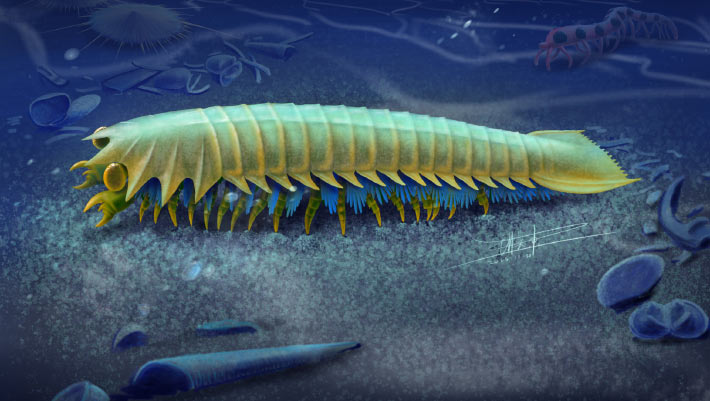
Half a billion years ago, a strange sea-dwelling creature called Mollisonia symmetrica may have paved the way for modern spiders. Using detailed fossil brain analysis, researchers uncovered neural patterns strikingly similar to today's arachnids—suggesting spiders evolved in the ocean, not on land as previously believed. This brain structure even hints at a critical evolutionary leap that allowed spiders their infamous speed, dexterity, and web-spinning prowess. The findings challenge long-held
24/07/2025 sciencedaily-human-evo
Butchery clues reveal Neanderthals may have had “family recipes”
bone hunting Israel
Neanderthals living in two nearby caves in ancient Israel prepared their food in surprisingly different ways, according to new archaeological evidence. Despite using the same tools and hunting the same animals, they left behind distinct cut-mark patterns on bones—hints of cultural traditions passed down through generations.
17/07/2025 sciencedaily-human-evo
Ceratosaurus: Beast of the Week
reconstitution Portugal United States Jurassic Late Jurassic Ceratosauria Dinosauria
This week we shall be looking at a popular meat-eater with some truly unique features.  Enter Ceratosaurus!Watercolor life reconstruction of Ceratosaurus nascornis eating the ancient lungfish, Ceratodus robustus by Christopher DiPiazza. Ceratosaurus was a meat-eating dinosaur that lived during the late Jurassic period, about 150 million years ago, in what is now the United States, specifically Utah and Colorado.  Bones thought to be from Ceratosaurus have also been unearthed in Portugal.  As an
14/07/2025 prehistoricbeastoftheweek
Princeton study maps 200,000 years of Human–Neanderthal interbreeding
DNA genetics study
For centuries, we’ve imagined Neanderthals as distant cousins — a separate species that vanished long ago. But thanks to AI-powered genetic research, scientists have revealed a far more entangled history. Modern humans and Neanderthals didn’t just cross paths; they repeatedly interbred, shared genes, and even merged populations over nearly 250,000 years. These revelations suggest that Neanderthals never truly disappeared — they were absorbed. Their legacy lives on in our DNA, reshaping our under
13/07/2025 sciencedaily-human-evo
Inside the Maya king’s tomb that rewrites Mesoamerican history
Belize
A major breakthrough in Maya archaeology has emerged from Caracol, Belize, where the University of Houston team uncovered the tomb of Te K'ab Chaak—Caracol’s first known ruler. Buried with elaborate jade, ceramics, and symbolic artifacts, the tomb offers unprecedented insight into early Maya royalty and their ties to the powerful Mexican city of Teotihuacan.
12/07/2025 sciencedaily-human-evo
Lepidotes: Beast of the Week
scale reconstitution Cretaceous Early Cretaceous Early Jurassic Jurassic Dinosauria
 This wee we will look at a unique kind of prehistoric fish that swam in rivers and lakes while some of the largest dinosaurs walked on land.  Check out Lepidotes!Watercolor reconstruction of Lepidotes gigas by Christopher DiPiazza.Lepidotes was a genus of heavily scaled bony fish that lived in what is now Europe and North America during the early Jurassic between 180 and 175 million years ago.  The genus may have even persisted into the Early Cretaceous, as recent as 115 million years ago, but
29/06/2025 prehistoricbeastoftheweek
Buried for 23,000 years: These footprints are rewriting American history
tracks study
Footprints found in the ancient lakebeds of White Sands may prove that humans lived in North America 23,000 years ago — much earlier than previously believed. A new study using radiocarbon-dated mud bolsters earlier findings, making it the third line of evidence pointing to this revised timeline.
29/06/2025 sciencedaily-human-evo
This team tried to cross 140 miles of treacherous ocean like stone-age humans—and it worked
Taiwan
Experiments and simulations show Paleolithic paddlers could outwit the powerful Kuroshio Current by launching dugout canoes from northern Taiwan and steering southeast toward Okinawa. A modern crew proved it, carving a Stone-Age-style canoe, then paddling 225 km in 45 hours guided only by celestial cues—demonstrating our ancestors’ daring and mastery of the sea.
26/06/2025 sciencedaily-human-evo
1 2 3 4 5 6 7 8 9 10 11 12 13 14 15