←

mammifères

Thématique

1 image(s) · 47 Actualités

Galerie d'images

Identifier: waterreptilesofp1914will
Title: Water reptiles of the past and present
Year: 1914 (1910s)
Authors:  Williston, Samuel Wendell, 1851-1918
Subjects:  Aquatic reptiles
Publisher:  Chicago, Ill., The University of Chicago Press
Contributing Library:  Boston Public Library
Digitizing Sponsor:  Boston Public Library

View Book Page: Book Viewer
About This Book: Catalog Entry
View All Images: All Images From Book
Click here to view book online to see this illustration in context in a browseable online version of this book.

Text Appearing Before Image:
served and very complete skeletons ofdifferent species of ichthyosaurs from the Jurassic deposits ofWiirtemberg, in which remains of these animals occur in great 112 WATER REPTILES OF THE PAST AND PRESENT profusion. His researches, and those of several authors since then,supplementing and confirming or disproving those of the manyobservers made during the preceding seventy years, have finallydetermined almost perfectly the complete structure of the moretypical ichthyosaurs, enabling us to infer not a little as to theirhabits and distribution in the old Jurassic oceans. Within thepast few years the discoveries of Professor J. C. Merriam of Cali-fornia have likewise added greatly to our knowledge of the earlierichthyosaurs. It may now truthfully be said that of no group ofextinct reptiles do we have a more complete and satisfactory knowl-edge than of the ichthyosaurs. Nevertheless we have yet very much more to learn about theorder Ichthyosauria as a whole—whence they came and how they
Text Appearing After Image:
Fig. 52.—Ichthyosaurus quadricissus.museum, from Dr. Dreverman. Photograph of specimen in Senckenberg originated; what their nearest kin were among other reptiles; andespecially, more about the connecting links between them andterrestrial reptiles. They have, as an order, so isolated a position,are so widely separated from all other reptiles in structure, that theyhave long been a puzzle to paleontologists. Like the whales andother cetaceans among mammals, we know the ichthyosaurs wellin the plenitude of their power and the fulness of their development,but have yet only an imperfect knowledge of their earlier history,and none whatever of their earliest. However, as will be seenfarther on, the recent discoveries by Merriam have shed much lighton some of the stages of their evolution. So nearly perfectly wereall the later ichthyosaurs adapted to their life in the water that itwas believed by nearly all paleontologists until about a score of years ICHTHYOSAURIA 3 ago that they had desc

Note About Images

Please note that these images are extracted from scanned page images that may have been digitally enhanced for readability - coloration and appearance of these illustrations may not perfectly resemble the original work.
Taxons Stenopterygiidae

Identifier: waterreptilesofp1914will Title: Water reptiles of the past and present Year: 1914 (1910s) Authors: Williston, Samuel Wendell, 1851-1918 Subjects: Aquatic reptiles Publisher: Chicago, Ill., The University of Chicago Press Contributing Library: Boston Public Library Digitizing Sponsor: Boston Public Library View Book Page: Book Viewer About This Book: Catalog Entry View All Images: All Images From Book Click here to view book online to see this illustration in context in a browseable online version of this book. Text Appearing Before Image: served and very complete skeletons ofdifferent species of ichthyosaurs from the Jurassic deposits ofWiirtemberg, in which remains of these animals occur in great 112 WATER REPTILES OF THE PAST AND PRESENT profusion. His researches, and those of several authors since then,supplementing and confirming or disproving those of the manyobservers made during the preceding seventy years, have finallydetermined almost perfectly the complete structure of the moretypical ichthyosaurs, enabling us to infer not a little as to theirhabits and distribution in the old Jurassic oceans. Within thepast few years the discoveries of Professor J. C. Merriam of Cali-fornia have likewise added greatly to our knowledge of the earlierichthyosaurs. It may now truthfully be said that of no group ofextinct reptiles do we have a more complete and satisfactory knowl-edge than of the ichthyosaurs. Nevertheless we have yet very much more to learn about theorder Ichthyosauria as a whole—whence they came and how they Text Appearing After Image: Fig. 52.—Ichthyosaurus quadricissus.museum, from Dr. Dreverman. Photograph of specimen in Senckenberg originated; what their nearest kin were among other reptiles; andespecially, more about the connecting links between them andterrestrial reptiles. They have, as an order, so isolated a position,are so widely separated from all other reptiles in structure, that theyhave long been a puzzle to paleontologists. Like the whales andother cetaceans among mammals, we know the ichthyosaurs wellin the plenitude of their power and the fulness of their development,but have yet only an imperfect knowledge of their earlier history,and none whatever of their earliest. However, as will be seenfarther on, the recent discoveries by Merriam have shed much lighton some of the stages of their evolution. So nearly perfectly wereall the later ichthyosaurs adapted to their life in the water that itwas believed by nearly all paleontologists until about a score of years ICHTHYOSAURIA 3 ago that they had desc Note About Images Please note that these images are extracted from scanned page images that may have been digitally enhanced for readability - coloration and appearance of these illustrations may not perfectly resemble the original work.

livre musée Jurassique spécimen +7

Actualités

Dinosaur-Era Mammal Swam Like Platypus and Replaced Its Teeth Multiple Times
Chine Dinosauria mammifères
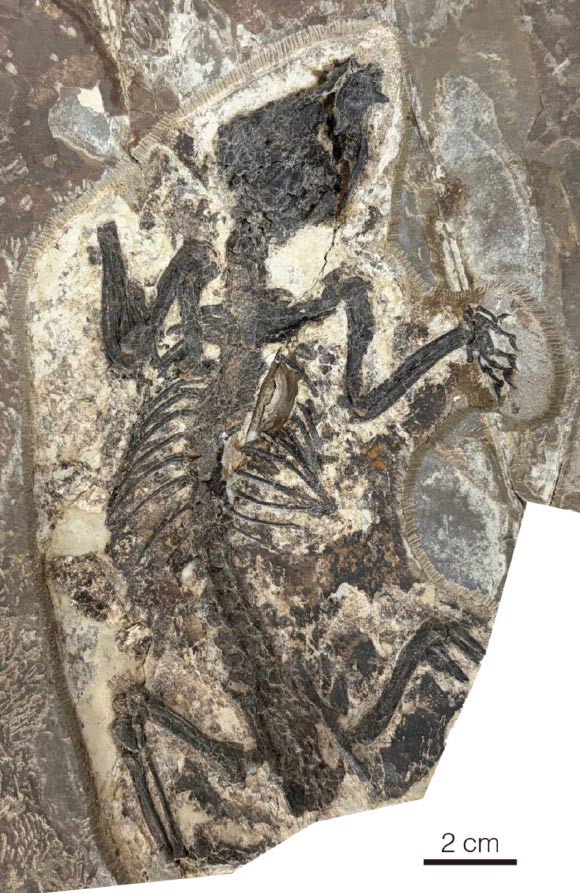
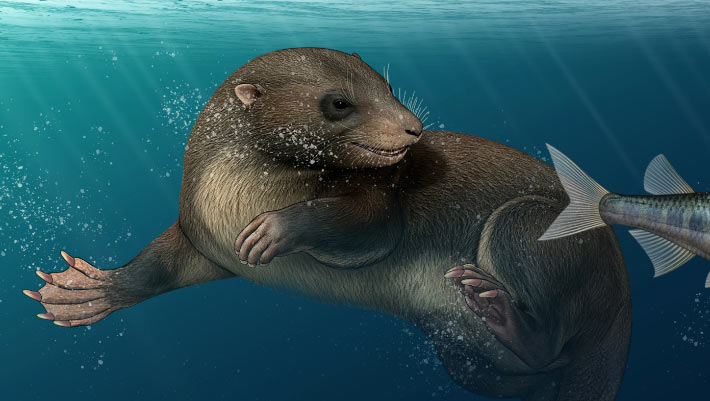
Dongoconodon platycauda, a small eutriconodontan mammal that lived alongside dinosaurs in what is now northeastern China paddled through the water with webbed, platypus-like hands and feet, and replaced its teeth multiple times. The post Dinosaur-Era Mammal Swam Like Platypus and Replaced Its Teeth Multiple Times appeared first on Sci.News: Breaking Science News.
01/10/2026 sci-news
Les chauves-souris auraient évolué pour la première fois en Europe il y a 65 millions d'années
vol fossile communication évolution mammifères étude
Une vaste étude génomique et fossile suggère que les chauves-souris ont évolué pour la première fois en Europe il y a environ 65 à 60 millions d’années avant de se propager à travers le monde. Les résultats indiquent également que le vol et l’écholocation sont apparus au début de l’évolution des chauves-souris, ce qui pourrait expliquer comment les chauves-souris sont devenues l’un des groupes de mammifères les plus prospères sur Terre.
30/09/2026 sciencedaily-paleo ⚙ Traduction automatique
120-Million-Year-Old Fossil Pushes Back Origin of Marsupial Lineage
Un fossile vieux de 120 millions d’années repousse l’origine de la lignée marsupiale
Chine fossile mammifères nouvelle espèce
Une nouvelle espèce de mammifère deltathéroide de Chine pourrait être le plus ancien ancêtre confirmé de marsupiaux jamais découvert, offrant une nouvelle preuve que l'Asie a joué un rôle central dans la profonde division évolutive entre les marsupiaux et les mammifères placentaires. L'article Un fossile vieux de 120 millions d'années repousse l'origine de la lignée marsupiale est apparu en premier sur Sci.News : Breaking Science News.
28/09/2026 sci-news ⚙ Traduction automatique
Les scientifiques se sont trompés sur cet étrange mammifère pendant près de 40 ans
Mongolie Crétacé fossile mammifères
Un fossile magnifiquement conservé du désert de Gobi en Mongolie a résolu un mystère qui a intrigué les paléontologues pendant près de 40 ans. Tamirkhan balcarceli montre que les zhelestidés n'étaient pas les premiers parents des mammifères placentaires modernes, malgré leurs dents qui semblaient le suggérer. Au lieu de cela, l’animal ressemblant à un lapin appartenait à une lignée distincte de petits mammifères du Crétacé.
28/09/2026 sciencedaily ⚙ Traduction automatique
Des protéines vieilles de 160 millions d’années présentent un pouvoir surprenant contre les superbactéries
protéine mammifères
Les scientifiques ont ressuscité des peptides antimicrobiens provenant de mammifères qui vivaient il y a des millions d’années et ont découvert que certains étaient plus puissants contre les bactéries résistantes aux médicaments que les versions humaines modernes. Ces reliques évolutives pourraient fournir de nouveaux indices pour concevoir des traitements alors que la résistance aux antibiotiques devient une menace de plus en plus sérieuse.
28/09/2026 sciencedaily-paleo ⚙ Traduction automatique
1 2 3 4 5 6 7 8 9 10