fossile

Nature du spécimen

223 image(s) · 128 Actualités

Galerie d'images

Khaan fossil holotype IGM 100/1127.
Taxons Khaan

Khaan fossil holotype IGM 100/1127.

États-Unis fossile holotype Khaan
Known fossil pieces after Aviatyrannis jurassica (Dinosauria, Theropoda, Coelurosauria, Tyrannosauroidea).[1]
Sources

↑ Rauhut O.W.M. (2003), "A tyrannosaurid dinosaur from the Upper Jurassic of Portugal", Paleontology 46(5): p. 903-910.
Taxons Aviatyrannis

Known fossil pieces after Aviatyrannis jurassica (Dinosauria, Theropoda, Coelurosauria, Tyrannosauroidea).[1] Sources ↑ Rauhut O.W.M. (2003), "A tyrannosaurid dinosaur from the Upper Jurassic of Portugal", Paleontology 46(5): p. 903-910.

Portugal Jurassique fossile Aviatyrannis +5
Datousaurus. Fossil in Shanghai Science & Technology Museum
Taxons Datousaurus

Datousaurus. Fossil in Shanghai Science & Technology Museum

musée fossile Datousaurus
Illustration of a fossil of Chubutisaurus
Taxons Chubutisaurus

Illustration of a fossil of Chubutisaurus

fossile Chubutisaurus
Illustration of a fossil of Plateosauravus
Taxons Plateosauravus

Illustration of a fossil of Plateosauravus

fossile Plateosauravus
Fossil of Nannopterygius, an extinct reptile-- Took the photo at Natural History Museum, London
Taxons Nannopterygius

Fossil of Nannopterygius, an extinct reptile-- Took the photo at Natural History Museum, London

musée fossile Nannopterygius Paraophthalmosaurus
Fossil of Nannopterygius, an extinct reptile-- Took the photo at Natural History Museum, London
Taxons Paraophthalmosaurus

Fossil of Nannopterygius, an extinct reptile-- Took the photo at Natural History Museum, London

musée fossile Nannopterygius Paraophthalmosaurus
Fossil of Macropterygius, an extinct reptile--
Taxons Aegirosaurus

Fossil of Macropterygius, an extinct reptile--

fossile Aegirosaurus
Cast of a Scaphognathus crassirostris, a kind of pterosaur. On display as part of the exhibit "Pterosaurs: Flight in the Age of Dinosaurs" at the Cleveland Natural History Museum in Cleveland, Ohio, in the United States.
This animal lived about 150 million years ago. This fossil was found in the Solnhofen formation in Germany. This is a cast; the fossil itself is held by the Institute of Geology and Paleontology at the University of Bonn.
Taxons Scaphognathus

Cast of a Scaphognathus crassirostris, a kind of pterosaur. On display as part of the exhibit "Pterosaurs: Flight in the Age of Dinosaurs" at the Cleveland Natural History Museum in Cleveland, Ohio, in the United States. This animal lived about 150 million years ago. This fossil was found in the Solnhofen formation in Germany. This is a cast; the fossil itself is held by the Institute of Geology and Paleontology at the University of Bonn.

vol musée Allemagne États-Unis +7
Fossil specimen of early Cretaceous pterosaur Sinopterus dongi, which is collected from Chaoyang, Liaoning, China. The specimen (BMNHC Ph773) is a collection of Beijing Museum of Natural History and was on display in the National Museum of Natural Science (Taichung, Taiwan) during a special exhibition.
Taxons Sinopterus

Fossil specimen of early Cretaceous pterosaur Sinopterus dongi, which is collected from Chaoyang, Liaoning, China. The specimen (BMNHC Ph773) is a collection of Beijing Museum of Natural History and was on display in the National Museum of Natural Science (Taichung, Taiwan) during a special exhibition.

musée Chine Taïwan Crétacé +6
Fossil specimen of early Cretaceous pterosaur Sinopterus dongi, which is collected from Chaoyang, Liaoning, China. The specimen (BMNHC Ph773) is a collection of Beijing Museum of Natural History and was on display in the National Museum of Natural Science (Taichung, Taiwan) during a special exhibition.
Taxons Huaxiapterus

Fossil specimen of early Cretaceous pterosaur Sinopterus dongi, which is collected from Chaoyang, Liaoning, China. The specimen (BMNHC Ph773) is a collection of Beijing Museum of Natural History and was on display in the National Museum of Natural Science (Taichung, Taiwan) during a special exhibition.

musée Chine Taïwan Crétacé +6
A diagram of the dromaeosaurid dinosaur Pyroraptor olympius with selected fossil elements that can be reliably scaled using measurements given by Allain & Taquet (2000) to produce a realistic estimate of the taxon's size and proportions in life. This silhouette is based on the supposition of the missing elements of Pyroraptor's skeleton having fairly generalized dromaeosaurid proportions.
Taxons Pyroraptor

A diagram of the dromaeosaurid dinosaur Pyroraptor olympius with selected fossil elements that can be reliably scaled using measurements given by Allain & Taquet (2000) to produce a realistic estimate of the taxon's size and proportions in life. This silhouette is based on the supposition of the missing elements of Pyroraptor's skeleton having fairly generalized dromaeosaurid proportions.

fossile Dinosauria Dromaeosauridae Pyroraptor +1
Sinornithosaurus millenii fossil displayed in Hong Kong Science Museum
Taxons Sinornithosaurus

Sinornithosaurus millenii fossil displayed in Hong Kong Science Museum

musée fossile Sinornithosaurus
Fossiles de Variraptor présentés lors de l'exposition "Sur les traces des dinosaures de la montagne Sainte-Victoire"
Taxons Variraptor

Fossiles de Variraptor présentés lors de l'exposition "Sur les traces des dinosaures de la montagne Sainte-Victoire"

fossile Dinosauria Variraptor
Fossil specimen of Anchiornis huxleyi on display at the Beijing Museum of Natural History.
Taxons Anchiornis

Fossil specimen of Anchiornis huxleyi on display at the Beijing Museum of Natural History.

musée fossile spécimen Anchiornis
Title: The dinosaur book : the ruling reptiles and their relatives
Identifier: bookruli00colb (find matches)
Year: 1951 (1950s)
Authors: Colbert, Edwin H. (Edwin Harris), 1905-2001; Knight, Charles Robert, 1874-1953; American Museum of Natural History
Subjects: Dinosaurs; Reptiles, Fossil
Publisher: New York : Published for the American Museum of Natural History by McGraw-Hill
Contributing Library: American Museum of Natural History Library
Digitizing Sponsor: IMLS / LSTA / METRO

View Book Page: Book Viewer
About This Book: Catalog Entry
View All Images: All Images From Book
Click here to view book online to see this illustration in context in a browseable online version of this book.

Text Appearing Before Image: 
'
Text Appearing After Image: 
bone A typical example of the parts usually found fossilized: portions of the skeleton of a small dinosaur from Mongolia A.M.N.H. photographs One of the rarest fossils: a dino- saur egg over 60 million years old, compared with a hen's egg (left) and an alligator egg (right)

Note About Images

Please note that these images are extracted from scanned page images that may have been digitally enhanced for readability - coloration and appearance of these illustrations may not perfectly resemble the original work.
Taxons Oviraptor

Title: The dinosaur book : the ruling reptiles and their relatives Identifier: bookruli00colb (find matches) Year: 1951 (1950s) Authors: Colbert, Edwin H. (Edwin Harris), 1905-2001; Knight, Charles Robert, 1874-1953; American Museum of Natural History Subjects: Dinosaurs; Reptiles, Fossil Publisher: New York : Published for the American Museum of Natural History by McGraw-Hill Contributing Library: American Museum of Natural History Library Digitizing Sponsor: IMLS / LSTA / METRO View Book Page: Book Viewer About This Book: Catalog Entry View All Images: All Images From Book Click here to view book online to see this illustration in context in a browseable online version of this book. Text Appearing Before Image: ' Text Appearing After Image: bone A typical example of the parts usually found fossilized: portions of the skeleton of a small dinosaur from Mongolia A.M.N.H. photographs One of the rarest fossils: a dino- saur egg over 60 million years old, compared with a hen's egg (left) and an alligator egg (right) Note About Images Please note that these images are extracted from scanned page images that may have been digitally enhanced for readability - coloration and appearance of these illustrations may not perfectly resemble the original work.

os musée Mongolie fossile +4
1 2 3 4 5 6 7 8 9 10 11 12 13 14

Actualités

Les scientifiques disent que nous avons cherché au mauvais endroit les origines humaines
Égypte fossile évolution origine humaine
Un singe fossile découvert dans le nord de l’Égypte est en train de remodeler l’histoire de l’évolution humaine. L'espèce Masripithecus vivait il y a environ 17 à 18 millions d'années et pourrait être très proche de l'ancêtre de tous les singes modernes. Cette constatation remet en question l’attention portée depuis longtemps à l’Afrique de l’Est. Au lieu de cela, il désigne l’Afrique du Nord et les régions voisines comme berceau possible des singes.
28/03/2026 sciencedaily-paleo ⚙ Traduction automatique
Des scientifiques ont découvert un rhinocéros dans l'Arctique et cela change tout
fossile datation nouvelle espèce
Des scientifiques ont découvert une nouvelle espèce de rhinocéros dans l'Extrême-Arctique canadien, révélant que les rhinocéros vivaient autrefois bien plus au nord que prévu. Le fossile, datant de 23 millions d'années, est exceptionnellement complet et a contribué à remodeler les idées sur la façon dont ces animaux ont migré entre les continents. Les preuves suggèrent que les rhinocéros ont traversé l'Europe vers l'Amérique du Nord plus récemment que les scientifiques ne le pensaient autrefois.
24/03/2026 sciencedaily ⚙ Traduction automatique
Ce crocodile courait comme un lévrier à travers la Grande-Bretagne préhistorique il y a 200 millions d'années.
Royaume-Uni Trias fossile nouvelle espèce
Un reptile du Trias récemment découvert au Royaume-Uni ressemblait plus à un lévrier de course qu'à un crocodile, construit pour la vitesse sur terre. Doté de longues pattes et d'un corps léger, il chassait les petits animaux dans un environnement sec et montagneux il y a des millions d'années. Les scientifiques l’ont identifié comme une nouvelle espèce après avoir repéré des différences clés dans ses fossiles. C’est aussi un hommage à un professeur inspirant qui a contribué à éveiller la curiosité d’un futur scientifique.
21/03/2026 sciencedaily ⚙ Traduction automatique
Ces dinosaures avaient des ailes mais ne pouvaient pas voler
plume fossile Anchiornis Dinosauria oiseau
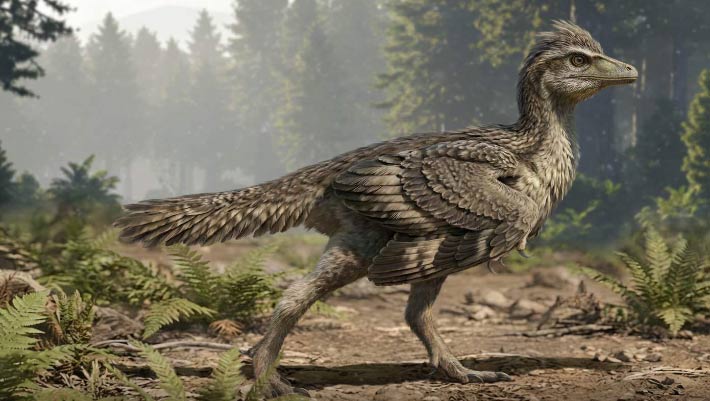
Certains dinosaures à plumes ont peut-être brièvement pris leur envol, pour y renoncer plus tard. En étudiant des fossiles rares avec des plumes préservées, les chercheurs ont découvert un indice surprenant caché dans les schémas de mue, révélant qu’Anchiornis ne pouvait probablement pas voler du tout. Au lieu du remplacement soigné et symétrique des plumes observé chez les oiseaux volants, ces dinosaures ont présenté une mue désordonnée et irrégulière, ce que seuls les animaux incapables de voler présentent.
18/03/2026 sciencedaily ⚙ Traduction automatique
Des fossiles de poissons vieux de 400 millions d'années révèlent comment la vie a commencé à s'installer sur terre
Australie Chine fossile formation crâne
Les scientifiques ont découvert de nouveaux indices sur certains des premiers poissons de la Terre, mettant ainsi en lumière les origines anciennes des vertébrés qui ont fini par s’installer sur terre. En réanalysant de mystérieux fossiles de la célèbre formation australienne Gogo et en étudiant un crâne de poisson-poumon récemment reconstruit, vieux de 410 millions d'années et provenant de Chine, les chercheurs révèlent comment ces créatures primitives ont évolué.
12/03/2026 sciencedaily ⚙ Traduction automatique
1 2 3 4 5 6 7 8 9 10 11 12 13 14 15 16 17 18 19 20 21 22 23 24 25 26