←

Canada

Pays

33 image(s) · 14 Actualités

Galerie d'images

The Canadian Fossil Discovery Centre in Morden boasts the largest collection of marine invertebrate fossils in Canada. Visitors to the museum not only get to see this collection, but can join a dig in search for more fossils at a 109-acre escarpment property.

Photo credit: Robyn Hanson
Taxons Tylosaurus

The Canadian Fossil Discovery Centre in Morden boasts the largest collection of marine invertebrate fossils in Canada. Visitors to the museum not only get to see this collection, but can join a dig in search for more fossils at a 109-acre escarpment property. Photo credit: Robyn Hanson

musée Canada fossile Tylosaurus +1
Identifier: annalsofmedicalh01pack (find matches)
Title: Annals of medical history
Year: 1917 (1910s)
Authors:  Packard, Francis R. (Francis Randolph), 1870-1950
Subjects:  Medicine
Publisher:  New York P.B. Hoeber
Contributing Library:  Gerstein - University of Toronto
Digitizing Sponsor:  University of Toronto

View Book Page: Book Viewer
About This Book: Catalog Entry
View All Images: All Images From Book
Click here to view book online to see this illustration in context in a browseable online version of this book.

Text Appearing Before Image:
ail strongly Hexed, and the toescontracted and appressed. The whole atti-tude strongly suggests a spastic distress,possibly brought on by some form ofpoisoning of the central nervous system,from infection or the deglutition of somepoisonous substance. 14. Osteomalacia is evidently the causeof the hypertrophy of the bones of Lim-nocyron potens, an early carnivore from theWashakie Eocene of Wyoming, nearly3,000,000 years old. MATERIALS AND METHODS The material described in the presentpaper has been loaned the writer lor de-scription by the Field Museum of Chii Osborn: Hull. Amcr. \lus. Natl. Hist., 1917,vol. 35. !>• 733. P>- 28. Studies in Paleopathology 393 by the American Museum of Natural His-tory of New York City, by Walker Museumof the University of Chicago, and by the Uni-versity of Kansas Natural History Museum. made by the well-known petrographic meth-ods so common in all geological labora-tories. The diagnoses, where they are at-tempted, arc made from comparisons of the
Text Appearing After Image:
Fig. 20. The skeleton of Strutbiomimus altus, a small dinosaur from the BeliyRiver series (Cretaceous), Red Deer River, Alberta, Canada, now regarded as ofapproximately the same age as the Judith River series. The unique feature ofthe skull is the total absence of teeth, with a size of skull one-third larger thanthe ostrich and a length of body of about fifteen feet. The position of the skeletonis decidedly that of the opisthotonos which may be regarded as an indication ofdisease. (After Osborn). A beautiful specimen of an osteoma, theonly one known so far, on the vertebra of aKansas Cretaceous mosasaur, was given thewriter by Dr. J. M. Armstrong of St. Paul.The writer expresses his obligations to thegentlemen connected with the above-men-tioned institutions and to Dr. Armstrong.The methods used are a combination ofprocedures in the various lines involved.Microscopic sections, which can be madethin enough for immersion lens study, are material with similar lesions in recent hu-man mat

Note About Images

Please note that these images are extracted from scanned page images that may have been digitally enhanced for readability - coloration and appearance of these illustrations may not perfectly resemble the original work.
Taxons Hexing

Identifier: annalsofmedicalh01pack (find matches) Title: Annals of medical history Year: 1917 (1910s) Authors: Packard, Francis R. (Francis Randolph), 1870-1950 Subjects: Medicine Publisher: New York P.B. Hoeber Contributing Library: Gerstein - University of Toronto Digitizing Sponsor: University of Toronto View Book Page: Book Viewer About This Book: Catalog Entry View All Images: All Images From Book Click here to view book online to see this illustration in context in a browseable online version of this book. Text Appearing Before Image: ail strongly Hexed, and the toescontracted and appressed. The whole atti-tude strongly suggests a spastic distress,possibly brought on by some form ofpoisoning of the central nervous system,from infection or the deglutition of somepoisonous substance. 14. Osteomalacia is evidently the causeof the hypertrophy of the bones of Lim-nocyron potens, an early carnivore from theWashakie Eocene of Wyoming, nearly3,000,000 years old. MATERIALS AND METHODS The material described in the presentpaper has been loaned the writer lor de-scription by the Field Museum of Chii Osborn: Hull. Amcr. \lus. Natl. Hist., 1917,vol. 35. !>• 733. P>- 28. Studies in Paleopathology 393 by the American Museum of Natural His-tory of New York City, by Walker Museumof the University of Chicago, and by the Uni-versity of Kansas Natural History Museum. made by the well-known petrographic meth-ods so common in all geological labora-tories. The diagnoses, where they are at-tempted, arc made from comparisons of the Text Appearing After Image: Fig. 20. The skeleton of Strutbiomimus altus, a small dinosaur from the BeliyRiver series (Cretaceous), Red Deer River, Alberta, Canada, now regarded as ofapproximately the same age as the Judith River series. The unique feature ofthe skull is the total absence of teeth, with a size of skull one-third larger thanthe ostrich and a length of body of about fifteen feet. The position of the skeletonis decidedly that of the opisthotonos which may be regarded as an indication ofdisease. (After Osborn). A beautiful specimen of an osteoma, theonly one known so far, on the vertebra of aKansas Cretaceous mosasaur, was given thewriter by Dr. J. M. Armstrong of St. Paul.The writer expresses his obligations to thegentlemen connected with the above-men-tioned institutions and to Dr. Armstrong.The methods used are a combination ofprocedures in the various lines involved.Microscopic sections, which can be madethin enough for immersion lens study, are material with similar lesions in recent hu-man mat Note About Images Please note that these images are extracted from scanned page images that may have been digitally enhanced for readability - coloration and appearance of these illustrations may not perfectly resemble the original work.

os vertèbre livre musée +11
Life restoration of the mosasaurine mosasaurid Eremiasaurus, with unknown portions and soft tissues based primarily on Prognathodon and supplemented with Mosasaurus where needed.
References
Leblanc, A.R.H.; Caldwell, M.W.; Bardet, N. (2012). "A new mosasaurine from the Maastrichtian (Upper Cretaceous) phosphates of Morocco and its implications for mosasaurine systematics". Journal of Vertebrate Paleontology 32 (1): 82–104.
Lindgren, J.; Kaddumi, H.; Polcyn, M. (2013). "Soft tissue preservation in a fossil marine lizard with a bilobed tail fin". Nature Communications 4: 2423. DOI:10.1038/ncomms3423.
Konishi, T.; Brinkman, D.; Massare, J.A.; Caldwell, M.W. (2011). "New exceptional specimens of Prognathodon overtoni (Squamata, Mosasauridae) from the upper Campanian of Alberta, Canada, and the systematics and ecology of the genus". Journal of Vertebrate Paleontology 31 (5): 1026–1046.
Russell, D.A. (1967). "Systematics and morphology of American mosasaurs". Bulletin of the Peabody Museum of Natural History 23: 1–241.
Taxons Eremiasaurus

Life restoration of the mosasaurine mosasaurid Eremiasaurus, with unknown portions and soft tissues based primarily on Prognathodon and supplemented with Mosasaurus where needed. References Leblanc, A.R.H.; Caldwell, M.W.; Bardet, N. (2012). "A new mosasaurine from the Maastrichtian (Upper Cretaceous) phosphates of Morocco and its implications for mosasaurine systematics". Journal of Vertebrate Paleontology 32 (1): 82–104. Lindgren, J.; Kaddumi, H.; Polcyn, M. (2013). "Soft tissue preservation in a fossil marine lizard with a bilobed tail fin". Nature Communications 4: 2423. DOI:10.1038/ncomms3423. Konishi, T.; Brinkman, D.; Massare, J.A.; Caldwell, M.W. (2011). "New exceptional specimens of Prognathodon overtoni (Squamata, Mosasauridae) from the upper Campanian of Alberta, Canada, and the systematics and ecology of the genus". Journal of Vertebrate Paleontology 31 (5): 1026–1046. Russell, D.A. (1967). "Systematics and morphology of American mosasaurs". Bulletin of the Peabody Museum of Natural History 23: 1–241.

tissus écologie musée Canada +11
Tromerosaurus is a medium-sized tyrannosaur that lived during the Late Cretaceous period in what is now Canada. It was a bipedal carnivore that grew to approximately 7 m in total body length. Tromerosaurus had many intermediate traits found among contemporary tyrannosaurs, revealing insight about how different lineages diverged and coexisted.

Tromerosaurus is a medium-sized tyrannosaur that lived during the Late Cretaceous period in what is now Canada. It was a bipedal carnivore that grew to approximately 7 m in total body length. Tromerosaurus had many intermediate traits found among contemporary tyrannosaurs, revealing insight about how different lineages diverged and coexisted.

Canada Crétacé Crétacé supérieur Tromerosaurus
Delegates from the Ichnia 2012 conference inspect the Global Boundary Stratotype Section and Point (GSSP) for the Ediacaran-Cambrian boundary at Fortune Head Ecological Reserve, Newfoundland, Canada. The boundary is defined on the first appearance of the complex trace fossil Treptichnus (formerly Phycodes) pedum.
Intervalles Fortunian

Delegates from the Ichnia 2012 conference inspect the Global Boundary Stratotype Section and Point (GSSP) for the Ediacaran-Cambrian boundary at Fortune Head Ecological Reserve, Newfoundland, Canada. The boundary is defined on the first appearance of the complex trace fossil Treptichnus (formerly Phycodes) pedum.

Canada Cambrien Édiacarien fossile
Fossil specimen RTMP 82.19.23 - A lacrimal, postorbitals, squamosals, frontals, parietals, and braincase referred to Latenivenatrix mcmasterae, but formerly assigned to Stenonychosaurus inequalis (=Troodon inequalis). Described by 

Currie, 1985. "Cranial anatomy of Stenonychosaurus inequalis (Saurischia, Theropoda) and its bearing on the origin of birds." Canadian Journal of Earth Sciences, 22(1), 643-658.
5d-dinosaur-camp-day2-20120802-15.jpg
Taxons Latenivenatrix

Fossil specimen RTMP 82.19.23 - A lacrimal, postorbitals, squamosals, frontals, parietals, and braincase referred to Latenivenatrix mcmasterae, but formerly assigned to Stenonychosaurus inequalis (=Troodon inequalis). Described by Currie, 1985. "Cranial anatomy of Stenonychosaurus inequalis (Saurischia, Theropoda) and its bearing on the origin of birds." Canadian Journal of Earth Sciences, 22(1), 643-658. 5d-dinosaur-camp-day2-20120802-15.jpg

Canada fossile spécimen Dinosauria +7
Pelvis (fused ilia and pubes) of UALVP 48778, holotype of Hesperonychus elizabethae, from the late Campanian Dinosaur Park Formation of Alberta, Canada. Fossil collected by Dr. Elizabeth Nicholls. Prepared by Clive Coy. Digital photography by Nick Longrich. Additional digital editing by Nick Longrich.
Taxons Hesperonychus

Pelvis (fused ilia and pubes) of UALVP 48778, holotype of Hesperonychus elizabethae, from the late Campanian Dinosaur Park Formation of Alberta, Canada. Fossil collected by Dr. Elizabeth Nicholls. Prepared by Clive Coy. Digital photography by Nick Longrich. Additional digital editing by Nick Longrich.

bassin Canada Dinosaur Park Campanien +6
Identifier: annalsofmedicalh01pack (find matches)
Title: Annals of medical history
Year: 1917 (1910s)
Authors:  Packard, Francis R. (Francis Randolph), 1870-1950
Subjects:  Medicine
Publisher:  New York P.B. Hoeber
Contributing Library:  Gerstein - University of Toronto
Digitizing Sponsor:  University of Toronto

View Book Page: Book Viewer
About This Book: Catalog Entry
View All Images: All Images From Book
Click here to view book online to see this illustration in context in a browseable online version of this book.

Text Appearing Before Image:
ail strongly Hexed, and the toescontracted and appressed. The whole atti-tude strongly suggests a spastic distress,possibly brought on by some form ofpoisoning of the central nervous system,from infection or the deglutition of somepoisonous substance. 14. Osteomalacia is evidently the causeof the hypertrophy of the bones of Lim-nocyron potens, an early carnivore from theWashakie Eocene of Wyoming, nearly3,000,000 years old. MATERIALS AND METHODS The material described in the presentpaper has been loaned the writer lor de-scription by the Field Museum of Chii Osborn: Hull. Amcr. \lus. Natl. Hist., 1917,vol. 35. !>• 733. P>- 28. Studies in Paleopathology 393 by the American Museum of Natural His-tory of New York City, by Walker Museumof the University of Chicago, and by the Uni-versity of Kansas Natural History Museum. made by the well-known petrographic meth-ods so common in all geological labora-tories. The diagnoses, where they are at-tempted, arc made from comparisons of the
Text Appearing After Image:
Fig. 20. The skeleton of Strutbiomimus altus, a small dinosaur from the BeliyRiver series (Cretaceous), Red Deer River, Alberta, Canada, now regarded as ofapproximately the same age as the Judith River series. The unique feature ofthe skull is the total absence of teeth, with a size of skull one-third larger thanthe ostrich and a length of body of about fifteen feet. The position of the skeletonis decidedly that of the opisthotonos which may be regarded as an indication ofdisease. (After Osborn). A beautiful specimen of an osteoma, theonly one known so far, on the vertebra of aKansas Cretaceous mosasaur, was given thewriter by Dr. J. M. Armstrong of St. Paul.The writer expresses his obligations to thegentlemen connected with the above-men-tioned institutions and to Dr. Armstrong.The methods used are a combination ofprocedures in the various lines involved.Microscopic sections, which can be madethin enough for immersion lens study, are material with similar lesions in recent hu-man mat

Note About Images

Please note that these images are extracted from scanned page images that may have been digitally enhanced for readability - coloration and appearance of these illustrations may not perfectly resemble the original work.

Identifier: annalsofmedicalh01pack (find matches) Title: Annals of medical history Year: 1917 (1910s) Authors: Packard, Francis R. (Francis Randolph), 1870-1950 Subjects: Medicine Publisher: New York P.B. Hoeber Contributing Library: Gerstein - University of Toronto Digitizing Sponsor: University of Toronto View Book Page: Book Viewer About This Book: Catalog Entry View All Images: All Images From Book Click here to view book online to see this illustration in context in a browseable online version of this book. Text Appearing Before Image: ail strongly Hexed, and the toescontracted and appressed. The whole atti-tude strongly suggests a spastic distress,possibly brought on by some form ofpoisoning of the central nervous system,from infection or the deglutition of somepoisonous substance. 14. Osteomalacia is evidently the causeof the hypertrophy of the bones of Lim-nocyron potens, an early carnivore from theWashakie Eocene of Wyoming, nearly3,000,000 years old. MATERIALS AND METHODS The material described in the presentpaper has been loaned the writer lor de-scription by the Field Museum of Chii Osborn: Hull. Amcr. \lus. Natl. Hist., 1917,vol. 35. !>• 733. P>- 28. Studies in Paleopathology 393 by the American Museum of Natural His-tory of New York City, by Walker Museumof the University of Chicago, and by the Uni-versity of Kansas Natural History Museum. made by the well-known petrographic meth-ods so common in all geological labora-tories. The diagnoses, where they are at-tempted, arc made from comparisons of the Text Appearing After Image: Fig. 20. The skeleton of Strutbiomimus altus, a small dinosaur from the BeliyRiver series (Cretaceous), Red Deer River, Alberta, Canada, now regarded as ofapproximately the same age as the Judith River series. The unique feature ofthe skull is the total absence of teeth, with a size of skull one-third larger thanthe ostrich and a length of body of about fifteen feet. The position of the skeletonis decidedly that of the opisthotonos which may be regarded as an indication ofdisease. (After Osborn). A beautiful specimen of an osteoma, theonly one known so far, on the vertebra of aKansas Cretaceous mosasaur, was given thewriter by Dr. J. M. Armstrong of St. Paul.The writer expresses his obligations to thegentlemen connected with the above-men-tioned institutions and to Dr. Armstrong.The methods used are a combination ofprocedures in the various lines involved.Microscopic sections, which can be madethin enough for immersion lens study, are material with similar lesions in recent hu-man mat Note About Images Please note that these images are extracted from scanned page images that may have been digitally enhanced for readability - coloration and appearance of these illustrations may not perfectly resemble the original work.

os vertèbre livre musée +11
Exhibit in the Royal Ontario Museum, Toronto, Ontario, Canada. This exhibit is old enough so that it is in the public domain, and photography was permitted in the museum. I took this photograph and release it into the public domain.
Taxons Excalibosaurus

Exhibit in the Royal Ontario Museum, Toronto, Ontario, Canada. This exhibit is old enough so that it is in the public domain, and photography was permitted in the museum. I took this photograph and release it into the public domain.

musée Canada Excalibosaurus
Tetrapodosaurus borealis footprint from the Dunvegan Formation, Canada.
Taxons Tetrapodosaurus

Tetrapodosaurus borealis footprint from the Dunvegan Formation, Canada.

Canada Tetrapodosaurus formation
The Canadian Fossil Discovery Centre in Morden boasts the largest collection of marine invertebrate fossils in Canada. Visitors to the museum not only get to see this collection, but can join a dig in search for more fossils at a 109-acre escarpment property.

Photo credit: Robyn Hanson

The Canadian Fossil Discovery Centre in Morden boasts the largest collection of marine invertebrate fossils in Canada. Visitors to the museum not only get to see this collection, but can join a dig in search for more fossils at a 109-acre escarpment property. Photo credit: Robyn Hanson

musée Canada fossile Tylosaurus +1
Fossil specimen of Ornithomimus sp. (TMP 1995.110.1), Royal Tyrrell Museum. This specimen was recovered from the middle Dinosaur Park Formation of Alberta, Canada.
Taxons Ornithomimidae

Fossil specimen of Ornithomimus sp. (TMP 1995.110.1), Royal Tyrrell Museum. This specimen was recovered from the middle Dinosaur Park Formation of Alberta, Canada.

musée Canada Allemagne Dinosaur Park +6
Greenlandite (fuchsite-quartz gneiss) (2.7 cm across at its widest) from the Precambrian of southwestern Greenland.  Green = fuchsite; gray = quartz; a few small, scattered pyrite crystals (brassy gold-colored) are also visible.


Attractive greenish-colored gneisses in southwestern Greenland that contain the minerals fuchsite (green) and quartz (gray) have been informally called greenlandite.  Fuchsite is a chromian muscovite mica (K(Al,Cr)2AlSi3O10(OH,F)2 - potassium chromium hydroxy-fluoro-aluminosilicate); it is typically encountered in schistose rocks.
Greenland greenlandite is part of a 3.8 billion year old, highly metamorphosed succession of rocks.  These represent the oldest known supracrustal rocks on Earth (the oldest crustal Earth rocks include 4.03 billion year old Acasta Gneiss, 4.28 b.y. rocks from the eastern Hudson Bay area, and 4.45-4.55 b.y. rocks in the subsurface of Baffin Island, Canada).
Locality: undisclosed locality in the Godthåbsfjord area or Nuuk area, southwestern Greenland.

Age: Eoarchean boundary, 3.8 billion years.
Intervalles Eoarchean

Greenlandite (fuchsite-quartz gneiss) (2.7 cm across at its widest) from the Precambrian of southwestern Greenland. Green = fuchsite; gray = quartz; a few small, scattered pyrite crystals (brassy gold-colored) are also visible. Attractive greenish-colored gneisses in southwestern Greenland that contain the minerals fuchsite (green) and quartz (gray) have been informally called greenlandite. Fuchsite is a chromian muscovite mica (K(Al,Cr)2AlSi3O10(OH,F)2 - potassium chromium hydroxy-fluoro-aluminosilicate); it is typically encountered in schistose rocks. Greenland greenlandite is part of a 3.8 billion year old, highly metamorphosed succession of rocks. These represent the oldest known supracrustal rocks on Earth (the oldest crustal Earth rocks include 4.03 billion year old Acasta Gneiss, 4.28 b.y. rocks from the eastern Hudson Bay area, and 4.45-4.55 b.y. rocks in the subsurface of Baffin Island, Canada). Locality: undisclosed locality in the Godthåbsfjord area or Nuuk area, southwestern Greenland. Age: Eoarchean boundary, 3.8 billion years.

Canada Groenland Éoarchéen
Pittsburgh-2013-05-18-058
Taxons Diabloceratops

Pittsburgh-2013-05-18-058

Canada Diabloceratops
Dinos at Courtenay Museum -20090628-7
Taxons Kourisodon

Dinos at Courtenay Museum -20090628-7

musée Canada Kourisodon
Puntledge River elasmosaur[1], Canadian Museum of Nature, Ottawa, Ontario, Canada
Taxons Traskasaura

Puntledge River elasmosaur[1], Canadian Museum of Nature, Ottawa, Ontario, Canada

musée Canada Traskasaura
1 2 3

Actualités

L’incroyable fossile « Hell Chicken » exposé au Musée royal de l’Ontario
plume musée Canada fossile holotype spécimen Dinosauria Infernogallus découverte crâne
Une découverte extraordinaire de fossiles de dinosaures contribue désormais à éduquer et à inspirer les visiteurs du Musée royal de l'Ontario (ROM) à Toronto, au Canada. Le spécimen remarquable est le fossile holotype d'Infernogallus jamesi, un dinosaure à plumes nouvellement décrit surnommé le « Poulet de l'Enfer ». Le crâne articulé presque complet et les restes squelettiques articulés associés fournissent aux paléontologues
11/11/2026 everythingdinosaur ⚙ Traduction automatique
Struthiomimus: Beast of the Week
Struthiomimus : Bête de la semaine
Canada États-Unis Crétacé Crétacé supérieur Dinosauria Struthiomimus oiseau
Tous les oiseaux sont des dinosaures, mais tous les dinosaures n’étaient pas des oiseaux.  La bête de cette semaine en est un exemple parfait, mais déroutant.  Voyons Struthiomimus ! Struthiomimus était un dinosaure théropode qui vivait dans ce qui est aujourd'hui l'Alberta, le Canada et certaines parties de l'ouest des États-Unis, à la fin du Crétacé, il y a 75 à 66 millions d'années.  Du bec à la queue, Struthiomimus mesurait environ 7,3 m de long.  Le nom Struthiomimus se traduit par "Autruche Mimic" parce que... regardez
08/11/2026 prehistoricbeastoftheweek ⚙ Traduction automatique
Tromerosaurus: Beast of the Week
Tromerosaurus : Bête de la semaine
Canada Crétacé Crétacé supérieur Dinosauria Tromerosaurus
 Cette semaine, nous examinons un dinosaure prédateur nouvellement décrit avec un nom vraiment effrayant et fantastique.  Attention aux solumons de Tromerosaurus ! Le Tromerosaurus était un dinosaure théropode qui vivait dans ce qui est aujourd'hui le sud de l'Alberta, au Canada, à la fin du Crétacé, il y a entre 76 et 77 millions d'années.  Il mesurait environ 7 mètres du museau à la queue et aurait été un mangeur de viande de son vivant.  Son nom de genre se traduit par "lézard/reptile effrayant" et le nom de son espèce par "
18/10/2026 prehistoricbeastoftheweek ⚙ Traduction automatique
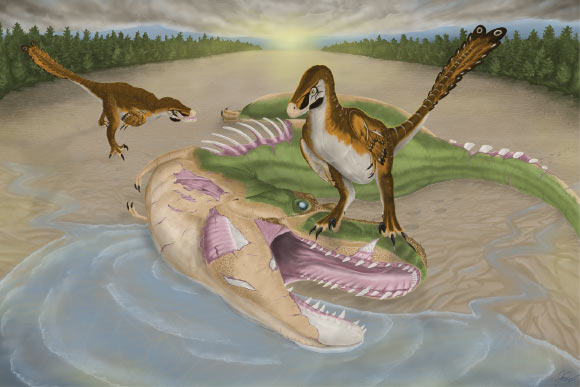
Small Raptors Likely Feasted on Fallen Tyrannosaur, Fossil Bite Marks Suggest
Les petits rapaces se sont probablement régalés d'un tyrannosaure déchu, suggèrent des marques de morsures fossiles
prédateur Canada fossile Albertosaurus
Les tyrannosaures se situent au sommet de la chaîne alimentaire dans l'imaginaire populaire, mais un fossile récemment décrit en Alberta, au Canada, suggère qu'un prédateur beaucoup plus petit aurait pu se nourrir de la carcasse du sarcophage d'Albertosaurus, un parent du tyrannosaure. L'article Les petits rapaces se sont probablement régalés d'un tyrannosaure déchu, suggèrent des marques de morsure fossiles, apparu en premier sur Sci.News : Breaking Science News.
14/10/2026 sci-news ⚙ Traduction automatique
Un nouveau tyrannosaure remarquable met en lumière un puzzle évolutif
prédateur Canada Campanien Crétacé Crétacé supérieur fossile Tyrannosauridae nouvelle espèce étude
Une nouvelle espèce de grand tyrannosaure a été nommée et décrite à partir de fossiles trouvés en Alberta (Canada). Le nouveau théropode, Tromerosaurus solumons, vivait il y a environ 76 millions d'années (stade faunique campanien du Crétacé supérieur). Curieusement, ce prédateur possédait un mélange de caractéristiques anatomiques associées à deux lignées majeures de tyrannosauridés. L'étude pourrait changer notre
05/10/2026 everythingdinosaur ⚙ Traduction automatique
1 2 3