17 image(s) · 1 Actualités
Dinosaur sand sculptures at the Sand Sculpting Australia "Dinostory" exhibit held at Frankston, Victoria, Australia 2008/2009.The sculpture was the created with the combined efforts of an international team of sand sculpting artists: Karen Fralich (Canada) - children playing in foreground; Peter Bignell (Tasmania, Australia) - Triceratops skull and logo; Martijn Rijerse (Netherlands) - Tyrannosaurus rex scene; Jino van Bruissenen and Christina Mija (NSW, Australia) - background panel.
Fossil specimen of Ornithomimus sp. (TMP 1995.110.1), Royal Tyrrell Museum. This specimen was recovered from the middle Dinosaur Park Formation of Alberta, Canada.
Geographic and stratigraphic relationships of the holotype EMK 0012 and the Loki Quarry in northern Montana. (A) Regional relationships between the cross-border paleontological sites in the Oldman and Judith River formations along the Milk River and in Kennedy Coulee in Alberta and Montana. (B) Generalized stratigraphic section in the Kennedy Coulee area modified after Goodwin & Deino (1989) and Rogers, Eberth & Ramezani (2023) with the relationships between the Foremost and Oldman formations in Canada and the Judith River Formation in Montana. Relative placements of important taxa in this area are indicated. Position of 40Ar/39Ar dates originally obtained by Goodwin & Deino (1989) are shown in relation to the new U–Pb CA-ID-TIMS date for KC061517-1 by Ramezani et al. (2022). Bentonite ash beds are only 5 to 7 cm thick so they are exaggerated for clarity. Scale bars delineated in map view are indicated kilometers and in meters stratigraphically.
Title: Dinosaur hunting in western Canada Identifier: dinosaurhuntingi00russ (find matches) Year: 1966 (1960s) Authors: Russell, Loris Shano, 1904-; Royal Ontario Museum Subjects: Dinosaurs; Paleontology Publisher: (Toronto : Printed at the University of Toronto Press) Contributing Library: ROM - University of Toronto Digitizing Sponsor: University of Toronto View Book Page: Book Viewer About This Book: Catalog Entry View All Images: All Images From Book Click here to view book online to see this illustration in context in a browseable online version of this book. Text Appearing Before Image: This season of 1921 George Sternberg became the first dinosaur col- lector on the Red Deer River to have his work recorded in motion pictures. This happened by a curious error. The Dominion Motion Picture Bureau, predecessor of the National Film Board of Canada, had decided to make a short motion picture based on the work being done by the Geological Survey of Canada in the collecting and displaying of Canadian dinosaurs. The camera party sent to Alberta was naturally supposed to visit the Geological Survey party under Charles M. Sternberg, but local directions sent them to the camp of George Sternberg. So this excellent little film records field work by the University of Alberta party and preparation being done at the National Museum of Canada in Ottawa. That winter George Sternberg continued the preparation of the speci- mens obtained during the two preceding field seasons, but in the spring he resigned to accept a position with the Field Museum of Natural History of Chicago, under Elmer S. Riggs. The summer of 1922 was the last time that the eldest of the Sternberg sons worked on the Red Deer River, his collec- tion going to Chicago. However, he returned to Edmonton for several months in 1935, to complete the preparation of the collection that he brought together in 1920 and 1921. When George Sternberg left the Geological Survey of Canada in 1918, the only one of the four Sternbergs remaining at Ottawa was Charles Mortram Sternberg, the second son of C. H. Sternberg. Actually, Charles had his first independent expedition to the Red Deer badlands in 1917, C. M. Sternberg ami G. E. Lindblad working on the skull of a horned dinosaur (Centrasaurus sp.), Oldman formation, Red Deer River, 1917. N.M.C., No. 39994. Text Appearing After Image: 22 Note About Images Please note that these images are extracted from scanned page images that may have been digitally enhanced for readability - coloration and appearance of these illustrations may not perfectly resemble the original work.
Brachylophosaurus canadensis skull (original). From the Oldman Formation, Milk River, Alberta. On display at the Royal Tyrrell Museum, Alberta, Canada.
Hoodoos in Writing-on-Stone Provincial Park, Alberta, Canada
World map showing Late Cretaceous metatherian locales. Europe 1. Font-de-Benon quarry, Archingeay-Les Nouillers (Cenomanian, Late Cretaceous), Charente-Maritime, southwestern France (Vullo et al. 2009) 2. Valkenburg Member, Maastricht Formation (late Maastrichtian, Late Cretaceous), southern Limburg, The Netherlands (Martin et al. 2005) Asia 3. Yixian Formation, China (Barremian, Early Cretaceous) 4. Bissekty Formation, Kyzylkum Desert, Uzbekistan (Turonian, Late Cretaceous) 5. Darbasa Formation, southern Kazakhstan (Campanian, Late Cretaceous) 6. Grey Mesa locality (Averianov 1997) 7. Barun Goyot Formation, Umuni Gobi, Mongolia (Campanian, Late Cretaceous) 8. Nemegt Formation, Omnogov, Mongolia (Maastrichtian, Late Cretaceous) 9. Djadokhta Formation, Mongolia (Campanian, Late Cretaceous) North America Alaska 9. Prince Creek Formation, Alaska (early Maastrichtian, Late Cretaceous) Alberta and Saskatchewan, Canada 10. Milk River Formation, southern Alberta, Canada (late Santonian, Late Cretaceous) 11. Oldman Formation, southern Alberta, Canada (Campanian, Late Cretaceous) 12. Dinosaur Park Formation, southern Alberta, Canada (late Campanian, Late Cretaceous) 13. Horseshoe Canyon Formation, southern Alberta, Canada (early Maastrichtian, Late Cretaceous) 14. St. Mary River Formation, Alberta and northwestern Montana (early Maastrichtian, Late Cretaceous) 15. Scollard Formation, Alberta (late Maastrichtian, Late Cretaceous) 16. Frenchman Formation, Saskatchewan (late Maastrichtian, Late Cretaceous) Montana and North Dakota 17. Judith River Formation (late Campanian, Late Cretaceous) 18. Two Medicine Formation (late Campanian, Late Cretaceous) 19. Hell Creek Formation, Montana and North Dakota (late Maastrichtian, Late Cretaceous) South Dakota 20. Fox Hills Formation, South Dakota (late Maastrichtian, Late Cretaceous) 21. Hell Creek Formation, South Dakota (late Maastrichtian, Late Cretaceous) Wyoming 22. “Mesa Verde Formation” (late Campanian, Late Cretaceous) 23. Lance Formation, Wyoming (late Maastrichtian, Late Cretaceous) 24. Ferris Formation, Wyoming (late Maastrichtian, Late Cretaceous) Utah 25. Cedar Mountain Formation (Albian-Cenomanian) 26. Dakota Formation fauna (late Cenomanian, Late Cretaceous) 27. Smoky Hollow Member, Straight Cliffs Formation (Turonian, Late Cretaceous) 28. John Henry Member, Straight Cliffs Formation (Coniacian-Santonian, Late Cretaceous) 29. Wahweap Formation (early-middle Campanian, Late Cretaceous) 30. Kaiparowits Formation (late Campanian, Late Cretaceous) 31. Iron Springs Formation fauna, southern Utah (Turonian – Santonian, Late Cretaceous) 32. North Horn Formation, Utah (late Maastrichtian, Late Cretaceous) Colorado 33. Williams Fork Formation, Colorado (late Campanian-early Maastrichtian) 34. Laramie Formation, northeastern Colorado (late Maastrichtian, Late Cretaceous) Baja California Del Norte, Mexico 35. El Gallo Formation (late Campanian, Late Cretaceous) (Clemens 1980; Lillegraven 1972; Lillegraven 1976) New Mexico 36. Fruitland and lower Kirtland Formation, San Juan Basin (late Campanian, Late Cretaceous) 37. Naashoibito Member, Kirtland Formation, New Mexico (late Maastrichtian, Late Cretaceous) Oklahoma 38. Antlers Formation, Texas and Oklahoma (Aptian-Albian, Early Cretaceous) Texas 39. Aguja Formation, West Texas (late Campanian, Late Cretaceous) New Jersey 40. Marshalltown Formation, New Jersey (Campanian, Late Cretaceous) Szalay 1994)
Tarsometatarsi of caenagnathids from the Upper Campanian Dinosaur Park Formation, Dinosaur Provincial Park, Alberta, Canada. A. TMP 1993.036.0181 (Chirostenotes pergracilis). B. TMP 1982.016.0006 (Citipes elegans). C. ROM 781 (Citipes elegans holotype). D. TMP 1996.012.0141 (Citipes elegans). Tarsometatarsi in proximal (A1–D1), anterior (A2–D2), and posterior (A3–D3) views.
Holotype specimen TMP 2000.29.01 of the ophthalmosaurian ichthyosaur Athabascasaurus bitumineus from the Lower Cretaceous Clearwater Formation of Alberta, in Royal Tyrrell Museum, Drumheller, Alberta, Canada.
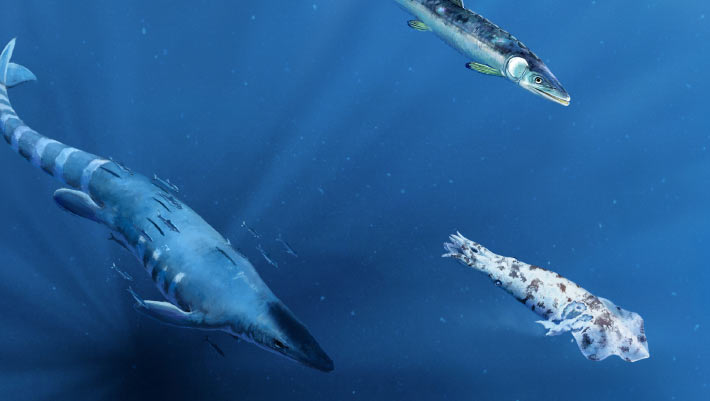
Life restoration of the mosasaurine mosasaurid Eremiasaurus, with unknown portions and soft tissues based primarily on Prognathodon and supplemented with Mosasaurus where needed. References Leblanc, A.R.H.; Caldwell, M.W.; Bardet, N. (2012). "A new mosasaurine from the Maastrichtian (Upper Cretaceous) phosphates of Morocco and its implications for mosasaurine systematics". Journal of Vertebrate Paleontology 32 (1): 82–104. Lindgren, J.; Kaddumi, H.; Polcyn, M. (2013). "Soft tissue preservation in a fossil marine lizard with a bilobed tail fin". Nature Communications 4: 2423. DOI:10.1038/ncomms3423. Konishi, T.; Brinkman, D.; Massare, J.A.; Caldwell, M.W. (2011). "New exceptional specimens of Prognathodon overtoni (Squamata, Mosasauridae) from the upper Campanian of Alberta, Canada, and the systematics and ecology of the genus". Journal of Vertebrate Paleontology 31 (5): 1026–1046. Russell, D.A. (1967). "Systematics and morphology of American mosasaurs". Bulletin of the Peabody Museum of Natural History 23: 1–241.
Exhibit in the Royal Ontario Museum, Toronto, Ontario, Canada. This exhibit is old enough so that it is in the public domain, and photography was permitted in the museum. I took this photograph and release it into the public domain.
Puntledge River elasmosaur[1], Canadian Museum of Nature, Ottawa, Ontario, Canada
Pelvis (fused ilia and pubes) of UALVP 48778, holotype of Hesperonychus elizabethae, from the late Campanian Dinosaur Park Formation of Alberta, Canada. Fossil collected by Dr. Elizabeth Nicholls. Prepared by Clive Coy. Digital photography by Nick Longrich. Additional digital editing by Nick Longrich.