15 image(s) · 4 Actualités
Dinosaur sand sculptures at the Sand Sculpting Australia "Dinostory" exhibit held at Frankston, Victoria, Australia 2008/2009.The sculpture was the created with the combined efforts of an international team of sand sculpting artists: Karen Fralich (Canada) - children playing in foreground; Peter Bignell (Tasmania, Australia) - Triceratops skull and logo; Martijn Rijerse (Netherlands) - Tyrannosaurus rex scene; Jino van Bruissenen and Christina Mija (NSW, Australia) - background panel.
Amargasaurus lived in the Cretaceous Period, about 100 million years ago.Photo taken in Museum of Victoria (Melbourne, Victoria, Australia)
Palaeogeographic distribution of late Early and early Late Cretaceous pterosaur assemblages. Taxonomic composition of assemblages shown on Fig. 1. Palaeogeography based on Smith et al. 1994. Abbreviations: 1. Cambridge Greensand, England: 2. Lower Chalk, England: 3. Züümbayan Svita, Khuren-Dukh, Mongolia: 4. Lysaya Gora, Saratov, Russia: 5. Kem Kem red beds, Morocco: 6. Paw Paw Formation, Texas, USA: 7. Lagarcito Formation, San Luis, Argentina: 8. Santana and Crato Formations, Ceara, Brazil: 9. Toolebuc Formation, Queensland, Australia.
Locality map for Australian eurypodan thyreophoran fossils. 1, Stegosaurian? footprint (QM F5701), Walloon Coal Measures, Balgowan Colliery, Balgowan (Bajocian–Bathonian); 2, Minmi paravertebra holotype (QM F10329) (Molnar, 1980), Minmi Member, Bungil Formation (Valanginian–Barremian); 3, Thyreophoran trackways, Broome Sandstone, Dampier Peninsula, Western Australia (Valanginian–Barremian); 4, Ankylosauria indet. (see Barrett et al., 2010) ‘Flat Rocks’ Wonthaggi Formation (upper Hauterivian–Albian); 5, NMV P216739, ‘Lake Copco–Dinosaur Cove’ Eumeralla Formation (middle upper Aptian to lower middle Albian) (Barrett et al., 2010); 6, QM F33286; 7, AM F119849 and AM F35259; 8, Kunbarrasaurus ieversi gen. et sp. nov. (formerly Minmi sp.) (QM F18101); 9, QM F33565 and QM F33566; 10, QM F44324-28. Legend: Dark Green, Toolebuc Formation (late middle–early late Albian); Green, Allaru Formation (upper Albian–(?)lower Cenomanian); Light green, Mackunda Formation (upper Albian–lower Cenomanian); Lightest green, Winton Formation (late Albian–early Turonian).
Precious opal from Australia. (public display, Denver Museum of Nature & Science, Denver, Colorado, USA) A mineral is a naturally-occurring, solid, inorganic, crystalline substance having a fairly definite chemical composition and having fairly definite physical properties. At its simplest, a mineral is a naturally-occurring solid chemical. Currently, there are over 4900 named and described minerals - about 200 of them are common and about 20 of them are very common. Mineral classification is based on anion chemistry. Major categories of minerals are: elements, sulfides, oxides, halides, carbonates, sulfates, phosphates, and silicates. The silicates are the most abundant and chemically complex group of minerals. All silicates have silica as the basis for their chemistry. "Silica" refers to SiO2 chemistry. The fundamental molecular unit of silica is one small silicon atom surrounded by four large oxygen atoms in the shape of a triangular pyramid - this is the silica tetrahedron - SiO4. Each oxygen atom is shared by two silicon atoms, so only half of the four oxygens "belong" to each silicon. The resulting formula for silica is thus SiO2, not SiO4. Opal is hydrous silica (SiO2·nH2O). Technically, opal is not a mineral because it lacks a crystalline structure. Opal is supposed to be called a mineraloid. Opal is made up of extremely tiny spheres (colloids - <a href="https://www.uwgb.edu/dutchs/acstalks/acscolor/OPALSPHR.jpg" rel="nofollow">www.uwgb.edu/dutchs/acstalks/acscolor/OPALSPHR.jpg</a>) that can be seen with a scanning electron microscope (SEM). Gem-quality opal, or precious opal, has a wonderful rainbow play of colors (opalescence). This play of color is the result of light being diffracted by planes of voids between large areas of regularly packed, same-sized opal colloids. Different opalescent colors are produced by colloids of differing sizes. If individual colloids are larger than 140 x 10-6 mm in size, purple & blue & green colors are produced. Once colloids get as large as about 240 x 10-6 mm, red color is seen (Carr et al., 1979). Not all opals have the famous play of colors, however. Common opal has a wax-like luster & is often milky whitish with no visible color play at all. Opal is moderately hard (H = 5 to 6), has a white streak, and has conchoidal fracture. Several groups of organisms make skeletons of opaline silica, for example hexactinellid sponges, diatoms, radiolarians, silicoflagellates, and ebridians. Some organisms incorporate opal into their tissues, for example horsetails/scouring rushes and sawgrass. Sometimes, fossils are preserved in opal or precious opal. The precious opal shown above is surrounded by silicified claystone. The rock is from the Griman Creek Formation, a Cretaceous-aged succession of nonmarine, fine-grained and coarse-grained siliciclastic sedimentary rocks. Stratigraphy: Griman Creek Formation, Albian Stage, upper Lower Cretaceous Locality: Coocoran Opal Field, west-southwest of Coocoran Lake, northern New South Wales, eastern Australia Photo gallery of opal: <a href="http://www.mindat.org/gallery.php?min=3004" rel="nofollow">www.mindat.org/gallery.php?min=3004</a> References cited: Carr et al. (1979) - Andamooka opal fields: the geology of the precious stones field and the results of the subsidised mining program. Geological Survey of South Australia Department of Mines and Energy Report of Investigations 51. 68 pp.
(A) Present day map of Australia with the town of Lightning Ridge indicated by the star. (B) Regional map of the Lightning Ridge region showing localities (where known) for specimens described in this text. Sealed (solid black lines) and unsealed roads (dashed lines) are indicated. The ephemeral Coocoran Lake is marked with a dotted blue line. (C) Correlative stratigraphy of the major Cretaceous depositional basins and geological units discussed in this study. The ornithopod icon and arrow indicate the approximate level of the Griman Creek Formation from which the current material pertains. Informal units are in quotation marks. Maps in (A) and (B) redrawn and modified from Bell et al. (2016) and Opal Fields—Lightning Ridge Region map produced by the NSW Department of Mineral Resources, respectively. Stratigraphy based on Toslini, McLoughlin & Drinnan (1999) and Cook, Bryan & Draper (2013). Ornithopod silhouette created by Caleb M. Brown and used under the Creative Commons Attribution-ShareAlike 3.0 Unported license.
Wide angle photo from the visitor’s walkway inside Lark Quarry Dinosaur Trackways, Australia. Here, the camera is pointing towards the south west corner of the building. On the top (in the far corner) is the natural landscape. In the middle ground of the photo, some of the overburden has been cleared. In the foreground is the dinosaur tracks.
Buttons, a species of Leptorhynchos. Traralgon, Latrobe Valley, Victoria Australia, September 2011.
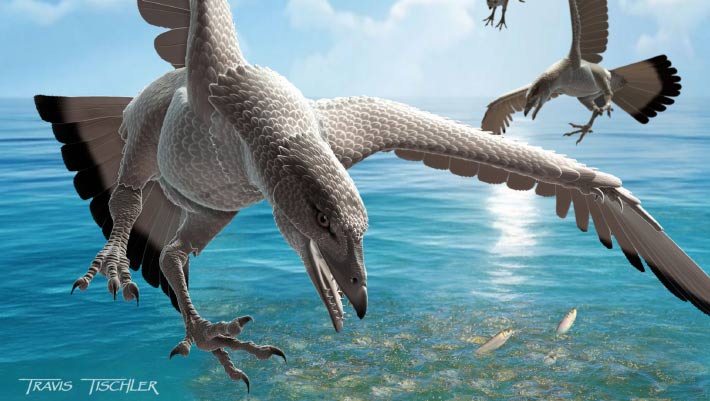
A cast replica of a skeletal mount of the prehistoric pterosaur Anhanguera blittersdorffi on display at Melbourne Museum in Victoria, Australia.
Specimens of Galleonosaurus dorisae n. gen. n. sp. from the Flat Rocks Sandstone in the upper Barremian, Wonthaggi Formation, Gippsland Basin, southeastern Australia: (1–2) holotype (NMV P229196), left maxilla in lateral (1) and medial (2) views; (3) NMV P208178, left maxilla in lateral view; (4) NMV P212845, left maxilla in lateral view; (5) NMV P209977, left maxilla in lateral view; (6) NMV P186440, left maxilla in lateral view; (7) NMV 208113, right maxillary tooth in labial view. Scale bars = 10 mm (1–6); 1 mm (7).
Muttaburrasaurus The plants, animals and climate of the Australian continent have changed dramatically over long periods of time. Imagine this giant creature roaming the luxuriant wet forests that covered parts of the continent in the Cretaceous period, about 100-110 million years ago. The Muttaburrasaurus ambled along on all four legs or stood on its hind legs. Its large teeth were well adapted to eat tough vegetation such as the leathery foliage of the evergreen forests of Araucaria trees, ancient relatives of the bunya pine of south-eastern Queensland. In 1963, grazier Doug Langdon discovered the fossilised bones of a dinosaur on his property near Muttaburra in central-west Queensland. It was one of the most complete dinosaur skeletons found in Australia. The bones belonged to a new species of ornithopod and palaeontologists named it Muttaburrasaurus langdoni. Cast of Muttaburresaurus langdoni 1987 made by Queensland Museum, Brisbane National Museum of Australia