Brésil

Pays

11 image(s) · 7 Actualités

Galerie d'images

Holotype and referred specimen of Amanasaurus nesbitti gen. et sp. nov. from the Candelária Sequence (mid-to-late Carnian) of the Santa Maria Supersequence, southern Brazil. Holotype (CAPPA/UFSM 0374) in anterior (a), lateral (b), proximal (c), medial (d), and posterior (e) views. Referred specimen (CAPPA/UFSM 0375) in anterior (f), lateral (g), posterior (h), and distal (i) views. alt anterolateral tuber, amt anteromedial tuber, at anterior trochanter, cl cleft, ctfb crista tibiofibularis, dlt dorsolateral trochanter, dltp posterior portion of the dorsolateral trochanter, fo foramen, fot fossa trochanterica, gt greater trochanter, lc lateral condyle, lia linea intermuscularis cranialis, mc medial condyle, ms muscle scar, no notch, pg proximal groove, pof popliteal fossa, scs sub-circular scar. Figures were generated with GIMP 2.8 (https://www.gimp.org/).
Taxons Amanasaurus

Holotype and referred specimen of Amanasaurus nesbitti gen. et sp. nov. from the Candelária Sequence (mid-to-late Carnian) of the Santa Maria Supersequence, southern Brazil. Holotype (CAPPA/UFSM 0374) in anterior (a), lateral (b), proximal (c), medial (d), and posterior (e) views. Referred specimen (CAPPA/UFSM 0375) in anterior (f), lateral (g), posterior (h), and distal (i) views. alt anterolateral tuber, amt anteromedial tuber, at anterior trochanter, cl cleft, ctfb crista tibiofibularis, dlt dorsolateral trochanter, dltp posterior portion of the dorsolateral trochanter, fo foramen, fot fossa trochanterica, gt greater trochanter, lc lateral condyle, lia linea intermuscularis cranialis, mc medial condyle, ms muscle scar, no notch, pg proximal groove, pof popliteal fossa, scs sub-circular scar. Figures were generated with GIMP 2.8 (https://www.gimp.org/).

Brésil Carnien holotype spécimen +1
A reconstruction of Erythrovenator jacuiensis based on a skeletal by Maurissauro. This basal theropod comes from the Late Triassic Candelária Formation of Brazil.
Taxons Erythrovenator

A reconstruction of Erythrovenator jacuiensis based on a skeletal by Maurissauro. This basal theropod comes from the Late Triassic Candelária Formation of Brazil.

Brésil Trias supérieur Trias Erythrovenator +1
Life restoration of Cearadactylus atrox.
Based on figure 2 of "On the systematic relationships of Cearadactylus atrox, an enigmatic Early Cretaceous pterosaur from the Santana Formation of Brazil" by D. M. Unwin Mitteilungen Museum für Naturkunde Berlin, Geowissenschaftlichen Reihe 5: 239-263
Taxons Brasileodactylus

Life restoration of Cearadactylus atrox. Based on figure 2 of "On the systematic relationships of Cearadactylus atrox, an enigmatic Early Cretaceous pterosaur from the Santana Formation of Brazil" by D. M. Unwin Mitteilungen Museum für Naturkunde Berlin, Geowissenschaftlichen Reihe 5: 239-263

musée Brésil Crétacé Crétacé inférieur +4
A photograph of partial specimen American Museum of Natural History (AMNH) 22555, skull without mandible, of Anhanguera sp. (formerly often assigned to Anhanguera santanae),[1] from the Early Cretaceous Romualdo Formation (former Romualdo Member of the Santana Formation) of NE Brazil in right lateral view.

A photograph of partial specimen American Museum of Natural History (AMNH) 22555, skull without mandible, of Anhanguera sp. (formerly often assigned to Anhanguera santanae),[1] from the Early Cretaceous Romualdo Formation (former Romualdo Member of the Santana Formation) of NE Brazil in right lateral view.

musée Brésil Conway Romualdo +7
A photograph of partial specimen American Museum of Natural History (AMNH) 22555, anterior dorsal vertebrae, dorsal ribs and partial shoulder girdle (at least right scapula) of Anhanguera sp. (formerly often assigned to Anhanguera santanae),[1] from the Early Cretaceous Romualdo Formation (former Romualdo Member of the Santana Formation) of NE Brazil in dorsal view.

A photograph of partial specimen American Museum of Natural History (AMNH) 22555, anterior dorsal vertebrae, dorsal ribs and partial shoulder girdle (at least right scapula) of Anhanguera sp. (formerly often assigned to Anhanguera santanae),[1] from the Early Cretaceous Romualdo Formation (former Romualdo Member of the Santana Formation) of NE Brazil in dorsal view.

musée Brésil Conway Romualdo +6
A photograph of partial specimen American Museum of Natural History (AMNH) 22555, posterior dorsal vertebrae, and the sacrum and pelvis (both iliae, and right ischium and pubis) of Anhanguera sp. (formerly often assigned to Anhanguera santanae),[1] from the Early Cretaceous Romualdo Formation (former Romualdo Member of the Santana Formation) of NE Brazil in dorsal view.
Taxons Anhanguera

A photograph of partial specimen American Museum of Natural History (AMNH) 22555, posterior dorsal vertebrae, and the sacrum and pelvis (both iliae, and right ischium and pubis) of Anhanguera sp. (formerly often assigned to Anhanguera santanae),[1] from the Early Cretaceous Romualdo Formation (former Romualdo Member of the Santana Formation) of NE Brazil in dorsal view.

bassin musée Brésil Conway +7
Reconstructed skull of Caupedactylus.
Taxons Caupedactylus

Reconstructed skull of Caupedactylus.

Brésil Caupedactylus crâne
Azhdarchoid pterosaur Kariridraco dianae gen. et sp. nov. holotype (MPSC R 1056) from Lower Cretaceous of Northeastern Brazil. Skull in right lateral view. Photograph (A1), interpretative drawing (A2). Dark grey areas indicate remains of the carbonate matrix still attachaed to the skull.
Taxons Kariridraco

Azhdarchoid pterosaur Kariridraco dianae gen. et sp. nov. holotype (MPSC R 1056) from Lower Cretaceous of Northeastern Brazil. Skull in right lateral view. Photograph (A1), interpretative drawing (A2). Dark grey areas indicate remains of the carbonate matrix still attachaed to the skull.

dessin Brésil Crétacé holotype +3
Model in resin in scale 1/5. São Paulo - Brazil
Taxons Mirischia

Model in resin in scale 1/5. São Paulo - Brazil

écaille Brésil Mirischia
Museum of Zoology of the University of São Paulo, Brazil
Taxons Tapuiasaurus

Museum of Zoology of the University of São Paulo, Brazil

musée Brésil Tapuiasaurus
Palaeogeographic distribution of late Early and early Late Cretaceous pterosaur assemblages. Taxonomic composition of assemblages shown on Fig. 1. Palaeogeography based on Smith et al. 1994. Abbreviations: 1. Cambridge Greensand, England: 2. Lower Chalk, England: 3. Züümbayan Svita, Khuren-Dukh, Mongolia: 4. Lysaya Gora, Saratov, Russia: 5. Kem Kem red beds, Morocco: 6. Paw Paw Formation, Texas, USA: 7. Lagarcito Formation, San Luis, Argentina: 8. Santana and Crato Formations, Ceara, Brazil: 9. Toolebuc Formation, Queensland, Australia.

Palaeogeographic distribution of late Early and early Late Cretaceous pterosaur assemblages. Taxonomic composition of assemblages shown on Fig. 1. Palaeogeography based on Smith et al. 1994. Abbreviations: 1. Cambridge Greensand, England: 2. Lower Chalk, England: 3. Züümbayan Svita, Khuren-Dukh, Mongolia: 4. Lysaya Gora, Saratov, Russia: 5. Kem Kem red beds, Morocco: 6. Paw Paw Formation, Texas, USA: 7. Lagarcito Formation, San Luis, Argentina: 8. Santana and Crato Formations, Ceara, Brazil: 9. Toolebuc Formation, Queensland, Australia.

Argentine Australie Brésil Mongolie +8

Actualités

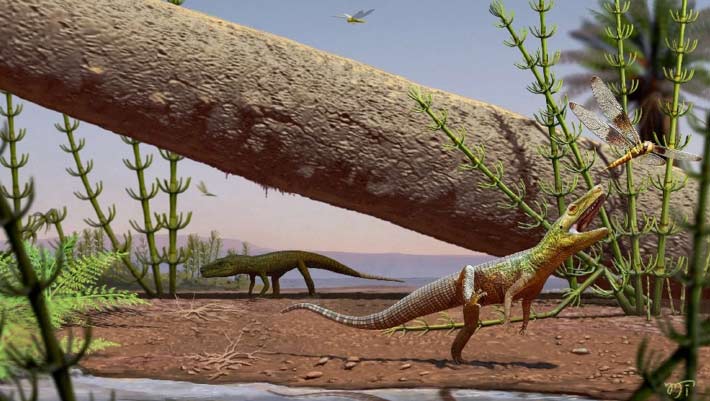
Distant Cousin of Crocodiles Stalked Brazil 240 Million Years Ago
Un cousin éloigné des crocodiles parcourait le Brésil il y a 240 millions d'années
Brésil Dinosauria autres reptiles
Les paléontologues travaillant au Brésil ont identifié une espèce d'archosauriforme jusqu'alors inconnue qui vivait il y a environ 240 millions d'années et pourrait appartenir à un groupe mal compris d'anciens reptiles qui ressemblaient beaucoup aux ancêtres des crocodiles et des dinosaures. L'article Le cousin éloigné des crocodiles traquait le Brésil il y a 240 millions d'années est apparu en premier sur Sci.News : Breaking Science News.
26/06/2026 sci-news ⚙ Traduction automatique
113-Million-Year-Old Pterosaur Fossil Reveals What Flying Reptiles Ate
Un fossile de ptérosaure vieux de 113 millions d'années révèle ce que mangeaient les reptiles volants
tissus alimentation Brésil fossile Anhangueridae Pterosauria poisson
Un fossile de ptérosaure vieux de 113 millions d'années provenant du nord-est du Brésil a fourni des preuves rares de tissus mous, de molécules organiques et de traces chimiques d'un régime alimentaire riche en poissons et en céphalopodes tels que les calmars ou les nautiles. L'article Un fossile de ptérosaure vieux de 113 millions d'années révèle ce que mangeaient les reptiles volants est apparu en premier sur Sci.News : Breaking Science News.
19/06/2026 sci-news ⚙ Traduction automatique
Un nouveau dinosaure sauropode du Crétacé inférieur du Brésil
Brésil Crétacé Crétacé inférieur Dasosaurus Dinosauria
Un nouveau genre de dinosaure sauropode a été nommé au Brésil.  Il élargit la diversité connue des sauropodes du Crétacé inférieur dans la partie nord de l'Amérique du Sud. En outre, le nouveau dinosaure Dasosaurus tocantinensis fournit de nouvelles preuves de la dispersion des dinosaures entre l’Europe, l’Afrique et l’Amérique du Sud. L'article scientifique décrivant le nouveau taxon a été
15/05/2026 everythingdinosaur ⚙ Traduction automatique
Une découverte étonnante de fossiles remet en question les origines de la vie animale
Brésil fossile découverte
Des scientifiques revisitant de mystérieux microfossiles brésiliens vieux de 540 millions d’années ont renversé une idée majeure sur les débuts de la vie animale. Ce que l’on pensait autrefois être des traces laissées par de minuscules créatures ressemblant à des vers sont maintenant considérées comme des communautés fossilisées de bactéries et d’algues – certaines avec des cellules remarquablement préservées et de la matière organique encore intacte.
12/05/2026 sciencedaily-paleo ⚙ Traduction automatique
Cet animal vieux de 275 millions d'années avait une mâchoire tordue comme aucun animal vivant aujourd'hui
mâchoire Brésil fossile datation
Au fond d'un lit de rivière asséché au Brésil, des scientifiques ont découvert un étrange mystère préhistorique : les mâchoires tordues d'un étrange animal perdu depuis longtemps, comme on n'en avait jamais vu auparavant. Datant de 275 millions d'années, cette créature, nommée Tanyka amnicola, appartenait à une lignée ancienne qui aurait déjà dû disparaître, ce qui en fait une sorte de « fossile vivant » de son époque.
01/05/2026 sciencedaily ⚙ Traduction automatique
1 2