Brazil

Country

12 image(s) · 10 News

Image gallery

A photograph of partial specimen American Museum of Natural History (AMNH) 22555, posterior dorsal vertebrae, and the sacrum and pelvis (both iliae, and right ischium and pubis) of Anhanguera sp. (formerly often assigned to Anhanguera santanae),[1] from the Early Cretaceous Romualdo Formation (former Romualdo Member of the Santana Formation) of NE Brazil in dorsal view.
Taxa Anhanguera

A photograph of partial specimen American Museum of Natural History (AMNH) 22555, posterior dorsal vertebrae, and the sacrum and pelvis (both iliae, and right ischium and pubis) of Anhanguera sp. (formerly often assigned to Anhanguera santanae),[1] from the Early Cretaceous Romualdo Formation (former Romualdo Member of the Santana Formation) of NE Brazil in dorsal view.

pelvis museum Brazil Conway +7
Holotype and referred specimen of Amanasaurus nesbitti gen. et sp. nov. from the Candelária Sequence (mid-to-late Carnian) of the Santa Maria Supersequence, southern Brazil. Holotype (CAPPA/UFSM 0374) in anterior (a), lateral (b), proximal (c), medial (d), and posterior (e) views. Referred specimen (CAPPA/UFSM 0375) in anterior (f), lateral (g), posterior (h), and distal (i) views. alt anterolateral tuber, amt anteromedial tuber, at anterior trochanter, cl cleft, ctfb crista tibiofibularis, dlt dorsolateral trochanter, dltp posterior portion of the dorsolateral trochanter, fo foramen, fot fossa trochanterica, gt greater trochanter, lc lateral condyle, lia linea intermuscularis cranialis, mc medial condyle, ms muscle scar, no notch, pg proximal groove, pof popliteal fossa, scs sub-circular scar. Figures were generated with GIMP 2.8 (https://www.gimp.org/).
Taxa Amanasaurus

Holotype and referred specimen of Amanasaurus nesbitti gen. et sp. nov. from the Candelária Sequence (mid-to-late Carnian) of the Santa Maria Supersequence, southern Brazil. Holotype (CAPPA/UFSM 0374) in anterior (a), lateral (b), proximal (c), medial (d), and posterior (e) views. Referred specimen (CAPPA/UFSM 0375) in anterior (f), lateral (g), posterior (h), and distal (i) views. alt anterolateral tuber, amt anteromedial tuber, at anterior trochanter, cl cleft, ctfb crista tibiofibularis, dlt dorsolateral trochanter, dltp posterior portion of the dorsolateral trochanter, fo foramen, fot fossa trochanterica, gt greater trochanter, lc lateral condyle, lia linea intermuscularis cranialis, mc medial condyle, ms muscle scar, no notch, pg proximal groove, pof popliteal fossa, scs sub-circular scar. Figures were generated with GIMP 2.8 (https://www.gimp.org/).

Brazil Carnian holotype specimen +1
A reconstruction of Erythrovenator jacuiensis based on a skeletal by Maurissauro. This basal theropod comes from the Late Triassic Candelária Formation of Brazil.
Taxa Erythrovenator

A reconstruction of Erythrovenator jacuiensis based on a skeletal by Maurissauro. This basal theropod comes from the Late Triassic Candelária Formation of Brazil.

Brazil Late Triassic Triassic Erythrovenator +1
Life restoration of Cearadactylus atrox.
Based on figure 2 of "On the systematic relationships of Cearadactylus atrox, an enigmatic Early Cretaceous pterosaur from the Santana Formation of Brazil" by D. M. Unwin Mitteilungen Museum für Naturkunde Berlin, Geowissenschaftlichen Reihe 5: 239-263

Life restoration of Cearadactylus atrox. Based on figure 2 of "On the systematic relationships of Cearadactylus atrox, an enigmatic Early Cretaceous pterosaur from the Santana Formation of Brazil" by D. M. Unwin Mitteilungen Museum für Naturkunde Berlin, Geowissenschaftlichen Reihe 5: 239-263

museum Brazil Cretaceous Early Cretaceous +4
A photograph of partial specimen American Museum of Natural History (AMNH) 22555, skull without mandible, of Anhanguera sp. (formerly often assigned to Anhanguera santanae),[1] from the Early Cretaceous Romualdo Formation (former Romualdo Member of the Santana Formation) of NE Brazil in right lateral view.

A photograph of partial specimen American Museum of Natural History (AMNH) 22555, skull without mandible, of Anhanguera sp. (formerly often assigned to Anhanguera santanae),[1] from the Early Cretaceous Romualdo Formation (former Romualdo Member of the Santana Formation) of NE Brazil in right lateral view.

museum Brazil Conway Romualdo +7
A photograph of partial specimen American Museum of Natural History (AMNH) 22555, anterior dorsal vertebrae, dorsal ribs and partial shoulder girdle (at least right scapula) of Anhanguera sp. (formerly often assigned to Anhanguera santanae),[1] from the Early Cretaceous Romualdo Formation (former Romualdo Member of the Santana Formation) of NE Brazil in dorsal view.

A photograph of partial specimen American Museum of Natural History (AMNH) 22555, anterior dorsal vertebrae, dorsal ribs and partial shoulder girdle (at least right scapula) of Anhanguera sp. (formerly often assigned to Anhanguera santanae),[1] from the Early Cretaceous Romualdo Formation (former Romualdo Member of the Santana Formation) of NE Brazil in dorsal view.

museum Brazil Conway Romualdo +6
A photograph of partial specimen American Museum of Natural History (AMNH) 22555, posterior dorsal vertebrae, and the sacrum and pelvis (both iliae, and right ischium and pubis) of Anhanguera sp. (formerly often assigned to Anhanguera santanae),[1] from the Early Cretaceous Romualdo Formation (former Romualdo Member of the Santana Formation) of NE Brazil in dorsal view.

A photograph of partial specimen American Museum of Natural History (AMNH) 22555, posterior dorsal vertebrae, and the sacrum and pelvis (both iliae, and right ischium and pubis) of Anhanguera sp. (formerly often assigned to Anhanguera santanae),[1] from the Early Cretaceous Romualdo Formation (former Romualdo Member of the Santana Formation) of NE Brazil in dorsal view.

pelvis museum Brazil Conway +7
Reconstructed skull of Caupedactylus.
Taxa Caupedactylus

Reconstructed skull of Caupedactylus.

Brazil Caupedactylus skull
Azhdarchoid pterosaur Kariridraco dianae gen. et sp. nov. holotype (MPSC R 1056) from Lower Cretaceous of Northeastern Brazil. Skull in right lateral view. Photograph (A1), interpretative drawing (A2). Dark grey areas indicate remains of the carbonate matrix still attachaed to the skull.
Taxa Kariridraco

Azhdarchoid pterosaur Kariridraco dianae gen. et sp. nov. holotype (MPSC R 1056) from Lower Cretaceous of Northeastern Brazil. Skull in right lateral view. Photograph (A1), interpretative drawing (A2). Dark grey areas indicate remains of the carbonate matrix still attachaed to the skull.

drawing Brazil Cretaceous holotype +3
Model in resin in scale 1/5. São Paulo - Brazil
Taxa Mirischia

Model in resin in scale 1/5. São Paulo - Brazil

scale Brazil Mirischia
Museum of Zoology of the University of São Paulo, Brazil
Taxa Tapuiasaurus

Museum of Zoology of the University of São Paulo, Brazil

museum Brazil Tapuiasaurus
Palaeogeographic distribution of late Early and early Late Cretaceous pterosaur assemblages. Taxonomic composition of assemblages shown on Fig. 1. Palaeogeography based on Smith et al. 1994. Abbreviations: 1. Cambridge Greensand, England: 2. Lower Chalk, England: 3. Züümbayan Svita, Khuren-Dukh, Mongolia: 4. Lysaya Gora, Saratov, Russia: 5. Kem Kem red beds, Morocco: 6. Paw Paw Formation, Texas, USA: 7. Lagarcito Formation, San Luis, Argentina: 8. Santana and Crato Formations, Ceara, Brazil: 9. Toolebuc Formation, Queensland, Australia.

Palaeogeographic distribution of late Early and early Late Cretaceous pterosaur assemblages. Taxonomic composition of assemblages shown on Fig. 1. Palaeogeography based on Smith et al. 1994. Abbreviations: 1. Cambridge Greensand, England: 2. Lower Chalk, England: 3. Züümbayan Svita, Khuren-Dukh, Mongolia: 4. Lysaya Gora, Saratov, Russia: 5. Kem Kem red beds, Morocco: 6. Paw Paw Formation, Texas, USA: 7. Lagarcito Formation, San Luis, Argentina: 8. Santana and Crato Formations, Ceara, Brazil: 9. Toolebuc Formation, Queensland, Australia.

Argentina Australia Brazil Mongolia +8

News

240-million-year-old reptile fossil reveals a lost chapter before dinosaurs and crocodiles
predator Brazil Triassic fossil Dinosauria evolution other reptiles
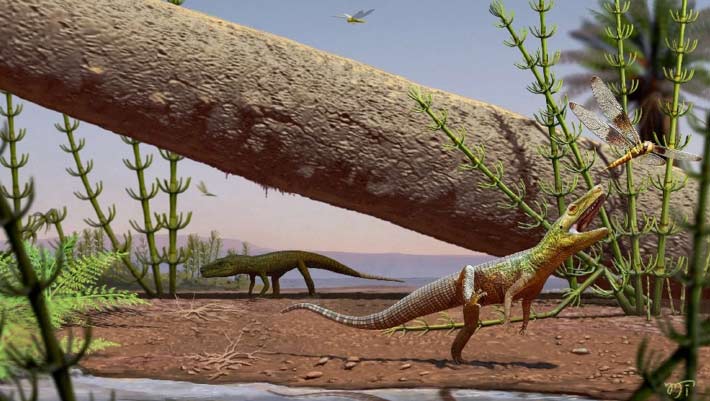
A 240-million-year-old reptile discovered in Brazil is revealing what evolution looked like just before the rise of dinosaurs and crocodiles. The small predator had unusually positioned legs that may have allowed it to move more efficiently than many earlier reptiles. Its close relatives were previously known mostly from other continents, suggesting these ancient animals spread much farther across the Triassic world than scientists realized.
10/08/2026 sciencedaily
80-million-year-old snake brain reveals a surprising evolutionary secret
Brazil fossil
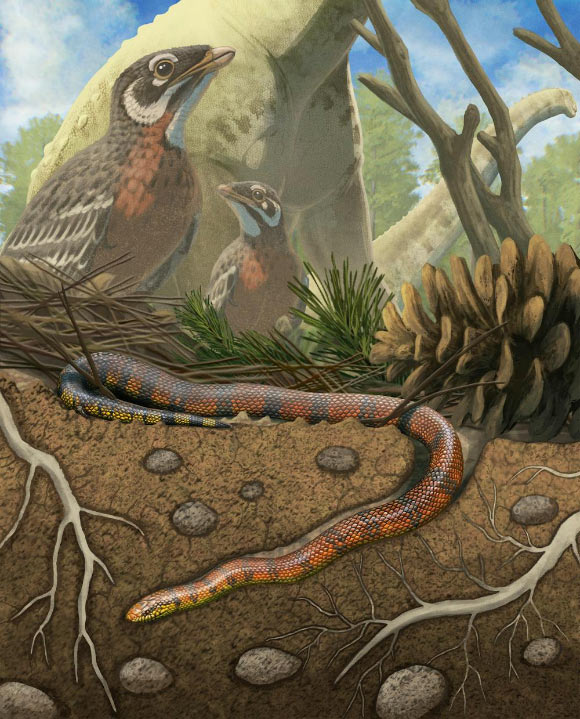
An exceptionally preserved snake fossil from Brazil reveals that early snakes were far more diverse than scientists once thought. Detailed brain reconstructions show that Tametara mirim was adapted for burrowing, while another ancient snake was suited to life above ground. Other fossils point to marine lifestyles as well. By 80 million years ago, snakes were already experimenting with very different habitats and sensory systems.
05/08/2026 sciencedaily-paleo
Did Early Snakes Burrow, Swim or Crawl? 80‑Million‑Year‑Old Fossil Suggests: All Three
Brazil fossil
Paleontologists have unearthed a remarkably preserved fossil snake in Brazil that is reshaping ideas about how the earliest snakes lived and complicating the long-running debate over whether their ancestors burrowed underground, swam in the sea or crawled the surface. The post Did Early Snakes Burrow, Swim or Crawl? 80‑Million‑Year‑Old Fossil Suggests: All Three appeared first on Sci.News: Breaking Science News.
24/07/2026 sci-news
Distant Cousin of Crocodiles Stalked Brazil 240 Million Years Ago
Brazil Dinosauria other reptiles
Paleontologists working in Brazil have identified a previously unknown species of archosauriform that lived about 240 million years ago and may belong to a poorly understood group of ancient reptiles that closely resembled the ancestors of crocodiles and dinosaurs. The post Distant Cousin of Crocodiles Stalked Brazil 240 Million Years Ago appeared first on Sci.News: Breaking Science News.
26/06/2026 sci-news
113-Million-Year-Old Pterosaur Fossil Reveals What Flying Reptiles Ate
tissue feeding Brazil fossil Anhangueridae Pterosauria fish
A 113-million-year-old pterosaur fossil from northeastern Brazil has yielded rare evidence of soft tissues, organic molecules and chemical traces of a diet heavy in fish and cephalopods such as squid or nautilus relatives. The post 113-Million-Year-Old Pterosaur Fossil Reveals What Flying Reptiles Ate appeared first on Sci.News: Breaking Science News.
19/06/2026 sci-news
1 2