moulage
Nature du spécimen67 image(s) · 0 Actualités
Galerie d'images

Bifurculapes laqueatus trackway (positive hyporelief, i.e. casts on the bottom surface of the bed) from the Early Jurassic East Berlin Formation (Hartford Basin) of Holyoke, Massachusetts (not the same specimen as this one). See coin (1 U.S. cent, 19.05 mm in diameter) for scale.

A trackway of the trace fossil Bifurculapes laqueatus (positive hyporelief, i.e. casts on the bottom surface of the bed) from the Early Jurassic East Berlin Formation (Hartford Basin) of Holyoke, Massachusetts (not the same specimen as this one). Scale is in cm.

Plate XII(XIX). Fig. 1. Coelophysis bauri COPE. Sacrum, consisting of three vertebrae and last dorsal vertebra. COPE’s original. Triassic, New Mexico. Preserved in American Museum of Natural History, New York. Nat. size, from a cast in Tübingen. a, right lateral view; b, left lateral view; c, ventral view. Fig. 2. Thecodontosaurus skirtopodus SEELEY sp. Right humerus. Original in Vienna Hofmuseum (Coll. ADLER 1886). Upper Karroo, Cape Colony, South Africa. 1/2 nat. size, from a cast in Tübingen. Fig. 3. Same. Ditto. Proximal end of a right humerus in posterior view. 1/2 nat. size (the lateral part is missing). Fig. 4. Same. Ditto. Distal end of a left humerus in anterior view. 1/2 nat. size. Fig. 5. Same. Ditto. Distal end of a left femur in posterior view. 1/2 nat. size. Fig. 6. Same. Ditto. Proximal end of a left tibia, lateral view. 1/2 nat. size. Fig. 7. Thecodontosaurus browni SEELEY sp. Left femur in posterior view. SEELEY’s original. From the Stormberg Beds of the Telle River near Aliwal North, Cape Colony, South Africa. (From casts in the British Museum and Tübingen.) 1/2 nat. size. Fig. 8. Same. Ditto. Right femur, medial view.

A cast replica of a skeletal mount of the prehistoric pterosaur Anhanguera blittersdorffi on display at Melbourne Museum in Victoria, Australia.

Cast of the holotype trackway of Eosauropus, a probable sauropodomorph dinosaur ichnogenus, on display at the Museum of Western Colorado’s Dinosaur Journey Museum in Fruita, Colorado

Figure description from paper: "A Cast of BES SC 999, the holotype of Besanosaurus leptorhynchus and (B) interpretative drawing (modified from Dal Sasso & Pinna, 1996). Foetal remains are highlighted with green lines. a astragalus, c calcaneum, Cl clavicle, Co coracoid, Fe femur, Fi Fibula, H humerus, i intermedium, Il Ilium, Is Ischium, P pubis, p pisiform, R radius, r radiale, S scapula, T Tibia, U Ulna, u ulnare; 2, 3, and 4, distal carpals and tarsals; II, III, IV, and V, metacarpals and metatarsals. The apostrophe (‘) indicates left elements. Scale bar represents 50 cm"
Figure description from paper: "A Cast of BES SC 999, the holotype of Besanosaurus leptorhynchus and (B) interpretative drawing (modified from Dal Sasso & Pinna, 1996). Foetal remains are highlighted with green lines. a astragalus, c calcaneum, Cl clavicle, Co coracoid, Fe femur, Fi Fibula, H humerus, i intermedium, Il Ilium, Is Ischium, P pubis, p pisiform, R radius, r radiale, S scapula, T Tibia, U Ulna, u ulnare; 2, 3, and 4, distal carpals and tarsals; II, III, IV, and V, metacarpals and metatarsals. The apostrophe (‘) indicates left elements. Scale bar represents 50 cm"
Figure description from paper: "A Cast of BES SC 999, the holotype of Besanosaurus leptorhynchus and (B) interpretative drawing (modified from Dal Sasso & Pinna, 1996). Foetal remains are highlighted with green lines. a astragalus, c calcaneum, Cl clavicle, Co coracoid, Fe femur, Fi Fibula, H humerus, i intermedium, Il Ilium, Is Ischium, P pubis, p pisiform, R radius, r radiale, S scapula, T Tibia, U Ulna, u ulnare; 2, 3, and 4, distal carpals and tarsals; II, III, IV, and V, metacarpals and metatarsals. The apostrophe (‘) indicates left elements. Scale bar represents 50 cm"

Skull of Pistosaurus longaevus (cast - USNM 16107) in right, left and posterior views.
Skull of Pistosaurus longaevus (cast - USNM 16107) in right, left and posterior views.
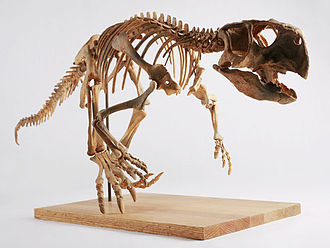
A Psittacosaurus skeleton cast in the permanent collection of The Children’s Museum of Indianapolis.
A Psittacosaurus skeleton cast in the permanent collection of The Children’s Museum of Indianapolis.

Moyeni dinosaur tracks. Photographs of plaster casts (positives) of Grallator track 6 (A) and Anomoepus track 8 (B) made at the Moyeni tracksite by the authors. Tracks are shown at the same scale (10 cm), and hatching pattern indicates broken surfaces. The Grallator hind foot print was made by pedal digits II–IV; the trackmaker's phalangeal formula was 3–4–5. Digits I and V did not contact the substrate. The rugose texture surrounding the print is the algal mat. The Anomoepus manus–pes couple registers all five manual digits (i–v), four pedal digits (I–IV), the metatarsus (mt), and toe drag marks (dm). Additional structures to the left of the pes are incidental marks made by a different trackmaker.
Moyeni dinosaur tracks. Photographs of plaster casts (positives) of Grallator track 6 (A) and Anomoepus track 8 (B) made at the Moyeni tracksite by the authors. Tracks are shown at the same scale (10 cm), and hatching pattern indicates broken surfaces. The Grallator hind foot print was made by pedal digits II–IV; the trackmaker's phalangeal formula was 3–4–5. Digits I and V did not contact the substrate. The rugose texture surrounding the print is the algal mat. The Anomoepus manus–pes couple registers all five manual digits (i–v), four pedal digits (I–IV), the metatarsus (mt), and toe drag marks (dm). Additional structures to the left of the pes are incidental marks made by a different trackmaker.

Mounted composite cast of Pteranodon longiceps (=P. ingens) at the American Museum of Natural History, New York. Photo credit Matt Martyniuk henteeth.com
Mounted composite cast of Pteranodon longiceps (=P. ingens) at the American Museum of Natural History, New York. Photo credit Matt Martyniuk henteeth.com