Paleocene

Geological interval

4 image(s) · 1 News

View page

Image gallery

“Golden spike” at the GSSP of the Selandian stage (lower Upper Paleocene) at Zumaia section, Spanish Basque Country. The spike sits on the top plane of the uppermost limestone bed of the Aitzgorri Limestone Formation which is identical to the basal plane of the overlying red marls of the lowest part of the Itzurun Formation (right-hand outside the picture).[1]

“Golden spike” at the GSSP of the Selandian stage (lower Upper Paleocene) at Zumaia section, Spanish Basque Country. The spike sits on the top plane of the uppermost limestone bed of the Aitzgorri Limestone Formation which is identical to the basal plane of the overlying red marls of the lowest part of the Itzurun Formation (right-hand outside the picture).[1]

Paleocene Selandian formation
Information sign for the GSSP of the Seelandian stage (lower Upper Paleocene) at Zumaia section, Spanish Basque Country. The sign is mounted near the “golden spike” on the top plane of the uppermost limestone bed of the Aitzgorri Limestone Formation which is identical to the basal plane of the overlying red marls of the lowest part of the Itzurun Formation (right-hand outside the picture).[1]

Information sign for the GSSP of the Seelandian stage (lower Upper Paleocene) at Zumaia section, Spanish Basque Country. The sign is mounted near the “golden spike” on the top plane of the uppermost limestone bed of the Aitzgorri Limestone Formation which is identical to the basal plane of the overlying red marls of the lowest part of the Itzurun Formation (right-hand outside the picture).[1]

Paleocene formation
View north across Frenchman River of Upper Cretaceous and Paleocene age strata of the Bearpaw, Whitemud, Battle, Frenchman, and Ravenscrag Formations in the Cypress Hills of southern Saskatchewan. Foreground strata on other side of (tree lined) creek represent a slumped section. Note the bright white zone is the Whitemud Formation. View includes type area of Frenchman and Ravenscrag Formations.

View north across Frenchman River of Upper Cretaceous and Paleocene age strata of the Bearpaw, Whitemud, Battle, Frenchman, and Ravenscrag Formations in the Cypress Hills of southern Saskatchewan. Foreground strata on other side of (tree lined) creek represent a slumped section. Note the bright white zone is the Whitemud Formation. View includes type area of Frenchman and Ravenscrag Formations.

Frenchman Cretaceous Paleocene formation
View northeast across Frenchman River of Upper Cretaceous and Paleocene age strata of the Bearpaw, Whitemud, Battle, Frenchman, and Ravenscrag Formations in the Cypress Hills of southern Saskatchewan. Foreground strata on other side of (tree lined) creek represent a slumped section. Note the bright white zone is the Whitemud Formation. View includes type area of Frenchman and Ravenscrag Formations.

View northeast across Frenchman River of Upper Cretaceous and Paleocene age strata of the Bearpaw, Whitemud, Battle, Frenchman, and Ravenscrag Formations in the Cypress Hills of southern Saskatchewan. Foreground strata on other side of (tree lined) creek represent a slumped section. Note the bright white zone is the Whitemud Formation. View includes type area of Frenchman and Ravenscrag Formations.

Frenchman Cretaceous Paleocene formation

News

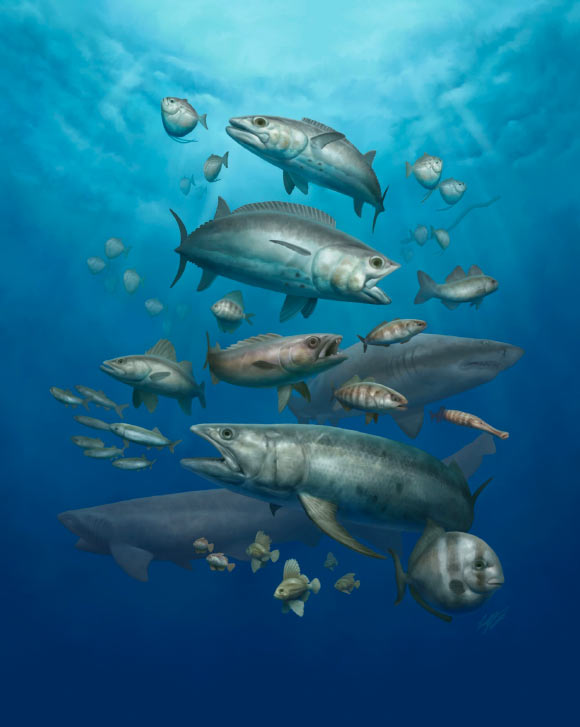
Fish Fossils from Early Paleocene Fill 10-Million-Year Gap after Dinosaur Extinction
Egypt Paleocene fossil Dinosauria extinction
Paleontologists have described an assemblage of marine fish fossils from the 62.2-million-year-old site of Qreiya 3 in the Eastern Desert of Egypt, providing a window into this transition. The post Fish Fossils from Early Paleocene Fill 10-Million-Year Gap after Dinosaur Extinction appeared first on Sci.News: Breaking Science News.
05/06/2026 sci-news