Flora and fauna from each of the twelve periods of the Phanerozoic. From top left: Cambrian, Ordovician, Silurian, Devonian, Carboniferous, Permian, Triassic, Jurassic, Cretaceous, Paleogene, Neogene, and Quaternary species.
Granite of Devonian/Carboniferous age from the Stubai Alps. This rock is on display at the geological public collection of the Alpines Museum in Munich.
Quarry called “Ratssteinbruch” at Plauenscher Grund (gorge-like valley of the river Weißeritz nearby/in the city of Dresden, Saxony, Germany), Upper Carboniferous Monzonite (historically identified as Syenite) of the Meißen Massif (Paleozoic basement) unconformably overlain by Upper Cenomanian beds of the Dölzschen Formation, yellowish basal conglomerate and overlying bluish silty clay-marlstone (“plenus-Pläner”) of the Saxo-Bohemian Cretaceous Basin (Mesozoic platform).[1]
Un remarquable fossile de cœlacanthe de Roundhay Park a été découvert à Leeds. Le fossile a environ 320 millions d'années. Elle date du Carbonifère. En outre, les experts estiment qu’il s’agit du cœlacanthe fossile le plus ancien jamais découvert dans le Yorkshire. Le géologue Ru Smith de la Yorkshire Geological Society a fait la découverte plus tôt cette année. Il a trouvé un bien conservé
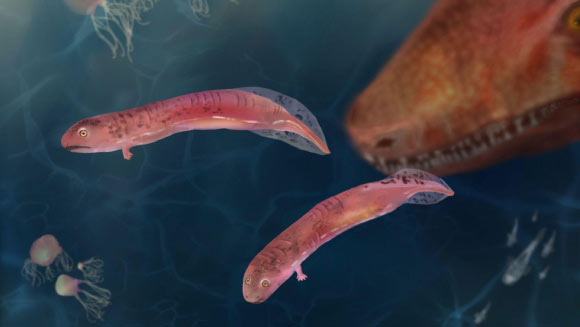
Les paléontologues du Field Museum of Natural History ont décrit les restes fossilisés de bébés embolomères, des prédateurs ressemblant à des crocodiles qui rôdaient dans d'anciennes rivières et marécages il y a entre 350 et 280 millions d'années. L’article Les premiers animaux terrestres de la Terre n’ont peut-être jamais ressemblé à des amphibiens après tout, apparu en premier sur Sci.News : Breaking Science News.