Genus
Valid Extinct

Angaturama

Kellner and Campos 1996

Irritator is a genus of spinosaurid dinosaur that lived in what is now Brazil during the Albian stage of the Early Cretaceous Period, about 113 to 110 million years ago. It is known from a nearly complete skull found in the Romualdo Formation of the Araripe Basin. Fossil dealers had acquired this skull and sold it to the State Museum of Natural History Stuttgart. It was the subject of an ongoing international restitution dispute between Germany and Brazil, until its return to Brazil in 2026. In 1996, the specimen became the holotype of the type species Irritator challengeri. The genus name comes from the word "irritation", reflecting the feelings of paleontologists who found the skull had been heavily damaged and altered by the collectors. The species name is a homage to the fictional character Professor Challenger from Arthur Conan Doyle's novels.

Temporal range
Triassic
Jurassic
Cretaceous
Paleogene
Neogene
252 201 145 66 0 Ma
PBDB occurrences
1
Group
Dinosaures
Carnivore Ground dwelling, solitary Terrestrial
Angaturama
click to enlarge
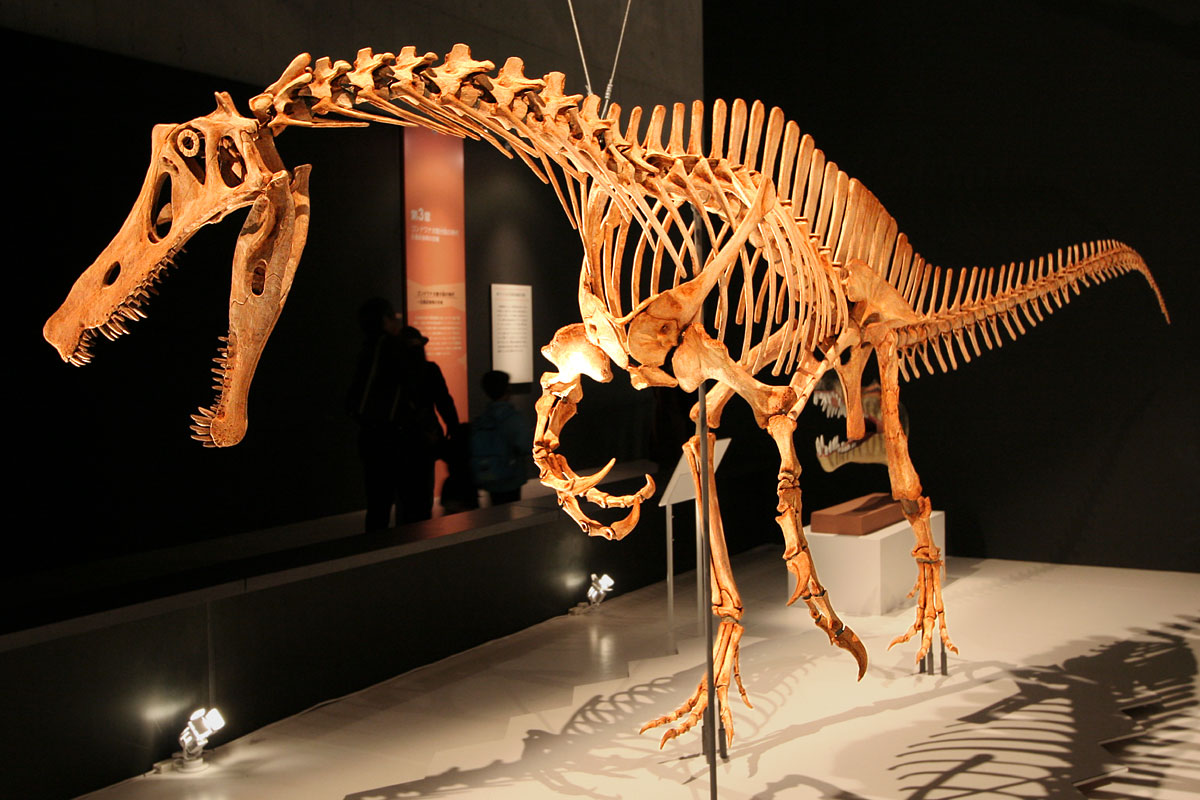
Reconstructed mount of Irritator challengeri (jr synonym = Angaturama) © Kabacchi · CC BY 2.0 · Wikimedia
PBDB Wikipedia
Classification
Dinosauria Unranked clade
Theropoda Unranked clade
Neotheropoda Unranked clade
Averostra Unranked clade
Tetanurae Unranked clade
Megalosauroidea Superfamily
Spinosauridae Family
Spinosaurinae Subfamily
Angaturama Genus
Fossil sites 1 geolocated sites
Distribution
Top countries
🇧🇷 Brazil
1
Geological formations
Temporal distribution
Aptian (121.4–113.2 Ma)
1
Species (1)
Angaturama limai 120 Ma
Bibliography
Original description
A. W. A. Kellner and D. d. A. Campos. 1996. First Early Cretaceous theropod dinosaur from Brazil with comments on Spinosauridae. Neues Jahrbuch für Geologie und Paläontologie, Abhandlungen 199(2):151-166 DOI ↗
Bibliography (1)
A. W. A. Kellner and D. d. A. Campos. 1996. First Early Cretaceous theropod dinosaur from Brazil with comments on Spinosauridae. Neues Jahrbuch für Geologie und Paläontologie, Abhandlungen 199(2):151-166 DOI ↗