Period J

Jurassic

201.4000 – 143.1000 Ma

The Jurassic is a geologic period and stratigraphic system that lasted about 58.3 million years, spanning from the end of the Triassic Period 201.4 Ma to the beginning of the Cretaceous Period, 143.1 Ma. The Jurassic constitutes the second and middle period of the Mesozoic Era as well as the eighth period of the Phanerozoic Eon and is named after the Jura Mountains, where limestone strata from the period were first identified.

← Geological time scale
Jurassic
click to enlarge
© Scotese, Christopher R.; Vérard, Christian; Burgener, Landon; Elling, Reece P.; Kocsis, Ádám T. · CC BY 4.0
Fossil genera 561
1 2 3 4 5 6 7 8 9 10 11 12 13 14 15 16 17 18 19 20 21 22 23 24 25 26 27 28 29 30 31 32 33 34 35 36
News 20
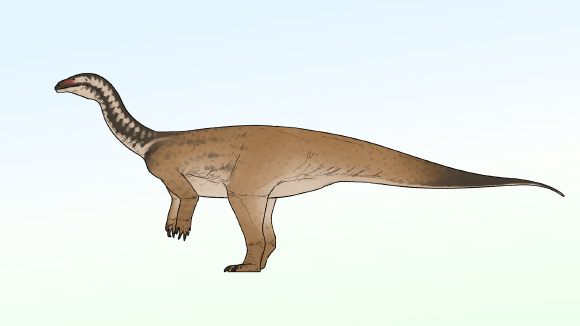
Early Sauropodomorph Dinosaur Unearthed in China
A new genus and species of massopodan sauropodomorph that lived during the Early Jurassic epoch has been identified from a partial skeleton unearthed in southwestern China. The post Early Sauropodomorph Dinosaur Unearthed in China appeared first on Sci.News: Breaking Science News.
04/05/2026 sci-news
Ammonite Model Proves Invaluable When on a Guided Fossil Walk
Lyme Regis is famous for its fossils.  Indeed, thousands of tourists flock to this part of the "Jurassic Coast" on the hunt for fossils. It is sensible to book a fossil walk with an experienced guide. Our chum Brandon Lennon took the guys out from the "All the Gear" YouTube channel for a guided fossil
04/05/2026 everythingdinosaur
190-million-year-old “Sword Dragon” fossil rewrites ichthyosaur history
A newly identified ichthyosaur from the UK’s Jurassic Coast is rewriting part of the prehistoric playbook. Nicknamed the “Sword Dragon of Dorset,” the three-meter-long marine reptile lived during a poorly understood window of evolution when major ichthyosaur groups were disappearing and new ones emerging. Its beautifully preserved skeleton — complete with a blade-like snout and possible last meal — helps pinpoint when this dramatic transition occurred.
24/02/2026 sciencedaily
Torvosaurus: Beast of the Week
Today we are going to look at a huge Jurassic predatory dinosaur, Torvosaurus tanneri!  Torvosaurus lived about 150 million years ago during the Late Jurassic period. Its bones have been unearthed in Colorado, USA, Portugal, and possibly Germany (Europe and North America were not as vastly separated back then, remember, so a lot of the dinosaurs on each of them from that time shared recent ancestors).  From nose to tail it measured up to 36 feet (about 11m) and would have been among the largest,
08/02/2026 prehistoricbeastoftheweek
Baby dinosaurs were the backbone of the Jurassic food chain
Despite growing into the largest animals ever to walk on land, sauropods began life small, exposed, and alone. Fossil evidence suggests their babies were frequently eaten by multiple predators, making them a key part of the Jurassic food chain. This steady supply of easy prey may explain why early predators thrived without needing extreme hunting adaptations. The findings offer a rare glimpse into how dinosaur ecosystems truly worked.
02/02/2026 sciencedaily
1 2 3 4
Parent interval
Mesozoic Era
Sub-intervals 3
Early Jurassic
201.4000 – 174.7000
Middle Jurassic
174.7000 – 161.5000
Late Jurassic
161.5000 – 143.1000