empreintes

Nature du spécimen

18 image(s) · 12 Actualités

Galerie d'images

Morphological variation in the Deltapodus ibericus holotype trackway from the CT-1 tracksite. (a) False-color depth maps and interpretative outline drawings of a selection of manus–pes sets within the trackway. Note the variation in manus (from crescent, kidney to semicircular shapes) and pes (reversed delta, semirectangular, and oval shapes) tracks depending on the manus–pes set. Note also that some manus are overprinted by the pes. (b) Mediotype of the pes impressions based on 4 specimens with a mean footprint length of 0.48 m. Note that the morphology of the posterior part of the print is slightly biased (more quadrangular) because this area in track 1CA17p is broken. (c) Mediotype of the manus impressions based on 2 specimens with a mean footprint width of 0.37 m. (d–f) Pictures of a selection of the best-preserved tracks (manus–pes set 1CA23, pes 1CA17p and manus 1CA3m). The false color depth maps were generated with the software CloudCompare (https://www.cloudcompare.org/) and the mediotypes with the software DigTrace (https://www.digtrace.co.uk/).
Taxons Deltapodus

Morphological variation in the Deltapodus ibericus holotype trackway from the CT-1 tracksite. (a) False-color depth maps and interpretative outline drawings of a selection of manus–pes sets within the trackway. Note the variation in manus (from crescent, kidney to semicircular shapes) and pes (reversed delta, semirectangular, and oval shapes) tracks depending on the manus–pes set. Note also that some manus are overprinted by the pes. (b) Mediotype of the pes impressions based on 4 specimens with a mean footprint length of 0.48 m. Note that the morphology of the posterior part of the print is slightly biased (more quadrangular) because this area in track 1CA17p is broken. (c) Mediotype of the manus impressions based on 2 specimens with a mean footprint width of 0.37 m. (d–f) Pictures of a selection of the best-preserved tracks (manus–pes set 1CA23, pes 1CA17p and manus 1CA3m). The false color depth maps were generated with the software CloudCompare (https://www.cloudcompare.org/) and the mediotypes with the software DigTrace (https://www.digtrace.co.uk/).

dessin holotype spécimen empreintes +1
Caririchnium leonardii - dinosaur track from the Cretaceous of Colorado, USA. (replica; public display, Red Rocks Amphitheater visitor center, west of Denver, Colorado, USA)
Dinosaur Ridge, Colorado has numerous dinosaur fossils, including bones and tracks.  The most common track type at the site is Caririchnium leonardii, which was made by an iguanodontid dinosaur.  The large, wide, three-toed print was produced by a hindfoot.
Stratigraphy: Dakota Sandstone, upper Lower Cretaceous

Provenance: eastern side of Dinosaur Ridge, Dakota Hogback, west of Denver, north-central Colorado, USA
Taxons Caririchnium

Caririchnium leonardii - dinosaur track from the Cretaceous of Colorado, USA. (replica; public display, Red Rocks Amphitheater visitor center, west of Denver, Colorado, USA) Dinosaur Ridge, Colorado has numerous dinosaur fossils, including bones and tracks. The most common track type at the site is Caririchnium leonardii, which was made by an iguanodontid dinosaur. The large, wide, three-toed print was produced by a hindfoot. Stratigraphy: Dakota Sandstone, upper Lower Cretaceous Provenance: eastern side of Dinosaur Ridge, Dakota Hogback, west of Denver, north-central Colorado, USA

os États-Unis Denver Crétacé +6
Moyeni dinosaur tracks.

Photographs of plaster casts (positives) of Grallator track 6 (A) and Anomoepus track 8 (B) made at the Moyeni tracksite by the authors. Tracks are shown at the same scale (10 cm), and hatching pattern indicates broken surfaces. The Grallator hind foot print was made by pedal digits II–IV; the trackmaker's phalangeal formula was 3–4–5. Digits I and V did not contact the substrate. The rugose texture surrounding the print is the algal mat. The Anomoepus manus–pes couple registers all five manual digits (i–v), four pedal digits (I–IV), the metatarsus (mt), and toe drag marks (dm). Additional structures to the left of the pes are incidental marks made by a different trackmaker.
Taxons Anomoepus

Moyeni dinosaur tracks. Photographs of plaster casts (positives) of Grallator track 6 (A) and Anomoepus track 8 (B) made at the Moyeni tracksite by the authors. Tracks are shown at the same scale (10 cm), and hatching pattern indicates broken surfaces. The Grallator hind foot print was made by pedal digits II–IV; the trackmaker's phalangeal formula was 3–4–5. Digits I and V did not contact the substrate. The rugose texture surrounding the print is the algal mat. The Anomoepus manus–pes couple registers all five manual digits (i–v), four pedal digits (I–IV), the metatarsus (mt), and toe drag marks (dm). Additional structures to the left of the pes are incidental marks made by a different trackmaker.

écaille moulage empreintes Anomoepus +3
Moyeni dinosaur tracks.

Photographs of plaster casts (positives) of Grallator track 6 (A) and Anomoepus track 8 (B) made at the Moyeni tracksite by the authors. Tracks are shown at the same scale (10 cm), and hatching pattern indicates broken surfaces. The Grallator hind foot print was made by pedal digits II–IV; the trackmaker's phalangeal formula was 3–4–5. Digits I and V did not contact the substrate. The rugose texture surrounding the print is the algal mat. The Anomoepus manus–pes couple registers all five manual digits (i–v), four pedal digits (I–IV), the metatarsus (mt), and toe drag marks (dm). Additional structures to the left of the pes are incidental marks made by a different trackmaker.
Taxons Trisauropodiscus

Moyeni dinosaur tracks. Photographs of plaster casts (positives) of Grallator track 6 (A) and Anomoepus track 8 (B) made at the Moyeni tracksite by the authors. Tracks are shown at the same scale (10 cm), and hatching pattern indicates broken surfaces. The Grallator hind foot print was made by pedal digits II–IV; the trackmaker's phalangeal formula was 3–4–5. Digits I and V did not contact the substrate. The rugose texture surrounding the print is the algal mat. The Anomoepus manus–pes couple registers all five manual digits (i–v), four pedal digits (I–IV), the metatarsus (mt), and toe drag marks (dm). Additional structures to the left of the pes are incidental marks made by a different trackmaker.

écaille moulage empreintes Anomoepus +3
1 2

Actualités

106-Million-Year-Old Pterosaur Footprints Discovered in Korea
Des empreintes de ptérosaures vieilles de 106 millions d'années découvertes en Corée
Corée du Sud empreintes Neoazhdarchia Pterosauria découverte
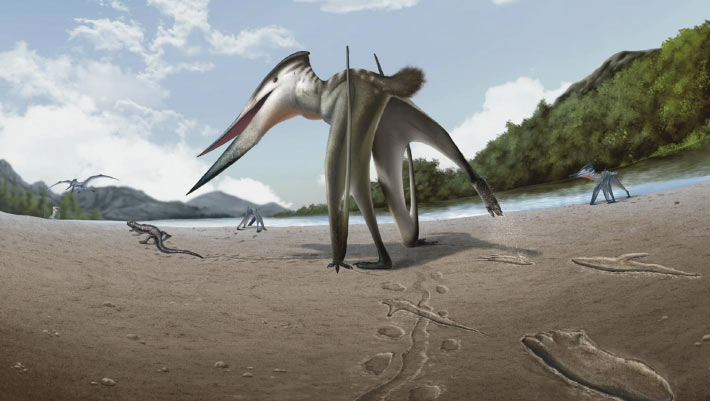
Un ensemble d'empreintes de ptérosaures néoazdarchiens découvertes en Corée du Sud offre un rare aperçu de la façon dont certains des plus grands reptiles volants auraient pu chasser sur terre. L'article Des empreintes de ptérosaures vieilles de 106 millions d'années découvertes en Corée sont apparues en premier sur Sci.News : Breaking Science News.
01/05/2026 sci-news ⚙ Traduction automatique
De superbes traces de dinosaures vieilles de 132 millions d’années réécrivent l’histoire
fossile empreintes Dinosauria découverte
Un mystère de longue date dans les archives fossiles de l’Afrique australe commence à être résolu. Après que des coulées de lave massives, il y a 182 millions d'années, aient semblé effacer les traces de dinosaures dans la région, les scientifiques ont maintenant découvert de nouveaux indices surprenants le long de la côte du Cap occidental. Des dizaines de traces de dinosaures, vieilles d'environ 132 millions d'années, ont été découvertes dans une petite étendue rocheuse près de Knysna, ce qui en fait les plus jeunes jamais découvertes en Afrique australe.
23/04/2026 sciencedaily ⚙ Traduction automatique
Une étude du MIT révèle que les premiers animaux de la Terre étaient probablement d’anciennes éponges de mer
empreintes découverte géologie étude
Les scientifiques du MIT ont trouvé des preuves chimiques convaincantes selon lesquelles les premiers animaux de la Terre étaient probablement d’anciennes éponges marines. Cachées à l’intérieur de roches vieilles de plus de 541 millions d’années se trouvent de rares « empreintes digitales » moléculaires qui correspondent aux composés fabriqués par les démosponges modernes. Après avoir testé des roches, des éponges vivantes et des molécules fabriquées en laboratoire, les chercheurs ont confirmé que les signaux provenaient de la vie et non de la géologie. Cette découverte suggère que les éponges prospéraient dans les océans bien avant l’apparition de la plupart des autres groupes d’animaux.
27/02/2026 sciencedaily-paleo ⚙ Traduction automatique
Cette application d'IA peut déterminer quel dinosaure a laissé une empreinte
fossile empreintes Dinosauria oiseau datation découverte
Les empreintes de dinosaures ont toujours été mystérieuses, mais une nouvelle application d'IA perce leurs secrets. DinoTracker analyse les photos de traces de fossiles et prédit quel dinosaure les a créées, avec une précision rivalisant avec celle des experts humains. En cours de route, il a découvert des empreintes de pas qui ressemblent étonnamment à celles d'un oiseau, remontant à plus de 200 millions d'années. Cette découverte pourrait repousser l’origine des oiseaux bien plus loin dans la préhistoire.
01/02/2026 sciencedaily ⚙ Traduction automatique
De nouvelles empreintes de Néandertal au Portugal révèlent une vie à laquelle nous ne nous attendions pas
chasse Portugal empreintes comportement
Les empreintes conservées sur d’anciennes dunes montrent que les Néandertaliens naviguaient, chassaient et vivaient activement le long du littoral portugais. Leur comportement et leur régime alimentaire suggèrent une population beaucoup plus adaptable et socialement complexe qu’on ne le pensait autrefois.
13/11/2025 sciencedaily-human-evo ⚙ Traduction automatique
1 2 3