peau

Partie anatomique

2 image(s) · 3 Actualités

Galerie d'images

An Ankylosaurus head (cast of specimen AMNH 5214), on display at the Museum of the Rockies in Bozeman, Montana.  This is from a specimen collected in Custer County, Montana.
The Ankylosauria were armored dinosaurs that lived from 122 million years ago to 66 million years ago in western North America, Europe, and East Asia.  There were two subgroups:  The Nodosauridae and Ankylosauridae. 
The Ankylosauridae contained six species, and a single subfamily -- the Ankylosaurinae.  There 18 genus within the subfamily, of which Ankylosaurus is the best known.  Ankylosaurus as the last of these, and lived 65.5 to 66.5 million years ago.
Ankylosaurus was about 20.5 feet long, 5 feet wide, and 5.5 feet tall at the hip.  It walked on all fours, with the rear legs longer than the front ones.  They ripped vegetation, and swallowed it whole.  Their defining feature was their armor.  They body was covered in thick, heavy bony plates, and most of the plates were fused together to make them even stronger.  Embedded in the skin were more knobs of bone, and the outer skin above these knobs covered in keratin (the same stuff fingernails are made of).  Ankylosaurus had a tail club, which consisted of several large osteoderms fused to the last few tail vertebrae.

Ankylosaurus was discovered in 1908.
Taxons Ankylosaurus

An Ankylosaurus head (cast of specimen AMNH 5214), on display at the Museum of the Rockies in Bozeman, Montana. This is from a specimen collected in Custer County, Montana. The Ankylosauria were armored dinosaurs that lived from 122 million years ago to 66 million years ago in western North America, Europe, and East Asia. There were two subgroups: The Nodosauridae and Ankylosauridae. The Ankylosauridae contained six species, and a single subfamily -- the Ankylosaurinae. There 18 genus within the subfamily, of which Ankylosaurus is the best known. Ankylosaurus as the last of these, and lived 65.5 to 66.5 million years ago. Ankylosaurus was about 20.5 feet long, 5 feet wide, and 5.5 feet tall at the hip. It walked on all fours, with the rear legs longer than the front ones. They ripped vegetation, and swallowed it whole. Their defining feature was their armor. They body was covered in thick, heavy bony plates, and most of the plates were fused together to make them even stronger. Embedded in the skin were more knobs of bone, and the outer skin above these knobs covered in keratin (the same stuff fingernails are made of). Ankylosaurus had a tail club, which consisted of several large osteoderms fused to the last few tail vertebrae. Ankylosaurus was discovered in 1908.

armure os peau musée +7
Rebun Island lies in the Sea of Japan off the northwestern tip of Hokkaido and is part of the Rishiri-Rebun-Sarobetsu National Park. Momoiwa ("Peach Rock") was created in a relatively new era of Rebun Island's strata when underground magma pushed the earth's surface upward where it cooled into a huge spherical rock formation. Spheroidal joints (plate-shaped joints on the surface) peeled away like the skin of an onion, revealing the scree, which cooled at a slower rate than the surface, creating the columnar jointing that can be seen.
Intervalles Serravallian

Rebun Island lies in the Sea of Japan off the northwestern tip of Hokkaido and is part of the Rishiri-Rebun-Sarobetsu National Park. Momoiwa ("Peach Rock") was created in a relatively new era of Rebun Island's strata when underground magma pushed the earth's surface upward where it cooled into a huge spherical rock formation. Spheroidal joints (plate-shaped joints on the surface) peeled away like the skin of an onion, revealing the scree, which cooled at a slower rate than the surface, creating the columnar jointing that can be seen.

peau Japon formation

Actualités

125-Million-Year-Old Crocodile Relative Reveals Its True Colors
Un parent de crocodile âgé de 125 millions d'années révèle ses vraies couleurs
écaille peau Espagne Crétacé Crétacé inférieur autres reptiles
La peau exceptionnellement préservée de Montsecosuchus depereti, un crocodylomorphe éteint pas plus gros qu'un chat domestique qui rôdait dans les zones humides tropicales de l'Espagne du Crétacé inférieur, a permis aux paléontologues de reconstituer les détails de ses écailles, de ses organes sensoriels et même d'éventuelles marques en bandes le long de sa queue. L'article Un parent de crocodile âgé de 125 millions d'années révèle ses vraies couleurs est apparu en premier sur Sci.News : Breaking Science News.
18/06/2026 sci-news ⚙ Traduction automatique
Une étude révolutionnaire renforce les arguments en faveur des lèvres chez les dinosaures
peau tissus dent Dinosauria biomécanique étude
Le débat sur les lèvres des dinosaures se poursuit.  La question de savoir si les dinosaures possédaient des tissus extra-oraux reste controversée. Cependant, une nouvelle étude remarquable vient renforcer considérablement l’idée selon laquelle la plupart des dinosaures possédaient des tissus extra-oraux qui recouvraient et protégeaient leurs dents. Une nouvelle étude, publiée dans la revue "Palaeontology", fournit des preuves irréfutables que les lèvres étaient une condition ancestrale
15/06/2026 everythingdinosaur ⚙ Traduction automatique
Derrière le sac en « cuir de T. rex » qui affole les enchères, voici ce que le luxe vend réellement
peau collagène Tyrannosaurus
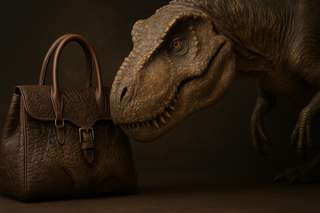
Entre prouesse biotechnologique et storytelling de luxe, un sac à main présenté comme fabriqué en « cuir de T. rex » vient de faire son apparition sur le marché des enchères parisiennes. Affiché à plusieurs centaines de milliers d’euros, l’objet invoque la paléontologie et des fragments de...
12/06/2026 futura-terre