←

Espagne

Pays

16 image(s) · 8 Actualités

Galerie d'images

Aalenian GSSP (Lower-Middle Jurassic boundary). Golden spike ceremony: July, 28th 2016. Fuentelsaz, Guadalajara, Spain
Intervalles Aalenian

Aalenian GSSP (Lower-Middle Jurassic boundary). Golden spike ceremony: July, 28th 2016. Fuentelsaz, Guadalajara, Spain

Espagne Aalénien Jurassique Jurassique moyen
The titanosaurian sauropod Lirainosaurus astibiae Sanz, Powell, Le Loeuff, Martínez, and Pereda Suberbiola, 1999 from the Late Cretaceous of Laño (northern Spain), paratypic braincase (MCNA 7439). Right lateral, left lateral, posterior, and anterior views.
Taxons Lirainosaurus

The titanosaurian sauropod Lirainosaurus astibiae Sanz, Powell, Le Loeuff, Martínez, and Pereda Suberbiola, 1999 from the Late Cretaceous of Laño (northern Spain), paratypic braincase (MCNA 7439). Right lateral, left lateral, posterior, and anterior views.

Espagne Crétacé Crétacé supérieur Lirainosaurus +1
Calvarius is a genus of styracosternan ornithopod from the Late Cretaceous of Spain. The name alludes to its chronostratigraphic proximity to the extinction event that wiped out the non-avian dinosaurs at the end of the Cretaceous. The highly modified metatarsal that is known from shows an example of convergent evolution, as it is more similar to non-iguanodontian ornithopods than to other styracosternans. It is thought that this is due to fulfilling a niche in its island habitat, resulting in Calvarius becoming a small-bodied animal, capable of rapid locomotion.
Taxons Calvarius

Calvarius is a genus of styracosternan ornithopod from the Late Cretaceous of Spain. The name alludes to its chronostratigraphic proximity to the extinction event that wiped out the non-avian dinosaurs at the end of the Cretaceous. The highly modified metatarsal that is known from shows an example of convergent evolution, as it is more similar to non-iguanodontian ornithopods than to other styracosternans. It is thought that this is due to fulfilling a niche in its island habitat, resulting in Calvarius becoming a small-bodied animal, capable of rapid locomotion.

locomotion Espagne Crétacé Crétacé supérieur +6
Qunkasaura is a titanosaurian sauropod dinosaur that lived approximately 75 million years ago in the Late Cretaceous of what is now Spain. Specifically, it is a saltasaurid titanosaur, and its discovery marks the first instance of two distinct lineages of this group present in the same locality. In the Late Cretaceous, Europe was a large archipelago, and the coexistence of these differing lineages indicates that saltasaurids arrived in the Iberian Peninsula much later than other groups of dinosaurs.
Taxons Qunkasaura

Qunkasaura is a titanosaurian sauropod dinosaur that lived approximately 75 million years ago in the Late Cretaceous of what is now Spain. Specifically, it is a saltasaurid titanosaur, and its discovery marks the first instance of two distinct lineages of this group present in the same locality. In the Late Cretaceous, Europe was a large archipelago, and the coexistence of these differing lineages indicates that saltasaurids arrived in the Iberian Peninsula much later than other groups of dinosaurs.

Espagne Crétacé Crétacé supérieur Dinosauria +4
Garumbatitan is a sauropod dinosaur from the Early Cretaceous of what is now Spain. It is classified as a basal somphospondylan - a Titanosauriform, but not a true Titanosaur.
Taxons Garumbatitan

Garumbatitan is a sauropod dinosaur from the Early Cretaceous of what is now Spain. It is classified as a basal somphospondylan - a Titanosauriform, but not a true Titanosaur.

Espagne Crétacé Crétacé inférieur Dinosauria +4
The geological park of Aliaga (Teruel, Spain) is one of the most interesting geological zones of Aragon, a viewpoint of the last 200 million years of Earth's history.
Formations Camarillas

The geological park of Aliaga (Teruel, Spain) is one of the most interesting geological zones of Aragon, a viewpoint of the last 200 million years of Earth's history.

Espagne
Stratigraphy, Tremp Formation in Spain.
Formations La Posa

Stratigraphy, Tremp Formation in Spain.

Espagne formation stratigraphie
Stratigraphy, Tremp Formation in Spain.
Formations Conques

Stratigraphy, Tremp Formation in Spain.

Espagne formation stratigraphie
Left dentary of rebbachisaurid sauropod Demandasaurus darwini
gen. et sp. nov. from Late Barremian–Early Aptian, Early Cretaceous of
Tenadas de los Vallejos II, Spain, MDS−RVII,443, in lateral (A) and dorsal

(B) views. The arrow indicates a depressed area in a dorsolateral position.
Taxons Demandasaurus

Left dentary of rebbachisaurid sauropod Demandasaurus darwini gen. et sp. nov. from Late Barremian–Early Aptian, Early Cretaceous of Tenadas de los Vallejos II, Spain, MDS−RVII,443, in lateral (A) and dorsal (B) views. The arrow indicates a depressed area in a dorsolateral position.

Espagne Aptien Barrémien Crétacé +3
A restoration of Rinconsaurus compared to a human ,

•  Based proportionally on fossil elements and skeletal reconstruction featured in the Rinconsaurus description,[1] with missing parts based on other titanosaur reconstructions. The remains of Rinconsaurus represent two adults and a juvenile all of which are incomplete; some of the proportions shown here, such as the neck, limb lengths, and skull shape are not certain.
•  Osteroderms are not yet known in Rinconsaurus.  The osteoderms shown here are based loosely on Mendozasaurus.[2] Osteoderms are known from at least 10 titanosaur genera spread across the family tree but it's not clear if all titanosaurs had them.[3] Titanosaur osteoderms are rare and their layout and position on the body are not certain. [4]
•  The colours and patterns, as with the majority of reconstructions of prehistoric creatures, are speculative.
•  Human silhouette approximately 180 cm tall.

NOTE: I often update my images. If you want to have any of my images on a website, please (if possible) don’t host/save it to the website server. I’d prefer it if the image's Wikimedia URL is used. This means that if I update an image, it will be updated on the site as well.  Thanks.   


References


↑ Coria, Jorge; B.J.G. Riga (2003). "Rinconsaurus caudamirus gen. et sp nov., a new titanosaurid (Dinosauria, Sauropoda) from the Late Cretaceous of Patagonia, Argentina". Revista Geologica de Chile 30 (2): 333–353. ISSN 0716-0208. Retrieved on 2007-05-21.

↑   González Riga B (2003) A new titanosaur (Dinosauria, Sauropoda) from the Upper Cretaceous of Mendoza, Argentina. Ameghiniana 40 (2) 

↑  Carrano, M.T. and D’Emic, M.D.  2015 'Osteoderms of the titanosaur sauropod dinosaur Alamosaurus sanjuanensis Gilmore, 1922'. Journal of Vertebrate Paleontology.

↑    Vidal D, Ortega F, Sanz JL (2014) Titanosaur Osteoderms from the Upper Cretaceous of Lo Hueco (Spain) and Their Implications on the Armor of Laurasian Titanosaurs. PLoS ONE 9(8): e102488. doi:10.1371/journal.pone.0102488
Taxons Rinconsauria

A restoration of Rinconsaurus compared to a human , • Based proportionally on fossil elements and skeletal reconstruction featured in the Rinconsaurus description,[1] with missing parts based on other titanosaur reconstructions. The remains of Rinconsaurus represent two adults and a juvenile all of which are incomplete; some of the proportions shown here, such as the neck, limb lengths, and skull shape are not certain. • Osteroderms are not yet known in Rinconsaurus. The osteoderms shown here are based loosely on Mendozasaurus.[2] Osteoderms are known from at least 10 titanosaur genera spread across the family tree but it's not clear if all titanosaurs had them.[3] Titanosaur osteoderms are rare and their layout and position on the body are not certain. [4] • The colours and patterns, as with the majority of reconstructions of prehistoric creatures, are speculative. • Human silhouette approximately 180 cm tall. NOTE: I often update my images. If you want to have any of my images on a website, please (if possible) don’t host/save it to the website server. I’d prefer it if the image's Wikimedia URL is used. This means that if I update an image, it will be updated on the site as well. Thanks. References ↑ Coria, Jorge; B.J.G. Riga (2003). "Rinconsaurus caudamirus gen. et sp nov., a new titanosaurid (Dinosauria, Sauropoda) from the Late Cretaceous of Patagonia, Argentina". Revista Geologica de Chile 30 (2): 333–353. ISSN 0716-0208. Retrieved on 2007-05-21. ↑ González Riga B (2003) A new titanosaur (Dinosauria, Sauropoda) from the Upper Cretaceous of Mendoza, Argentina. Ameghiniana 40 (2) ↑ Carrano, M.T. and D’Emic, M.D. 2015 'Osteoderms of the titanosaur sauropod dinosaur Alamosaurus sanjuanensis Gilmore, 1922'. Journal of Vertebrate Paleontology. ↑ Vidal D, Ortega F, Sanz JL (2014) Titanosaur Osteoderms from the Upper Cretaceous of Lo Hueco (Spain) and Their Implications on the Armor of Laurasian Titanosaurs. PLoS ONE 9(8): e102488. doi:10.1371/journal.pone.0102488

armure membre description Argentine +14
A restoration of Rinconsaurus compared to a human ,

•  Based proportionally on fossil elements and skeletal reconstruction featured in the Rinconsaurus description,[1] with missing parts based on other titanosaur reconstructions. The remains of Rinconsaurus represent two adults and a juvenile all of which are incomplete; some of the proportions shown here, such as the neck, limb lengths, and skull shape are not certain.
•  Osteroderms are not yet known in Rinconsaurus.  The osteoderms shown here are based loosely on Mendozasaurus.[2] Osteoderms are known from at least 10 titanosaur genera spread across the family tree but it's not clear if all titanosaurs had them.[3] Titanosaur osteoderms are rare and their layout and position on the body are not certain. [4]
•  The colours and patterns, as with the majority of reconstructions of prehistoric creatures, are speculative.
•  Human silhouette approximately 180 cm tall.

NOTE: I often update my images. If you want to have any of my images on a website, please (if possible) don’t host/save it to the website server. I’d prefer it if the image's Wikimedia URL is used. This means that if I update an image, it will be updated on the site as well.  Thanks.   


References


↑ Coria, Jorge; B.J.G. Riga (2003). "Rinconsaurus caudamirus gen. et sp nov., a new titanosaurid (Dinosauria, Sauropoda) from the Late Cretaceous of Patagonia, Argentina". Revista Geologica de Chile 30 (2): 333–353. ISSN 0716-0208. Retrieved on 2007-05-21.

↑   González Riga B (2003) A new titanosaur (Dinosauria, Sauropoda) from the Upper Cretaceous of Mendoza, Argentina. Ameghiniana 40 (2) 

↑  Carrano, M.T. and D’Emic, M.D.  2015 'Osteoderms of the titanosaur sauropod dinosaur Alamosaurus sanjuanensis Gilmore, 1922'. Journal of Vertebrate Paleontology.

↑    Vidal D, Ortega F, Sanz JL (2014) Titanosaur Osteoderms from the Upper Cretaceous of Lo Hueco (Spain) and Their Implications on the Armor of Laurasian Titanosaurs. PLoS ONE 9(8): e102488. doi:10.1371/journal.pone.0102488
Taxons Rinconsaurus

A restoration of Rinconsaurus compared to a human , • Based proportionally on fossil elements and skeletal reconstruction featured in the Rinconsaurus description,[1] with missing parts based on other titanosaur reconstructions. The remains of Rinconsaurus represent two adults and a juvenile all of which are incomplete; some of the proportions shown here, such as the neck, limb lengths, and skull shape are not certain. • Osteroderms are not yet known in Rinconsaurus. The osteoderms shown here are based loosely on Mendozasaurus.[2] Osteoderms are known from at least 10 titanosaur genera spread across the family tree but it's not clear if all titanosaurs had them.[3] Titanosaur osteoderms are rare and their layout and position on the body are not certain. [4] • The colours and patterns, as with the majority of reconstructions of prehistoric creatures, are speculative. • Human silhouette approximately 180 cm tall. NOTE: I often update my images. If you want to have any of my images on a website, please (if possible) don’t host/save it to the website server. I’d prefer it if the image's Wikimedia URL is used. This means that if I update an image, it will be updated on the site as well. Thanks. References ↑ Coria, Jorge; B.J.G. Riga (2003). "Rinconsaurus caudamirus gen. et sp nov., a new titanosaurid (Dinosauria, Sauropoda) from the Late Cretaceous of Patagonia, Argentina". Revista Geologica de Chile 30 (2): 333–353. ISSN 0716-0208. Retrieved on 2007-05-21. ↑ González Riga B (2003) A new titanosaur (Dinosauria, Sauropoda) from the Upper Cretaceous of Mendoza, Argentina. Ameghiniana 40 (2) ↑ Carrano, M.T. and D’Emic, M.D. 2015 'Osteoderms of the titanosaur sauropod dinosaur Alamosaurus sanjuanensis Gilmore, 1922'. Journal of Vertebrate Paleontology. ↑ Vidal D, Ortega F, Sanz JL (2014) Titanosaur Osteoderms from the Upper Cretaceous of Lo Hueco (Spain) and Their Implications on the Armor of Laurasian Titanosaurs. PLoS ONE 9(8): e102488. doi:10.1371/journal.pone.0102488

armure membre description Argentine +14
From El Plomo, Agua Amarga basin, Mesinnian of southern Spain.

From El Plomo, Agua Amarga basin, Mesinnian of southern Spain.

Espagne
From El Plomo, Agua Amarga basin, Mesinnian of southern Spain.
Intervalles Messinian

From El Plomo, Agua Amarga basin, Mesinnian of southern Spain.

Espagne
Ceratosaurian theropod Camarillasaurus cirugedae gen. et sp. nov. from the Camarillas Formation of Camarillas, Soria Province, Spain, presacral vertebra, MPG-KPC9,  in anterior (A), left lateral (B), and posterior (C) views; possible neural spine tips, MPG1116, 32, 33 in ?posterior (D) and transverse (E) views; and presacral rib MPG-KPC7, in ventral view (F) and detail of its proximal end (G). Scale bars are 10 mm (A-C, G), 20 mm (D-E) and 100 mm (F).

Ceratosaurian theropod Camarillasaurus cirugedae gen. et sp. nov. from the Camarillas Formation of Camarillas, Soria Province, Spain, presacral vertebra, MPG-KPC9, in anterior (A), left lateral (B), and posterior (C) views; possible neural spine tips, MPG1116, 32, 33 in ?posterior (D) and transverse (E) views; and presacral rib MPG-KPC7, in ventral view (F) and detail of its proximal end (G). Scale bars are 10 mm (A-C, G), 20 mm (D-E) and 100 mm (F).

écaille vertèbre Espagne Camarillas +3
Detail of the stratigraphic section of the El Castellar dinosaur footprints site, Teruel, Spain.

Detail of the stratigraphic section of the El Castellar dinosaur footprints site, Teruel, Spain.

Espagne El Castellar Dinosauria
Dryolestidan mammal Crusafontia amoae sp. nov., MPZ CC2−1 M4 or M5, holotype, from the site of Cuesta Corrales 2, Colladico Blanco level, El Castellar Formation, Galve, Teruel, Spain in, occlusal (A), mesial (B), labial (C), distal (D), and lingual (E) views. The schematic drawing of C. amoae, in the box in the lower left−hand corner shows the main anatomical elements of the occlusal surface of a dryolestidan.
Formations El Castellar

Dryolestidan mammal Crusafontia amoae sp. nov., MPZ CC2−1 M4 or M5, holotype, from the site of Cuesta Corrales 2, Colladico Blanco level, El Castellar Formation, Galve, Teruel, Spain in, occlusal (A), mesial (B), labial (C), distal (D), and lingual (E) views. The schematic drawing of C. amoae, in the box in the lower left−hand corner shows the main anatomical elements of the occlusal surface of a dryolestidan.

dessin Espagne El Castellar holotype +1

Actualités

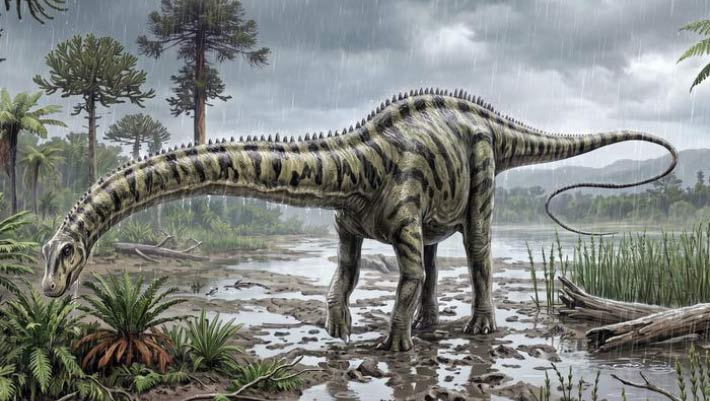
Des scientifiques découvrent le premier diplodocus jamais découvert en dehors de l'Amérique du Nord
os Espagne Jurassique Jurassique supérieur fossile Dinosauria Diplodocia
Un fossile de dinosaure vieux de 150 millions d'années provenant d'Espagne a été identifié comme le premier Diplodocus confirmé jamais découvert en dehors de l'Amérique du Nord. Le sauropode géant mesurait environ 25 mètres de long et était suffisamment bien conservé pour que les chercheurs puissent associer les caractéristiques distinctives de ses os de la queue au célèbre genre. Son apparition inattendue en Europe suggère que les dinosaures se déplaçaient entre les continents à la fin du Jurassique, peut-être via des connexions terrestres temporaires.
19/09/2026 sciencedaily ⚙ Traduction automatique
Une découverte passionnante de fossiles fournit la première preuve définitive de Diplodocus en Europe
vertèbre Espagne fossile Dinosauria Diplodocia Diplodocus découverte étude
La découverte de Diplodocus en Europe a été confirmée suite à l'étude de fossiles de sauropodes de l'est de l'Espagne. Quatorze vertèbres caudales et plusieurs chevrons de Teruel ont été attribués au genre emblématique Diplodocus. Il s'agit de la première preuve définitive de l'existence de ce célèbre dinosaure en dehors de l'Amérique du Nord. Les fossiles proviennent du site de La Tejería
17/09/2026 everythingdinosaur ⚙ Traduction automatique
Spanish Amber Deposit Offers Rare Window into Cretaceous Life
Le gisement d'ambre espagnol offre une rare fenêtre sur la vie du Crétacé
Espagne Crétacé fossile
El Soplao, un site fossile niché dans les collines de Cantabrie, dans le nord de l'Espagne, se distingue par la production de morceaux d'ambre avec une teinte bleu-violet et d'abondantes bioinclusions, selon un nouvel article de synthèse. Le post Le gisement d'ambre espagnol offre une fenêtre rare sur la vie du Crétacé apparaît en premier sur Sci.News : Breaking Science News.
14/09/2026 sci-news ⚙ Traduction automatique
Diplodocus, Long Thought Exclusively American, Turns Up in Spain
Diplodocus, longtemps considéré comme exclusivement américain, débarque en Espagne
Espagne fossile Diplodocia Diplodocus
Les paléontologues de la Fundación Dinópolis ont identifié les premiers fossiles confirmés du genre Diplodocus trouvés en dehors de l'Amérique du Nord. L'article Diplodocus, longtemps pensé exclusivement américain, apparaît en Espagne en premier sur Sci.News : Breaking Science News.
14/09/2026 sci-news ⚙ Traduction automatique
125-Million-Year-Old Crocodile Relative Reveals Its True Colors
Un parent de crocodile âgé de 125 millions d'années révèle ses vraies couleurs
écaille peau Espagne Crétacé Crétacé inférieur autres reptiles
La peau exceptionnellement préservée de Montsecosuchus depereti, un crocodylomorphe éteint pas plus gros qu'un chat domestique qui rôdait dans les zones humides tropicales de l'Espagne du Crétacé inférieur, a permis aux paléontologues de reconstituer les détails de ses écailles, de ses organes sensoriels et même d'éventuelles marques en bandes le long de sa queue. L'article Un parent de crocodile âgé de 125 millions d'années révèle ses vraies couleurs est apparu en premier sur Sci.News : Breaking Science News.
18/06/2026 sci-news ⚙ Traduction automatique
1 2