skin

Anatomical part

2 image(s) · 3 News

Image gallery

An Ankylosaurus head (cast of specimen AMNH 5214), on display at the Museum of the Rockies in Bozeman, Montana.  This is from a specimen collected in Custer County, Montana.
The Ankylosauria were armored dinosaurs that lived from 122 million years ago to 66 million years ago in western North America, Europe, and East Asia.  There were two subgroups:  The Nodosauridae and Ankylosauridae. 
The Ankylosauridae contained six species, and a single subfamily -- the Ankylosaurinae.  There 18 genus within the subfamily, of which Ankylosaurus is the best known.  Ankylosaurus as the last of these, and lived 65.5 to 66.5 million years ago.
Ankylosaurus was about 20.5 feet long, 5 feet wide, and 5.5 feet tall at the hip.  It walked on all fours, with the rear legs longer than the front ones.  They ripped vegetation, and swallowed it whole.  Their defining feature was their armor.  They body was covered in thick, heavy bony plates, and most of the plates were fused together to make them even stronger.  Embedded in the skin were more knobs of bone, and the outer skin above these knobs covered in keratin (the same stuff fingernails are made of).  Ankylosaurus had a tail club, which consisted of several large osteoderms fused to the last few tail vertebrae.

Ankylosaurus was discovered in 1908.
Taxa Ankylosaurus

An Ankylosaurus head (cast of specimen AMNH 5214), on display at the Museum of the Rockies in Bozeman, Montana. This is from a specimen collected in Custer County, Montana. The Ankylosauria were armored dinosaurs that lived from 122 million years ago to 66 million years ago in western North America, Europe, and East Asia. There were two subgroups: The Nodosauridae and Ankylosauridae. The Ankylosauridae contained six species, and a single subfamily -- the Ankylosaurinae. There 18 genus within the subfamily, of which Ankylosaurus is the best known. Ankylosaurus as the last of these, and lived 65.5 to 66.5 million years ago. Ankylosaurus was about 20.5 feet long, 5 feet wide, and 5.5 feet tall at the hip. It walked on all fours, with the rear legs longer than the front ones. They ripped vegetation, and swallowed it whole. Their defining feature was their armor. They body was covered in thick, heavy bony plates, and most of the plates were fused together to make them even stronger. Embedded in the skin were more knobs of bone, and the outer skin above these knobs covered in keratin (the same stuff fingernails are made of). Ankylosaurus had a tail club, which consisted of several large osteoderms fused to the last few tail vertebrae. Ankylosaurus was discovered in 1908.

armor bone skin museum +7
Rebun Island lies in the Sea of Japan off the northwestern tip of Hokkaido and is part of the Rishiri-Rebun-Sarobetsu National Park. Momoiwa ("Peach Rock") was created in a relatively new era of Rebun Island's strata when underground magma pushed the earth's surface upward where it cooled into a huge spherical rock formation. Spheroidal joints (plate-shaped joints on the surface) peeled away like the skin of an onion, revealing the scree, which cooled at a slower rate than the surface, creating the columnar jointing that can be seen.
Intervals Serravallian

Rebun Island lies in the Sea of Japan off the northwestern tip of Hokkaido and is part of the Rishiri-Rebun-Sarobetsu National Park. Momoiwa ("Peach Rock") was created in a relatively new era of Rebun Island's strata when underground magma pushed the earth's surface upward where it cooled into a huge spherical rock formation. Spheroidal joints (plate-shaped joints on the surface) peeled away like the skin of an onion, revealing the scree, which cooled at a slower rate than the surface, creating the columnar jointing that can be seen.

skin Japan formation

News

125-Million-Year-Old Crocodile Relative Reveals Its True Colors
scale skin Spain Cretaceous Early Cretaceous other reptiles
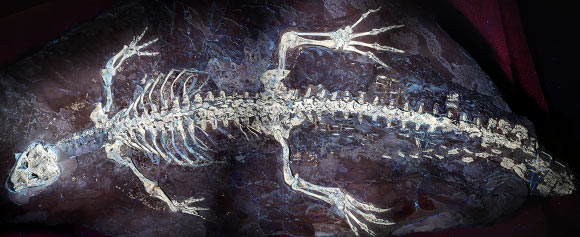
Exceptionally preserved skin of Montsecosuchus depereti, an extinct crocodylomorph no larger than a house cat that prowled the tropical wetlands of Early Cretaceous Spain, has allowed paleontologists to reconstruct details of its scales, sensory organs and even possible banded markings along its tail. The post 125-Million-Year-Old Crocodile Relative Reveals Its True Colors appeared first on Sci.News: Breaking Science News.
18/06/2026 sci-news
Ground-breaking Study Strengthens the Case for Lips in Dinosaurs
skin tissue tooth Dinosauria biomechanics study
The debate about lips in dinosaurs continues.  Whether dinosaurs possessed extraoral tissue remains controversial. However, a remarkable new study has added substantial support to the idea that most dinosaurs possessed extraoral tissues that covered and protected their teeth. A new study, published in the journal "Palaeontology" provides compelling evidence that lips were the ancestral condition
15/06/2026 everythingdinosaur
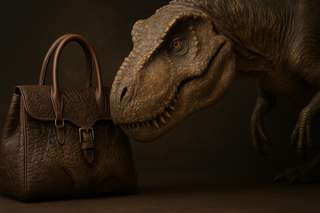
Derrière le sac en « cuir de T. rex » qui affole les enchères, voici ce que le luxe vend réellement
Behind the “T. rex leather” bag that is driving auctions, here’s what luxury really sells
skin collagen Tyrannosaurus
Between biotechnological prowess and luxury storytelling, a handbag presented as made from “T. rex leather” has just appeared on the Parisian auction market. Priced at several hundred thousand euros, the object invokes paleontology and fragments of...
12/06/2026 futura-terre ⚙ Auto-translated