musée

Type de contenu

496 image(s) · 24 Actualités

Galerie d'images

Caudipteryx zoui, Skelett - Untere Kreide - Liaoning/China - aufgenommen im Museum am Löwentor, Stuttgart
Taxons Caudipterygidae

Caudipteryx zoui, Skelett - Untere Kreide - Liaoning/China - aufgenommen im Museum am Löwentor, Stuttgart

musée Chine Caudipterygidae Caudipteryx
The "Big Mama" Citipati osmolskae skeleton (IGM 100/979) on display at the American Museum of Natural History.

The "Big Mama" Citipati osmolskae skeleton (IGM 100/979) on display at the American Museum of Natural History.

musée Citipati squelette
Falcarius skeleton reconstruction, Utah Museum of Natural History.

Falcarius skeleton reconstruction, Utah Museum of Natural History.

musée États-Unis Falcarius squelette
Lourinhanosaurus antunesi in Museum of Lourinhã

Lourinhanosaurus antunesi in Museum of Lourinhã

musée Lourinhã Lourinhanosaurus
Dracovenator on display at the Royal Ontario Museum.

Dracovenator on display at the Royal Ontario Museum.

musée Dracovenator
Achelousaurus horneri skull, collected in Glacier County, Montana, at the Museum of the Rockies in Bozeman, Montana.
The Ceratopsidae are those dinosaurs with head frills.  There are three large subgroups of Ceratopsidae: Centrosaurinae, Ceratopsinae, and Chasmosaurinae. The Triceratopsini are a "tribe" of the Chasmosaurinae -- a genus so vast that it gets the special name "tribe".  The Pachyrhinosaurini are a "tribe" within the Centrosaurinae.

Achelousaurus is a genus within the Pachyrhinosaurini.  So far, only three skulls and some limited skeletal remains have been collected anywhere in the world -- and all of them in Montana.  Their bony frills are quite similar to the Styracosaurus albertensis, although their other skull features (such as big bony bosses on the nose and behind the eyes) are not.

Achelousaurus horneri skull, collected in Glacier County, Montana, at the Museum of the Rockies in Bozeman, Montana. The Ceratopsidae are those dinosaurs with head frills. There are three large subgroups of Ceratopsidae: Centrosaurinae, Ceratopsinae, and Chasmosaurinae. The Triceratopsini are a "tribe" of the Chasmosaurinae -- a genus so vast that it gets the special name "tribe". The Pachyrhinosaurini are a "tribe" within the Centrosaurinae. Achelousaurus is a genus within the Pachyrhinosaurini. So far, only three skulls and some limited skeletal remains have been collected anywhere in the world -- and all of them in Montana. Their bony frills are quite similar to the Styracosaurus albertensis, although their other skull features (such as big bony bosses on the nose and behind the eyes) are not.

musée États-Unis Achelousaurus Centrosaurinae +8
Skull cast of Liaoceratops yanzigouensis on display at the Baoding Natural History Museum.

Skull cast of Liaoceratops yanzigouensis on display at the Baoding Natural History Museum.

musée moulage Liaoceratops crâne
Photo of a skeletal mount of the incomplete holotype of the pachycephalosaur Homalocephale calathocercos in left lateral view, at the Mongolian Natural History Museum. Scan of physical photograph.
Taxons Homalocephale

Photo of a skeletal mount of the incomplete holotype of the pachycephalosaur Homalocephale calathocercos in left lateral view, at the Mongolian Natural History Museum. Scan of physical photograph.

musée holotype Homalocephale Homalocephalidae +1
Photo of a skeletal mount of the incomplete holotype of the pachycephalosaur Homalocephale calathocercos in left lateral view, at the Mongolian Natural History Museum. Scan of physical photograph.
Taxons Homalocephalidae

Photo of a skeletal mount of the incomplete holotype of the pachycephalosaur Homalocephale calathocercos in left lateral view, at the Mongolian Natural History Museum. Scan of physical photograph.

musée holotype Homalocephale Homalocephalidae +1
Photo: mounted skeleton of Qantassaurus intrepidus at the Australian Museum, Sydney.
Taxons Qantassaurus

Photo: mounted skeleton of Qantassaurus intrepidus at the Australian Museum, Sydney.

musée Qantassaurus squelette
Holotype skull of Augustynolophus morrisi (LACM 2852) on display at the Natural History Museum of Los Angeles County.
Taxons Augustynolophus

Holotype skull of Augustynolophus morrisi (LACM 2852) on display at the Natural History Museum of Los Angeles County.

musée holotype Augustynolophus crâne
Figure 1, 1a. Outer and oral aspects of the imperfect dentary bone of Sarcolestes Leedsi, from the Oxford Clay of Peterborough. 2/3 nat size. s = symphysis. Figure 1b. A single tooth of the former. 3/1 nat size. Figure 2, 2a. Outer aspect and quadratic cavity of the hinder region of the same jaw. 2/3 nat size. Figure 3. A single tooth of Priodontognathus Phillipsi, 3/1 nat size, shown for purposes of comparison. Specimen in the Woodwardian Museum, Cambridge.

Figure 1, 1a. Outer and oral aspects of the imperfect dentary bone of Sarcolestes Leedsi, from the Oxford Clay of Peterborough. 2/3 nat size. s = symphysis. Figure 1b. A single tooth of the former. 3/1 nat size. Figure 2, 2a. Outer aspect and quadratic cavity of the hinder region of the same jaw. 2/3 nat size. Figure 3. A single tooth of Priodontognathus Phillipsi, 3/1 nat size, shown for purposes of comparison. Specimen in the Woodwardian Museum, Cambridge.

os dent musée Oxford Clay +3
Skeletal mount of Gobisaurus domoculus on display at the Baoding Natural History Museum.

Skeletal mount of Gobisaurus domoculus on display at the Baoding Natural History Museum.

musée Gobisaurus
The holotype humerus (bottom) and coracoid (top) of Texasetes pleurohalio (USNM PAL337987)

The holotype humerus (bottom) and coracoid (top) of Texasetes pleurohalio (USNM PAL337987)

humérus musée holotype Texasetes
Datousaurus. Fossil in Shanghai Science & Technology Museum

Datousaurus. Fossil in Shanghai Science & Technology Museum

musée fossile Datousaurus
historická budova Národního muzea v Praze - západní dvorana s proskleným stropem a kostrou dinosaura / historic building of the National Museum in Prague - West hall with glass ceiling and dinosaur skeleton
location: Prague, Czech Republic
author: Jan Helebrant
www.juhele.blogspot.com

license CC0 Public Domain Dedication

historická budova Národního muzea v Praze - západní dvorana s proskleným stropem a kostrou dinosaura / historic building of the National Museum in Prague - West hall with glass ceiling and dinosaur skeleton location: Prague, Czech Republic author: Jan Helebrant www.juhele.blogspot.com license CC0 Public Domain Dedication

musée Tchéquie Amargasaurus Dinosauria +1
1 2 3 4 5 6 7 8 9 10 11 12 13 14 15 16 17 18 19 20 21 22 23 24 25 26 27 28 29 30 31

Actualités

L'évolution des yeux d'araignée explorée dans une nouvelle étude
chasse musée anatomie évolution étude
Une nouvelle étude scientifique a fourni des informations fascinantes sur l’évolution des yeux d’araignée. Une équipe internationale de chercheurs a découvert que les araignées chasseuses évoluaient indépendamment dans la disposition de leurs yeux orientés vers l'avant. L'étude, dirigée par Atal Pande du Museum für Naturkunde Berlin, démontre que les systèmes visuels des araignées sont très flexibles. Leurs yeux peuvent évoluer séparément
07/07/2026 everythingdinosaur ⚙ Traduction automatique
Un nouveau projet de recherche sur les collections coloniales examine des spécimens de musée du Togo et du Ghana
musée Ghana Togo spécimen étude
Un nouveau projet de recherche sur les collections coloniales a été lancé avec la participation de plusieurs grands musées berlinois. Les chercheurs étudieront les origines et l’histoire d’importantes collections d’histoire naturelle et culturelles rassemblées pendant la période coloniale allemande. Pour la première fois, des institutions berlinoises travaillent ensemble pour étudier les collections liées à l'ancienne colonie allemande du Togo. À
04/07/2026 everythingdinosaur ⚙ Traduction automatique
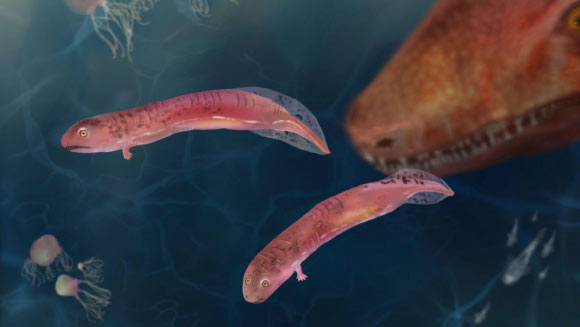
Earth’s First Land Animals May Never Have Been Amphibian-Like After All
Les premiers animaux terrestres de la Terre n’ont peut-être jamais ressemblé à des amphibiens après tout
prédateur musée Carbonifère évolution
Les paléontologues du Field Museum of Natural History ont décrit les restes fossilisés de bébés embolomères, des prédateurs ressemblant à des crocodiles qui rôdaient dans d'anciennes rivières et marécages il y a entre 350 et 280 millions d'années. L’article Les premiers animaux terrestres de la Terre n’ont peut-être jamais ressemblé à des amphibiens après tout, apparu en premier sur Sci.News : Breaking Science News.
19/06/2026 sci-news ⚙ Traduction automatique
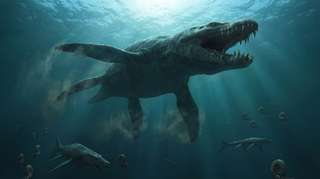
On le croyait roi des océans au Jurassique : une vertèbre percée raconte un combat d’une violence extrême
os dent vertèbre chasse musée Jurassique fossile Ichthyosauria Ichthyosaurus Pliosaurus comportement
Oublié pendant plus d’un siècle dans les tiroirs d’un musée, un fossile refait aujourd’hui surface et raconte une scène de violence extrême dans les océans du Jurassique. Une vertèbre d’ichtyosaure, marquée par l’impact d’une dent brisée, révèle peut-être l’attaque d’un des plus redoutables...
17/06/2026 futura-terre
Un superbe crâne de théropode exposé
musée fossile Tyrannosaurus crâne
Lors d'une visite au Museum für Naturkunde (Berlin) nous en avons profité pour photographier le magnifique crâne de Tristan le Tyrannosaurus rex.  Le crâne est l’un des crânes de tyrannosaure les plus complets et les mieux conservés connus de la science.  Les fossiles de T. rex, exposés à côté du crâne, ont été nommés Tristan Otto.  À
12/06/2026 everythingdinosaur ⚙ Traduction automatique
1 2 3 4 5