Archaeopteryx
Taxon16 image(s) · 2 Actualités
Voir la ficheGalerie d'images

Wellnhoferia_grandis, Jura-Museum Eichstätt, eigene Gattung, ursprünglich als Archaeopteryx beschrieben


Six exemplar coelurosaurs (clockwise from top left): Tyrannosaurus rex, Sinosauropteryx prima, Deinonychus antirrhopus, Archaeopteryx lithographica, an undescribed crested oviraptorid, and Passer domesticus. This is a collection of six different works which have been previously published on Wikimedia Commons (see source field below).

Archaeopteryx lithographica, specimen displayed at the Museum für Naturkunde in Berlin. (This image shows the original fossil - not a cast.)

The "dromaeo-avemorphs", as they are informally known (Paul, 2002), represent a group of early paravian theropods with asymmetrical feathers and an Archaeopteryx-like body. According to Hartman et al. (2019), the animals shown in this image might, together, form a clade (monophyletic group) without modern birds.

Archaeopteryx, Romanian stamp from 1993

Diagram illustrating the "Temporal paradox" in paleontology. First given it's nickname by Alan Feduccia, the paradox is made up by the fact that almost all feathered dinosaurs are dated to have lived millions of years after Archaeopteryx, the oldest bird (late Jurassic, believed to have existed about 150 million years ago). Only a few of the feathered dinosaurs/birdlike dinosaurs are given an older date than Archaeopteryx.

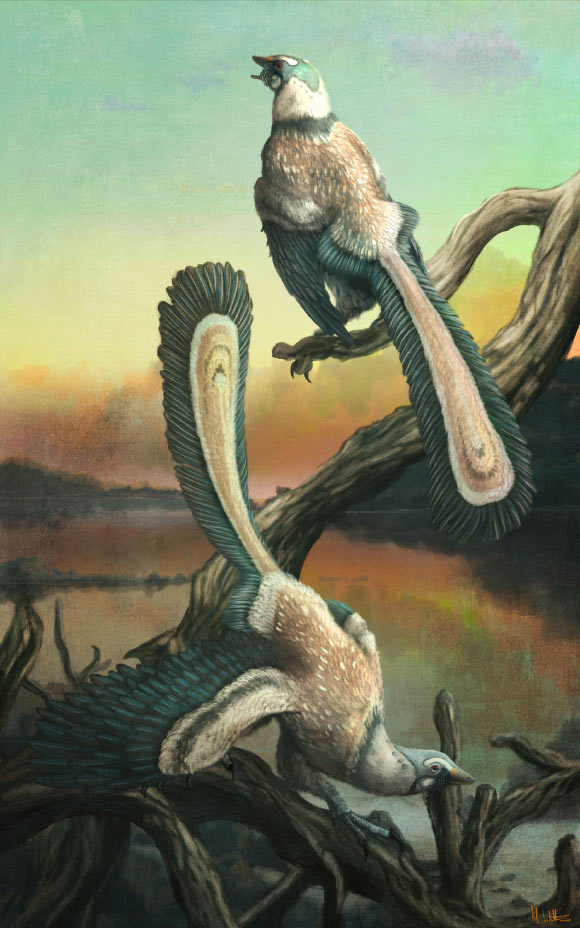
Composite figure of various feathered maniraptorans: Archaeopteryx, Anchiornis, Microraptor and Zhenyuanlong

Diagram made to illustrate the debate over the hands of theropod dinosaurs and their alleged descendants, the birds ( Aves ). In the last years, the difference between the hands of theropods and birds have been an important thing when it comes question the theory that birds evolved from dinosaurs, even though some scientists may could refute it. In the diagram, a Neotheropoda ( 1 ), basal tetanurae ( 2 ), a coelurosaurian ( 3 ), the bird (?)Archaeopteryx ( 4 ) and modern bird ( 5 ). In 1997, birdexpert Alan Feduccia at University of North Carolina discovered that birds develop hands with the digits II, III and IV ( see The Cincinnati Enquirer, 25 - 10 - 1997 ). This is in contrast with the hands of tetanurae, which seems to have the digits I, II and III. This make it almost impossible for dinosaurs and birds to be closely related, according to Feduccia. Since the discovery by Feduccia, scientific research have came up with a possible explanation to the mystery of the dinosaur - bird hand difference, called The frame shift hypothesis ( see http://scienceblogs.com/tetrapodzoology/2009/06/limusaurus_is_awesome.php ). This hypothesis is based on a discovery which shows that although bird embryos develop the fingers II, III and IV, the genes which is coding for the external appearance of the digits seems to be from the fingers I, II and III. Based on this, scientists belive this: when neotheropods evolved into tetanurae, the losed digit I ( not digit IV, as earlier suggested ). During this process, the genes which coded for how the digits should looks like ( the number of phalanges, for example ) became refurnished ( see the color spots in th upper section in the diagram to understan ). The discovery of Limusaurus has been said to support this theory ( see https://www.livescience.com/animals/090617-dinosaur-hands.html ). One thing is that may can be used to refute that Limusaurus should support the Frame shift hypothesis is that Limusaurus was a ceratosaurian, and is dated to be much younger than the oldest tetanurae's. Also, some tetanure´s may had 4 digits' like the Archaeornithomimus ( see number 4 in the diagram ) ( see also http://dml.cmnh.org/1998Oct/msg00443.html and the Allosaurus hand in the image here: http://upload.wikimedia.org/wikipedia/commons/6/69/Allosaurus-mounted.jpg ). If this is the digits I, II, III and IV. If so, it shows that tetanurae had the digits I, II and III, and not II, II and IV, like birds. For more in this debate, see text section to my picture Raptor-Archaeopteryx-bird hands differens.JPG at http://commons.wikimedia.org/wiki/File:Raptor-Archaeopteryx-bird_hands_differens.JPG.

*Row 1: Sinosauropteryx prima, Cryolophosaurus ellioti, Vultur gryphus Row 2: Gypaetus barbatus, Concavenator corcovatus, Carnotaurus sastrei Row 3: Deinocheirus mirificus & Tarbosaurus bataar, Balaeniceps rex, Archaeopteryx lithographica & Compsognathus longipes Row 4: Anchiornis huxleyi, Dakotaraptor steini & Ornithomimus, Nanuqsaurus hoglundi, Passer domesticus Row 5: Spinosaurus aegyptiacus, Bubo scandiacus & Anas rubripes, Coelophysis kayentakatae

The Chicago specimen of Archaeopteryx (PA 830), a well-preserved fossil highlighting the transitional features between non-avian dinosaurs and birds, housed at the Field Museum of Natural History.
![This diagram illustrates how scientists believe the dinosaur group theropoda shall be classed in a phylogenetic tree, besides Sauropoda and Pterosauria. The main reason of this diagram is to show groups or families which had respiratory system like birds. AS in the diagram is abbreviations for "Airsacs", and ASW means "AirSacs supported by immobile femur and a knee-driven Walk". BL means "Bellow lungs".
Airsacs are known in many different theropods, as well as in birds, which most scientists believe are descendants of dinosaurus. Air sacs are found in the primitive Tawa hallae,[1] the abelisaurid Majungasaurus,[2] as well as Allosauroids like Aerosteon.[3] There is also evidence for respiratory systems like penguinss in Deinonychosaurians.[4] The primitive bird Archaeopteryx also had airsacs (Bonde and Christiansen, 2000).
It is very likely that Deinonychosaurians had airsacs. We don't know whether Deinonychosauria had a walking/breathing system with immobile thighbones, ASW (like birds) or movable thighbones. However, some people suggsest coeluosaurs had the same type of leg movement as birds ("kneedriven walking").[5]
Bellow lungs are lungs like our own, which alternately is filled with air, and thereafter emptied, after which you take a new breath. This type of lungs exist in mammals, most reptiles, and most amphibians (although some frogs get their oxygen through the skin). There is no evidence for airsacs in Ornithischia, so the likely had bellow lungs.
References.=
↑ (see the video at http://www.nsf.gov/news/special_reports/tawa/)
↑ (Claessens & O'connor, 2006).
↑ Alcober O.A, Sereno P.C, Larsson H.C.E et.al (2008), "Evidence for Avian Intrathoracic Air Sacs in a New Predatory Dinosaur from Argentina", Public Library of Science Journals.
↑ http://www.stumbleupon.com/su/20q5Z4/news.bbc.co.uk/2/hi/science/nature/7081166.stm
↑ http://www.geol.umd.edu/~tholtz/G104/lectures/104coelur.html.](https://upload.wikimedia.org/wikipedia/commons/thumb/f/f3/Phylogenetic_tree_of_Theropods_respiratory_system_01.JPG/960px-Phylogenetic_tree_of_Theropods_respiratory_system_01.JPG?utm_source=commons.wikimedia.org&utm_campaign=imageinfo&utm_content=thumbnail)
This diagram illustrates how scientists believe the dinosaur group theropoda shall be classed in a phylogenetic tree, besides Sauropoda and Pterosauria. The main reason of this diagram is to show groups or families which had respiratory system like birds. AS in the diagram is abbreviations for "Airsacs", and ASW means "AirSacs supported by immobile femur and a knee-driven Walk". BL means "Bellow lungs". Airsacs are known in many different theropods, as well as in birds, which most scientists believe are descendants of dinosaurus. Air sacs are found in the primitive Tawa hallae,[1] the abelisaurid Majungasaurus,[2] as well as Allosauroids like Aerosteon.[3] There is also evidence for respiratory systems like penguinss in Deinonychosaurians.[4] The primitive bird Archaeopteryx also had airsacs (Bonde and Christiansen, 2000). It is very likely that Deinonychosaurians had airsacs. We don't know whether Deinonychosauria had a walking/breathing system with immobile thighbones, ASW (like birds) or movable thighbones. However, some people suggsest coeluosaurs had the same type of leg movement as birds ("kneedriven walking").[5] Bellow lungs are lungs like our own, which alternately is filled with air, and thereafter emptied, after which you take a new breath. This type of lungs exist in mammals, most reptiles, and most amphibians (although some frogs get their oxygen through the skin). There is no evidence for airsacs in Ornithischia, so the likely had bellow lungs. References.= ↑ (see the video at http://www.nsf.gov/news/special_reports/tawa/) ↑ (Claessens & O'connor, 2006). ↑ Alcober O.A, Sereno P.C, Larsson H.C.E et.al (2008), "Evidence for Avian Intrathoracic Air Sacs in a New Predatory Dinosaur from Argentina", Public Library of Science Journals. ↑ http://www.stumbleupon.com/su/20q5Z4/news.bbc.co.uk/2/hi/science/nature/7081166.stm ↑ http://www.geol.umd.edu/~tholtz/G104/lectures/104coelur.html.

Six exemplar coelurosaurs (clockwise from top left): Tyrannosaurus rex, Sinosauropteryx prima, Deinonychus antirrhopus, Archaeopteryx lithographica, an undescribed crested oviraptorid, and Passer domesticus. This is a collection of six different works which have been previously published on Wikimedia Commons (see source field below).
Six exemplar coelurosaurs (clockwise from top left): Tyrannosaurus rex, Sinosauropteryx prima, Deinonychus antirrhopus, Archaeopteryx lithographica, an undescribed crested oviraptorid, and Passer domesticus. This is a collection of six different works which have been previously published on Wikimedia Commons (see source field below).
Six exemplar coelurosaurs (clockwise from top left): Tyrannosaurus rex, Sinosauropteryx prima, Deinonychus antirrhopus, Archaeopteryx lithographica, an undescribed crested oviraptorid, and Passer domesticus. This is a collection of six different works which have been previously published on Wikimedia Commons (see source field below).
Six exemplar coelurosaurs (clockwise from top left): Tyrannosaurus rex, Sinosauropteryx prima, Deinonychus antirrhopus, Archaeopteryx lithographica, an undescribed crested oviraptorid, and Passer domesticus. This is a collection of six different works which have been previously published on Wikimedia Commons (see source field below).
Actualités