Galerie d'images
Toutes les images de la base — taxons, formations et intervalles géologiques.
⚠ La fonctionnalité de récupération des images est en cours de test, des images non pertinentes peuvent apparaître.
4,826 image(s)

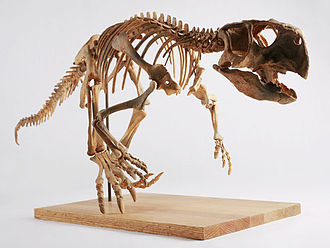
A Psittacosaurus skeleton cast in the permanent collection of The Children’s Museum of Indianapolis.

Limaysaurus tessonei skeleton restoration, Copenhagen.
Limaysaurus tessonei skeleton restoration, Copenhagen.
Limaysaurus tessonei skeleton restoration, Copenhagen.
Limaysaurus tessonei skeleton restoration, Copenhagen.

Coelophysis bauri (Cope, 1887) theropod dinosaur from the Triassic of New Mexico, USA. This is a remarkable complete skeleton of the small early theropod Coelophysis. It comes from a nearly monospecific concentration of numerous complete to disarticulated skeletons in reddish-colored fluvial siltstones, often called a "Coelophysis graveyard". This occurrence has been interpreted as a carcass-jammed channel filling following mass mortality of dinosaurs by regional drought (see Schwartz & Gillette, 1994). Stratigraphy: Rock Point Member, Chinle Formation, Upper Triassic Locality: Whitaker Quarry (Coelophysis Quarry), Ghost Ranch, Rio Arriba County, northern New Mexico, USA Some info. from: Hunt, A.P. & S.G. Lucas. 1991. Rioarribasaurus, a new name for a Late Triassic dinosaur from New Mexico (USA). Paläontologische Zeitschrift 65: 191-198. Schwartz, H.L. & D.D. Gillette. 1994. Geology and taphonomy of the Coelophysis Quarry, Upper Triassic Chinle Formation, Ghost Ranch, New Mexico. Journal of Paleontology 68: 1118-1130. Theropod were small to large, bipedal dinosaurs. Almost all known members of the group were carnivorous (predators and/or scavengers). They represent the ancestral group to the birds, and some theropods are known to have had feathers. Some of the most well known dinosaurs to the general public are theropods, such as Tyrannosaurus, Allosaurus, and Spinosaurus.
Coelophysis bauri (Cope, 1887) theropod dinosaur from the Triassic of New Mexico, USA. This is a remarkable complete skeleton of the small early theropod Coelophysis. It comes from a nearly monospecific concentration of numerous complete to disarticulated skeletons in reddish-colored fluvial siltstones, often called a "Coelophysis graveyard". This occurrence has been interpreted as a carcass-jammed channel filling following mass mortality of dinosaurs by regional drought (see Schwartz & Gillette, 1994). Stratigraphy: Rock Point Member, Chinle Formation, Upper Triassic Locality: Whitaker Quarry (Coelophysis Quarry), Ghost Ranch, Rio Arriba County, northern New Mexico, USA Some info. from: Hunt, A.P. & S.G. Lucas. 1991. Rioarribasaurus, a new name for a Late Triassic dinosaur from New Mexico (USA). Paläontologische Zeitschrift 65: 191-198. Schwartz, H.L. & D.D. Gillette. 1994. Geology and taphonomy of the Coelophysis Quarry, Upper Triassic Chinle Formation, Ghost Ranch, New Mexico. Journal of Paleontology 68: 1118-1130. Theropod were small to large, bipedal dinosaurs. Almost all known members of the group were carnivorous (predators and/or scavengers). They represent the ancestral group to the birds, and some theropods are known to have had feathers. Some of the most well known dinosaurs to the general public are theropods, such as Tyrannosaurus, Allosaurus, and Spinosaurus.
Coelophysis bauri (Cope, 1887) theropod dinosaur from the Triassic of New Mexico, USA. This is a remarkable complete skeleton of the small early theropod Coelophysis. It comes from a nearly monospecific concentration of numerous complete to disarticulated skeletons in reddish-colored fluvial siltstones, often called a "Coelophysis graveyard". This occurrence has been interpreted as a carcass-jammed channel filling following mass mortality of dinosaurs by regional drought (see Schwartz & Gillette, 1994). Stratigraphy: Rock Point Member, Chinle Formation, Upper Triassic Locality: Whitaker Quarry (Coelophysis Quarry), Ghost Ranch, Rio Arriba County, northern New Mexico, USA Some info. from: Hunt, A.P. & S.G. Lucas. 1991. Rioarribasaurus, a new name for a Late Triassic dinosaur from New Mexico (USA). Paläontologische Zeitschrift 65: 191-198. Schwartz, H.L. & D.D. Gillette. 1994. Geology and taphonomy of the Coelophysis Quarry, Upper Triassic Chinle Formation, Ghost Ranch, New Mexico. Journal of Paleontology 68: 1118-1130. Theropod were small to large, bipedal dinosaurs. Almost all known members of the group were carnivorous (predators and/or scavengers). They represent the ancestral group to the birds, and some theropods are known to have had feathers. Some of the most well known dinosaurs to the general public are theropods, such as Tyrannosaurus, Allosaurus, and Spinosaurus.

Spheroolithus fossil dinosaur eggs, from China. Exhibit in the Academy of Natural Sciences, 1900 Benjamin Franklin Parkway, Philadelphia, Pennsylvania, USA. Photography was permitted in this area of the museum without restrictions.

Edmontosaurus in the Rocky Mountain Dinosaur Resource Center, Woodland Park, Colorado

Fossil - Took The picture at Royal Belgian Institute of Natural Sciences, Brussels
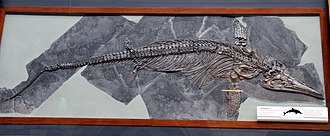

Dakosaurus andinensis on right & Caypullisaurus on left


Science Museum - Carcharodontosaurus Skull - 2014
Science Museum - Carcharodontosaurus Skull - 2014

Iguanodon de Bernissart (Iguanodon bernissartensis) présenté en position quadrupède, Institut Royal des Sciences naturelles de Belgique, Bruxelles
Iguanodon de Bernissart (Iguanodon bernissartensis) présenté en position quadrupède, Institut Royal des Sciences naturelles de Belgique, Bruxelles
Iguanodon de Bernissart (Iguanodon bernissartensis) présenté en position quadrupède, Institut Royal des Sciences naturelles de Belgique, Bruxelles

Moyeni dinosaur tracks. Photographs of plaster casts (positives) of Grallator track 6 (A) and Anomoepus track 8 (B) made at the Moyeni tracksite by the authors. Tracks are shown at the same scale (10 cm), and hatching pattern indicates broken surfaces. The Grallator hind foot print was made by pedal digits II–IV; the trackmaker's phalangeal formula was 3–4–5. Digits I and V did not contact the substrate. The rugose texture surrounding the print is the algal mat. The Anomoepus manus–pes couple registers all five manual digits (i–v), four pedal digits (I–IV), the metatarsus (mt), and toe drag marks (dm). Additional structures to the left of the pes are incidental marks made by a different trackmaker.

Camarasaurus lentus (Marsh, 1889) sauropod dinosaur from the Jurassic of Utah, USA (public display, CM 11338, Carnegie Museum of Natural History, Pittsburgh, Pennsylvania, USA). This is a near-complete juvenile sauropod dinosaur in the original fluvial sandstone matrix - such skeletons are extremely rare. Classification: Animalia, Chordata, Vertebrata, Dinosauria, Sauropodomorpha, Camarasauridae Stratigraphy: Brushy Basin Member, Morrison Formation, Upper Jurassic, 151 Ma Locality: Carnegie Quarry, Dinosaur National Monument, northeastern Utah, USA Sauropod dinosaurs were the largest terrestrial animals ever. They all have the same basic body plan: large body with four walking legs, very long neck & tail, and a small head relative to body size. Sauropods were herbivores, and are often perceived as holding their heads & necks up high to reach vegetation normally out of reach to other organisms. Modern reconstructions of many sauropod species depict them with heads and necks held close to the horizontal, or at low angles above the horizontal.
Camarasaurus lentus (Marsh, 1889) sauropod dinosaur from the Jurassic of Utah, USA (public display, CM 11338, Carnegie Museum of Natural History, Pittsburgh, Pennsylvania, USA). This is a near-complete juvenile sauropod dinosaur in the original fluvial sandstone matrix - such skeletons are extremely rare. Classification: Animalia, Chordata, Vertebrata, Dinosauria, Sauropodomorpha, Camarasauridae Stratigraphy: Brushy Basin Member, Morrison Formation, Upper Jurassic, 151 Ma Locality: Carnegie Quarry, Dinosaur National Monument, northeastern Utah, USA Sauropod dinosaurs were the largest terrestrial animals ever. They all have the same basic body plan: large body with four walking legs, very long neck & tail, and a small head relative to body size. Sauropods were herbivores, and are often perceived as holding their heads & necks up high to reach vegetation normally out of reach to other organisms. Modern reconstructions of many sauropod species depict them with heads and necks held close to the horizontal, or at low angles above the horizontal.

Ophthalmosaurus icenius, from the time of the Callovian period of the Middle Jurassic. This specimen was found in Oxford Clay, in Peterborough, England. Photo lightly touched up to remove lighting flares.


Dinosaur State Park and Arboretum, Rocky Hill, Connecticut, USA. Close-up of dinosaur prints.

Elasmosaurus platyurus in the Rocky Mountain Dinosaur Resource Center in Woodland Park, Colorado
Elasmosaurus platyurus in the Rocky Mountain Dinosaur Resource Center in Woodland Park, Colorado
Elasmosaurus platyurus in the Rocky Mountain Dinosaur Resource Center in Woodland Park, Colorado
Elasmosaurus platyurus in the Rocky Mountain Dinosaur Resource Center in Woodland Park, Colorado
Elasmosaurus platyurus in the Rocky Mountain Dinosaur Resource Center in Woodland Park, Colorado


Lamont-Doherty Earth Observatory specimen of Ichnogenus Grallator
Lamont-Doherty Earth Observatory specimen of Ichnogenus Grallator
Lamont-Doherty Earth Observatory specimen of Ichnogenus Grallator
Lamont-Doherty Earth Observatory specimen of Ichnogenus Grallator
Lamont-Doherty Earth Observatory specimen of Ichnogenus Grallator
Lamont-Doherty Earth Observatory specimen of Ichnogenus Grallator
Lamont-Doherty Earth Observatory specimen of Ichnogenus Grallator
Lamont-Doherty Earth Observatory specimen of Ichnogenus Grallator
Lamont-Doherty Earth Observatory specimen of Ichnogenus Grallator
Lamont-Doherty Earth Observatory specimen of Ichnogenus Grallator
Lamont-Doherty Earth Observatory specimen of Ichnogenus Grallator
Lamont-Doherty Earth Observatory specimen of Ichnogenus Grallator
Lamont-Doherty Earth Observatory specimen of Ichnogenus Grallator