Galerie d'images
Toutes les images de la base — taxons, formations et intervalles géologiques.
⚠ La fonctionnalité de récupération des images est en cours de test, des images non pertinentes peuvent apparaître.
4,914 image(s)

Giganotosaurus skeleton mount at the Fernbank Museum of Natural History in Atlanta, Georgia.

Material of the dinosaur Bahariasaurus ingens (1-4, 7-18, 24-26) and indeterminate theropods (5-6, 19-23) from the Bahariya Formation of Egypt.

A cast of BYU 9025, the holotype fossil of the sauropod dinosaur Supersaurus, a giant scapulocoracoid measuring 2.4m long. • The source photo was taken at the Dinosaur Journey Musuem. • Notes regarding the file; This image was edited and extracted from the original seen here. [1] The Photoshop CC lens correction profile and a 'perspective warp' correction were applied.


Cráneo desarticulado y vértebras cervicales del mosasáurido Yaguarasaurus columbianus. Museo Geólogico José Royo y Gómez, Bogotá.


Comparison of cranial features between closely related southern Laramidian taxa; (A), Akainacephalus johnsoni (UMNH VP 20202) from the Late Cretaceous Kaiparowits Formation of Utah; and (B), Nodocephalosaurus kirtlandensis (SMP VP-900) from the Late Cretaceous Kirtland Formation of New Mexico, in left lateral views. Various synapomorphies are shared with N. kirtlandensis (highlighted in black and white arrows) and includes “flaring nostrils”; enlarged, laterally projecting, loreal osteoderms that are situated directly dorsal to the external nares. Other synapomorphies include pyramid-shaped nasal and frontal osteoderms positioned on the dorsal regions of the skull. A number of significant differences have been observed between both specimens; in A. johnsoni, the anterior, and posterior supraorbital bosses form an enlarged element that is somewhat backswept, whereas in N. kirtlandensis, the posterior and anterior supraorbital bosses are clearly defined as individual osteoderms, and are much smaller in size. Additionally, the squamosal horn in Akainacephalus is very small but is prominent and tetrahedrally shaped in Nodocephalosaurus. The quadratojugal horn in Akainacephalus is massive, has a subtriangular morphology in lateral view and projects almost entirely ventral, whereas in Nodocephalosaurus, the quadratojugal horn is smaller and has a typical fin-shaped morphology. Study sites: asob, anterior supraorbital boss; ext naris, external naris; laca, lacrimal caputegulum; loca, loreal caputegulum; naca, nasal caputegulae; orb, orbit; psob, posterior supraorbital boss; qjh, quadratojugal horn; sqh, squamosal horn.

Pararhabdodon isonensis, maxillae. A. Right maxilla (IPS 36327) in lateral view. B. Medial view of same. C. Left maxilla (IPS 693-6) in medial view. D. Lateral view of same.

Digital illustration of the Sauropod Dinosaur Isisaurus colberti from the Late Cretaceous (Maastrichtian) of India (72.2-66 MYA). References include Jain & Bandyopadhyay (1997), several papers from Wilson et al. and skeletal reconstruction by Scott Hartman. Illustrated by Ansh Saxena. About Isisaurus– Isisaurus colberti (=Titanosaurus colberti) was a species of Titanosaurian Sauropod Dinosaur from the Late Cretaceous (Maastrichtian) age in the Indian Subcontinent. Isisaurus lived sympatrically with another Titanosaurian Sauropod Jainosaurus. It also lived alongside Theropods like Rajasaurus, Rahiolisaurus, Indosuchus etc. Remains of Isisaurus come from the Lameta formation of Central India.


Saurexallopus, a four toed dinosaur or bird trace fossil (jr syn Exallopus

Fossil samples – e.g. ‘primitive’ bony fish (1, 2), a skull of a temnospondyl ‘amphibian’ (probably a metoposauroid) in dorsal view (3), a skull of an archosaur of the crocodile lineage (probably a phytosaur) in palatal view (4), holotype of the “gliding reptile” Icarosaurus siefkeri [1] (5) and Atreipus-Grallator-type dinosaur tracks (bottom right) – from the Newark Supergroup, i.e. a series of mainly Late Triassic to Early Jurassic sedimentary rocks of eastern North America ↑ Edwin H. Colbert: A gliding reptile from the Triassic of New Jersey. American Museum Novitates, 2230. American Museum of Natural History, New York 1966, digitallibrary.amnh.org, cf. fig. 3 therein.


Eonatator sternbergi, a mosasaur from the Late Cretaceous of Kansas. Digital.


Leptorhynchos, a small caenagnathid from the Campanian of Western North America. Original work in pencil and charcoal by Nick Longrich. Additional digital editing in Adobe Photoshop by Nick Longrich.


Type skull of Pentaceratops sternbergii, American Museum of Natural History # AMNH6325

Designated lectotype for Pervushovisaurus campylodon (Carter, 1846a), CAMSM B20659. (A) Mid-snout fragment in right lateral view, showing the diagenetically deformed dentary teeth. (B) Same fragment in dorsolateral view.

Phylogenetic relationships, chronostratigraphic, and paleoecological implications of M. intrepidus. a Graphic illustrating temporal range of North American tyrannosauroids including species-level range prior to the discovery of M. intrepidus, extension of current range, and hypothesized range based on isolated teeth12. The current gap in the North American tyrannosauroid record spans from the Tithonian to the Aptian. Faunal composition of Late Cretaceous ecosystems was established between the Albian and Turonian, as recognized by the stratigraphic appearance of major clades (see refs. 7,12 and references therein). b generalized phylogenetic relationships of Tyrannosauroidea, showing the appearance of select traits related to cursoriality in tyrannosaurs that are newly optimized as a result of the discovery of M. intrepidus. Tree topology follows this study using the modified dataset of Carr and colleagues27. Coelurus and Tanycolagreus are grafted as basal tyrannosauroids following Brusatte and colleagues5. c Stratigraphic distribution of Allosauria in North America (incl. Megaraptora but see ref. 70 for alternative hypotheses regarding this clade) documents overlap with M. intrepidus in early Late Cretaceous ecosystems leading to (d) refined calibration on the origin of late diverging tyrannosauroids and clade-level faunal turnover within apex predator roles throughout the Late Jurassic–Late Cretaceous of North America. Colored polygons are stylized call-outs and are not intended to reflect two-dimensional data. Temporal data corresponding to this figure are available in Supplementary Table 5

Mounted skeleton of Acrocanthosaurus specimen NCSM 14345 at North Carolina Museum of Natural Sciences

Carinodens acrodon holotype left maxilla (MHNM.KHG.1510) (A) compared to Xenodens calminechari holotype left maxilla (MHNM.KHG.331) (B), in lateral view; both from Sidi Chennane, Oulad Abdoun Basin, Morocco; Phosphates, Upper Couche III, uppermost Maastrichtian [9,24]. Scales = 50 mm.


An Ankylosaurus head (cast of specimen AMNH 5214), on display at the Museum of the Rockies in Bozeman, Montana. This is from a specimen collected in Custer County, Montana. The Ankylosauria were armored dinosaurs that lived from 122 million years ago to 66 million years ago in western North America, Europe, and East Asia. There were two subgroups: The Nodosauridae and Ankylosauridae. The Ankylosauridae contained six species, and a single subfamily -- the Ankylosaurinae. There 18 genus within the subfamily, of which Ankylosaurus is the best known. Ankylosaurus as the last of these, and lived 65.5 to 66.5 million years ago. Ankylosaurus was about 20.5 feet long, 5 feet wide, and 5.5 feet tall at the hip. It walked on all fours, with the rear legs longer than the front ones. They ripped vegetation, and swallowed it whole. Their defining feature was their armor. They body was covered in thick, heavy bony plates, and most of the plates were fused together to make them even stronger. Embedded in the skin were more knobs of bone, and the outer skin above these knobs covered in keratin (the same stuff fingernails are made of). Ankylosaurus had a tail club, which consisted of several large osteoderms fused to the last few tail vertebrae. Ankylosaurus was discovered in 1908.


Phylogenetic position of Akainacephalus johnsoni in (A), a strict consensus of 21 equally most parsimonious trees, including the wildcard taxon Ahshislepelta minor, placing A. johnsoni within a large polytomy, consisting of crown group taxa that include Asian and all Laramidian ankylosaurids; and (B), the resulting strict consensus of six equally most phylogenetic trees, from which the wildcard taxon Ahshislepelta minor has been pruned. The crown group taxa are slightly better resolved in the pruned analysis, in which Akainacephalus johnsoni forms a clade with its sister taxon Nodocephalosaurus kirtlandensis, nested within the clade that also includes the Asian taxa Minotaurasaurus ramachandrani, Tarchia kilanae, and Shanxia tianzhenensis, suggesting a close taxonomic relationship with Nodocephalosaurus kirtlandensis and Asian taxa.
Phylogenetic position of Akainacephalus johnsoni in (A), a strict consensus of 21 equally most parsimonious trees, including the wildcard taxon Ahshislepelta minor, placing A. johnsoni within a large polytomy, consisting of crown group taxa that include Asian and all Laramidian ankylosaurids; and (B), the resulting strict consensus of six equally most phylogenetic trees, from which the wildcard taxon Ahshislepelta minor has been pruned. The crown group taxa are slightly better resolved in the pruned analysis, in which Akainacephalus johnsoni forms a clade with its sister taxon Nodocephalosaurus kirtlandensis, nested within the clade that also includes the Asian taxa Minotaurasaurus ramachandrani, Tarchia kilanae, and Shanxia tianzhenensis, suggesting a close taxonomic relationship with Nodocephalosaurus kirtlandensis and Asian taxa.
Phylogenetic position of Akainacephalus johnsoni in (A), a strict consensus of 21 equally most parsimonious trees, including the wildcard taxon Ahshislepelta minor, placing A. johnsoni within a large polytomy, consisting of crown group taxa that include Asian and all Laramidian ankylosaurids; and (B), the resulting strict consensus of six equally most phylogenetic trees, from which the wildcard taxon Ahshislepelta minor has been pruned. The crown group taxa are slightly better resolved in the pruned analysis, in which Akainacephalus johnsoni forms a clade with its sister taxon Nodocephalosaurus kirtlandensis, nested within the clade that also includes the Asian taxa Minotaurasaurus ramachandrani, Tarchia kilanae, and Shanxia tianzhenensis, suggesting a close taxonomic relationship with Nodocephalosaurus kirtlandensis and Asian taxa.

The "Dinosaurs in Their Time" exhibit at the Carnegie Museum of Natural History. Pictures from some of my free time during the Project Zero Perspectives conference (#PZPGH) in Pittsburg, Pennsylvania - May 2017.


Clidastes propython, a mosasaur from the Late Cretaceous of Kansas, digital.


Mounted composite cast of Pteranodon longiceps (=P. ingens) at the American Museum of Natural History, New York. Photo credit Matt Martyniuk henteeth.com


Science Museum - Carcharodontosaurus Skull - 2014
Science Museum - Carcharodontosaurus Skull - 2014


Figure 32: Right metatarsi of selected ornithopods in proximal view. A–R: (A) Diluvicursor pickeringi; (B) NMV P186047; (C) Morrosaurus antarcticus; (D) Gasparinisaura cincosaltensis; (E) Anabisetia saldiviai; (F) Kangnasaurus coetzeei; (G) Eousdryosaurus nanohallucis; (H) Dysalotosaurus lettowvorbecki; (I) Dryosaurus altus; (J) Changchunsaurus parvus; (K) Mantellisaurus atherfieldensis; (L) Hypsilophodon foxii; (M) Tenontosaurus tilletti; (N) Cumnoria prestwichii; (O) Muttaburrasaurus langdoni; (P) Talenkauen santacrucensis; (Q) Parksosaurus warreni; and (R) Thescelosaurus assiniboiensis. Metatarsi normalised for dorsoplantar depth of metatarsal II (shaded black). Dashed lines indicate uncertain bone margins. ?, indicates location of uncertain/expected/missing metatarsal. Abbreviation: mt #, metatarsal position. For data sources, see Table S1.
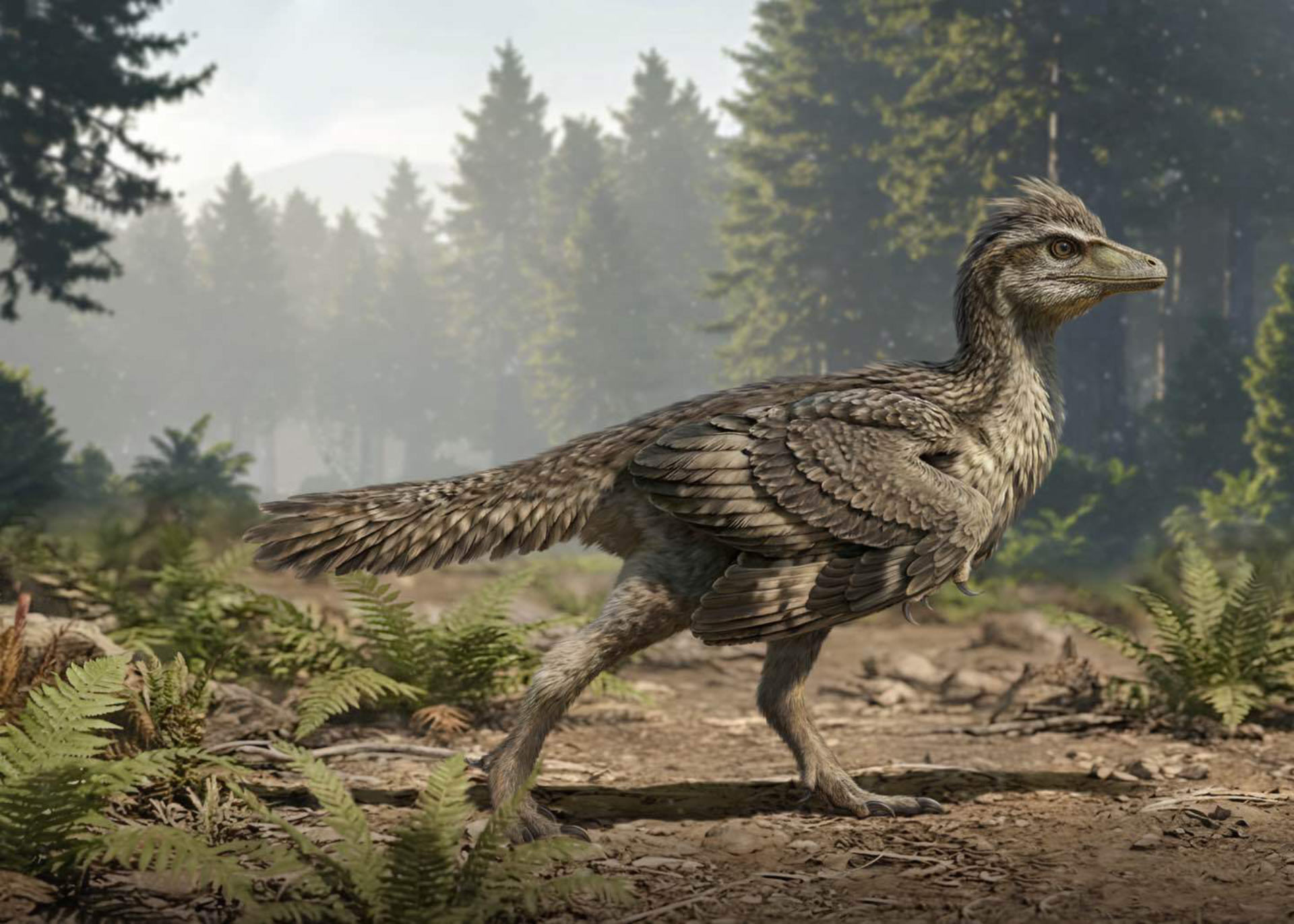
Reconstitution de Zhengheornis buyu dans son milieu.


Left manual digits of Gualicho shinyae. Digit I phalanges in (A, D) medial, (B, E) lateral, and (C, F) dorsal views. Digit II phalanges in (G-I) medial, (J-L) lateral, and (M-O) dorsal views. Abbreviations: clp, collateral ligament pit; ft, flexor tubercle; t tuber.


Global and temporal distribution of silesaurids shown on a Middle and Late Triassic (Ladinian-Norian) map of the northern and southern regions of Pangea.

Holotype and referred specimen of Amanasaurus nesbitti gen. et sp. nov. from the Candelária Sequence (mid-to-late Carnian) of the Santa Maria Supersequence, southern Brazil. Holotype (CAPPA/UFSM 0374) in anterior (a), lateral (b), proximal (c), medial (d), and posterior (e) views. Referred specimen (CAPPA/UFSM 0375) in anterior (f), lateral (g), posterior (h), and distal (i) views. alt anterolateral tuber, amt anteromedial tuber, at anterior trochanter, cl cleft, ctfb crista tibiofibularis, dlt dorsolateral trochanter, dltp posterior portion of the dorsolateral trochanter, fo foramen, fot fossa trochanterica, gt greater trochanter, lc lateral condyle, lia linea intermuscularis cranialis, mc medial condyle, ms muscle scar, no notch, pg proximal groove, pof popliteal fossa, scs sub-circular scar. Figures were generated with GIMP 2.8 (https://www.gimp.org/).


Baminornis is the oldest known bird with a fused pygostyle, a skeletal feature that implies tail feathers. Its discovery pushed back current understanding of bird evolution and global distribution by 20 million years. Baminornis was about 15 cm in length, had many features in common with modern birds, including the capability for powered flight.


Paleoarte de pterossauro encontrado na China em 2006, pertecente ao grupos do Istiodactylus em estágio de pouso. Corpo com picnofibras é evidenciado no fóssil holótipo.

