←

musée

Type de contenu

449 image(s) · 46 Actualités

Galerie d'images

Holotype skeleton (AGB 6257) of Cartorhynchus lenticarpus on display at the Geological Museum of China.

Holotype skeleton (AGB 6257) of Cartorhynchus lenticarpus on display at the Geological Museum of China.

musée Chine holotype squelette
Collage of three leptoceratopsids, clockwise from top left: Prenoceratops, Montanoceratops and Leptoceratops. These files are already on Commons with their respective licenses. This montage was made for the article Leptoceratopsidae on Wikipedia.
File:The Childrens Museum of Indianapolis - Prenoceratops pieganensis -1.jpg
File:Montanoceratops Royal Tyrrell 1.jpg
File:Leptoceratopsidae - Leptoceratops.JPG
File:Leptoceratops skull Royal Tyrrell.jpg
Taxons Leptoceratopsidae

Collage of three leptoceratopsids, clockwise from top left: Prenoceratops, Montanoceratops and Leptoceratops. These files are already on Commons with their respective licenses. This montage was made for the article Leptoceratopsidae on Wikipedia. File:The Childrens Museum of Indianapolis - Prenoceratops pieganensis -1.jpg File:Montanoceratops Royal Tyrrell 1.jpg File:Leptoceratopsidae - Leptoceratops.JPG File:Leptoceratops skull Royal Tyrrell.jpg

musée Leptoceratops Leptoceratopsidae Montanoceratops +2
Central Museum of Mongolian Dinosaurs, Ulaanbaatar. Complete indexed photo collection at WorldHistoryPics.com.

Central Museum of Mongolian Dinosaurs, Ulaanbaatar. Complete indexed photo collection at WorldHistoryPics.com.

musée Dictyoolithus Dinosauria
Reconstructed skull of Einiosaurus procurvicornis on display at the Natural History Museum of Los Angeles County.
Taxons Einiosaurus

Reconstructed skull of Einiosaurus procurvicornis on display at the Natural History Museum of Los Angeles County.

musée Einiosaurus crâne
Restoration of the skeleton, Age of Dinosaur Museum, Winton, Australia
Taxons Australovenator

Restoration of the skeleton, Age of Dinosaur Museum, Winton, Australia

musée Australie Winton Australovenator +2
Giganotosaurus skeleton mount at the Fernbank Museum of Natural History in Atlanta, Georgia.
Taxons Giganotosaurus

Giganotosaurus skeleton mount at the Fernbank Museum of Natural History in Atlanta, Georgia.

musée Géorgie Giganotosaurus squelette
Maiasaura peeblesorum skeletal mount, Brussels Natural History museum (2009).
Taxons Maiasaura

Maiasaura peeblesorum skeletal mount, Brussels Natural History museum (2009).

musée Maiasaura
Fossil samples – e.g. ‘primitive’ bony fish (1, 2), a skull of a temnospondyl ‘amphibian’ (probably a metoposauroid) in dorsal view (3), a skull of an archosaur of the crocodile lineage (probably a phytosaur) in palatal view (4), holotype of the “gliding reptile” Icarosaurus siefkeri [1] (5) and Atreipus-Grallator-type dinosaur tracks (bottom right) – from the Newark Supergroup, i.e. a series of mainly Late Triassic to Early Jurassic sedimentary rocks of eastern North America


↑ Edwin H. Colbert: A gliding reptile from the Triassic of New Jersey. American Museum Novitates, 2230. American Museum of Natural History, New York 1966, digitallibrary.amnh.org, cf. fig. 3 therein.

Fossil samples – e.g. ‘primitive’ bony fish (1, 2), a skull of a temnospondyl ‘amphibian’ (probably a metoposauroid) in dorsal view (3), a skull of an archosaur of the crocodile lineage (probably a phytosaur) in palatal view (4), holotype of the “gliding reptile” Icarosaurus siefkeri [1] (5) and Atreipus-Grallator-type dinosaur tracks (bottom right) – from the Newark Supergroup, i.e. a series of mainly Late Triassic to Early Jurassic sedimentary rocks of eastern North America ↑ Edwin H. Colbert: A gliding reptile from the Triassic of New Jersey. American Museum Novitates, 2230. American Museum of Natural History, New York 1966, digitallibrary.amnh.org, cf. fig. 3 therein.

musée Jurassique inférieur Jurassique Trias supérieur +9
Archaeopteryx lithographica, specimen displayed at the Museum für Naturkunde in Berlin. (This image shows the original fossil - not a cast.)
Taxons Archaeopteryx

Archaeopteryx lithographica, specimen displayed at the Museum für Naturkunde in Berlin. (This image shows the original fossil - not a cast.)

musée moulage fossile spécimen +1
Type skull of Pentaceratops sternbergii, American Museum of Natural History # AMNH6325
Taxons Pentaceratops

Type skull of Pentaceratops sternbergii, American Museum of Natural History # AMNH6325

musée Pentaceratops crâne
Mounted skeleton of Acrocanthosaurus specimen NCSM 14345 at North Carolina Museum of Natural Sciences
Taxons Acrocanthosaurus

Mounted skeleton of Acrocanthosaurus specimen NCSM 14345 at North Carolina Museum of Natural Sciences

musée spécimen Acrocanthosaurus squelette
An Ankylosaurus head (cast of specimen AMNH 5214), on display at the Museum of the Rockies in Bozeman, Montana.  This is from a specimen collected in Custer County, Montana.
The Ankylosauria were armored dinosaurs that lived from 122 million years ago to 66 million years ago in western North America, Europe, and East Asia.  There were two subgroups:  The Nodosauridae and Ankylosauridae. 
The Ankylosauridae contained six species, and a single subfamily -- the Ankylosaurinae.  There 18 genus within the subfamily, of which Ankylosaurus is the best known.  Ankylosaurus as the last of these, and lived 65.5 to 66.5 million years ago.
Ankylosaurus was about 20.5 feet long, 5 feet wide, and 5.5 feet tall at the hip.  It walked on all fours, with the rear legs longer than the front ones.  They ripped vegetation, and swallowed it whole.  Their defining feature was their armor.  They body was covered in thick, heavy bony plates, and most of the plates were fused together to make them even stronger.  Embedded in the skin were more knobs of bone, and the outer skin above these knobs covered in keratin (the same stuff fingernails are made of).  Ankylosaurus had a tail club, which consisted of several large osteoderms fused to the last few tail vertebrae.

Ankylosaurus was discovered in 1908.
Taxons Ankylosaurus

An Ankylosaurus head (cast of specimen AMNH 5214), on display at the Museum of the Rockies in Bozeman, Montana. This is from a specimen collected in Custer County, Montana. The Ankylosauria were armored dinosaurs that lived from 122 million years ago to 66 million years ago in western North America, Europe, and East Asia. There were two subgroups: The Nodosauridae and Ankylosauridae. The Ankylosauridae contained six species, and a single subfamily -- the Ankylosaurinae. There 18 genus within the subfamily, of which Ankylosaurus is the best known. Ankylosaurus as the last of these, and lived 65.5 to 66.5 million years ago. Ankylosaurus was about 20.5 feet long, 5 feet wide, and 5.5 feet tall at the hip. It walked on all fours, with the rear legs longer than the front ones. They ripped vegetation, and swallowed it whole. Their defining feature was their armor. They body was covered in thick, heavy bony plates, and most of the plates were fused together to make them even stronger. Embedded in the skin were more knobs of bone, and the outer skin above these knobs covered in keratin (the same stuff fingernails are made of). Ankylosaurus had a tail club, which consisted of several large osteoderms fused to the last few tail vertebrae. Ankylosaurus was discovered in 1908.

armure os peau musée +7
Chasmosaurus  on display at the Royal Ontario Museum.
Taxons Chasmosaurus

Chasmosaurus on display at the Royal Ontario Museum.

musée Chasmosaurus
The "Dinosaurs in Their Time" exhibit at the Carnegie Museum of Natural History.
Pictures from some of my free time during the Project Zero Perspectives conference (#PZPGH) in Pittsburg, Pennsylvania - May 2017.
Taxons Corythosaurus

The "Dinosaurs in Their Time" exhibit at the Carnegie Museum of Natural History. Pictures from some of my free time during the Project Zero Perspectives conference (#PZPGH) in Pittsburg, Pennsylvania - May 2017.

musée Corythosaurus Dinosauria
Ajancingenia mounted cast (labeled as Ingenia), on display at the Museum of Ancient Life, Utah.

Ajancingenia mounted cast (labeled as Ingenia), on display at the Museum of Ancient Life, Utah.

musée moulage Ajancingenia Ingenia
Ajancingenia mounted cast (labeled as Ingenia), detail of pelvis, on display at the Museum of Ancient Life, Utah.

Ajancingenia mounted cast (labeled as Ingenia), detail of pelvis, on display at the Museum of Ancient Life, Utah.

bassin musée moulage Ajancingenia +1
1 2 3 4 5 6 7 8 9 10 11 12 13 14 15 16 17 18 19 20 21 22 23 24 25 26 27 28 29

Actualités

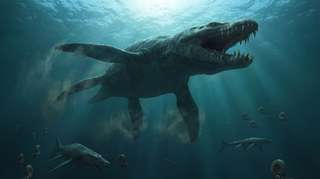
On le croyait roi des océans au Jurassique : une vertèbre percée raconte un combat d’une violence extrême
os dent vertèbre chasse musée Jurassique fossile Ichthyosauria Ichthyosaurus Pliosaurus comportement
Oublié pendant plus d’un siècle dans les tiroirs d’un musée, un fossile refait aujourd’hui surface et raconte une scène de violence extrême dans les océans du Jurassique. Une vertèbre d’ichtyosaure, marquée par l’impact d’une dent brisée, révèle peut-être l’attaque d’un des plus redoutables...
17/06/2026 futura-terre
Un superbe crâne de théropode exposé
musée fossile Tyrannosaurus crâne
Lors d'une visite au Museum für Naturkunde (Berlin) nous en avons profité pour photographier le magnifique crâne de Tristan le Tyrannosaurus rex.  Le crâne est l’un des crânes de tyrannosaure les plus complets et les mieux conservés connus de la science.  Les fossiles de T. rex, exposés à côté du crâne, ont été nommés Tristan Otto.  À
12/06/2026 everythingdinosaur ⚙ Traduction automatique
Les os géants d'un camarasaure exposés pour la première fois à Angoulême
os musée Camarasaurus Diplodocia découverte
Le musée d’Angoulême expose, à partir de vendredi 22 mai, les ossements d’un camarasaure, un cousin du diplodocus de 20 mètres de long. Une première, deux ans après leur découverte spectaculaire à Angeac-Charente (Charente).
22/05/2026 sciencesetavenir
Bonne Journée internationale des musées (2026)
musée Dinosauria communication
Aujourd'hui, c'est la Journée internationale des musées et, ici à Everything Dinosaur, nous souhaitons célébrer le travail incroyable réalisé par les musées du monde entier. Les musées contribuent à inspirer la curiosité, à encourager l’apprentissage et à connecter les gens avec la nature. Ils jouent également un rôle crucial dans l’éducation, la communication scientifique et la sensibilisation. Nous avons toujours aimé visiter les musées, notamment
18/05/2026 everythingdinosaur ⚙ Traduction automatique

Il construisait un mur dans son jardin… quand une silhouette vieille de 240 millions d’années apparaît
musée fossile
Destiné à devenir un simple bloc de construction, un morceau de grès récupéré dans une carrière australienne cache en réalité un secret vieux de 240 millions d’années. Oublié pendant des décennies dans les réserves d’un musée, ce fossile exceptionnel vient seulement de révéler l’existence d’une...
18/05/2026 futura-terre
1 2 3 4 5 6 7 8 9 10