Ichthyosauria

Taxon

38 image(s) · 7 Actualités

Voir la fiche

Galerie d'images

Figure description from paper: "Figure 23: Early and Middle Triassic ichthyopterygian heads possessing longirostry.
Simplified outlines of four different Early and Middle Triassic ichthyopterygian heads possessing a long and slender rostrum. Specimens are at the same scale. (A) Utatsusaurus hataii (UHR 30691, Motani, Minoura & Ando, 1998); (B) Grippia longirostris (PMU R445, Motani, 2000); (C) Mixosaurus cornalianus (BES SC 1000, Renesto et al., 2020); (D) Besanosaurus leptorhynchus (PIMUZ T 4847, this paper); (E) Cymbospondylus buchseri (PIMUZ T 4351, Sander, 1989). Scale bar represents 10 cm."
References:

Bindellini, G.; Wolniewicz, A.S.; Miedema, F.; Scheyer, T.M.; Dal Sasso, C. (2021). "Cranial anatomy of Besanosaurus leptorhynchus Dal Sasso & Pinna, 1996 (Reptilia: Ichthyosauria) from the Middle Triassic Besano Formation of Monte San Giorgio, Italy/Switzerland: Taxonomic and palaeobiological implications". PeerJ 9: e11179. DOI:10.7717/peerj.11179.

Figure description from paper: "Figure 23: Early and Middle Triassic ichthyopterygian heads possessing longirostry. Simplified outlines of four different Early and Middle Triassic ichthyopterygian heads possessing a long and slender rostrum. Specimens are at the same scale. (A) Utatsusaurus hataii (UHR 30691, Motani, Minoura & Ando, 1998); (B) Grippia longirostris (PMU R445, Motani, 2000); (C) Mixosaurus cornalianus (BES SC 1000, Renesto et al., 2020); (D) Besanosaurus leptorhynchus (PIMUZ T 4847, this paper); (E) Cymbospondylus buchseri (PIMUZ T 4351, Sander, 1989). Scale bar represents 10 cm." References: Bindellini, G.; Wolniewicz, A.S.; Miedema, F.; Scheyer, T.M.; Dal Sasso, C. (2021). "Cranial anatomy of Besanosaurus leptorhynchus Dal Sasso & Pinna, 1996 (Reptilia: Ichthyosauria) from the Middle Triassic Besano Formation of Monte San Giorgio, Italy/Switzerland: Taxonomic and palaeobiological implications". PeerJ 9: e11179. DOI:10.7717/peerj.11179.

écaille description Italie Suisse +12
Besanosaurus leptorhynchus referred specimen PIMUZ T 4376, preserved on the same slab as a specimen of the smaller Mixosaurus. Scale bar represents 50 cm (1.6 ft). Figure 3C of Bindellini et al. (2021).
References:

Bindellini, G.; Wolniewicz, A.S.; Miedema, F.; Scheyer, T.M.; Dal Sasso, C. (2021). "Cranial anatomy of Besanosaurus leptorhynchus Dal Sasso & Pinna, 1996 (Reptilia: Ichthyosauria) from the Middle Triassic Besano Formation of Monte San Giorgio, Italy/Switzerland: Taxonomic and palaeobiological implications". PeerJ 9: e11179. DOI:10.7717/peerj.11179.

Besanosaurus leptorhynchus referred specimen PIMUZ T 4376, preserved on the same slab as a specimen of the smaller Mixosaurus. Scale bar represents 50 cm (1.6 ft). Figure 3C of Bindellini et al. (2021). References: Bindellini, G.; Wolniewicz, A.S.; Miedema, F.; Scheyer, T.M.; Dal Sasso, C. (2021). "Cranial anatomy of Besanosaurus leptorhynchus Dal Sasso & Pinna, 1996 (Reptilia: Ichthyosauria) from the Middle Triassic Besano Formation of Monte San Giorgio, Italy/Switzerland: Taxonomic and palaeobiological implications". PeerJ 9: e11179. DOI:10.7717/peerj.11179.

écaille Italie Suisse Trias moyen +8
Modified version of figure 23 of Bindellini et al. (2021) showing just the ichthyosaurs from the Besano Formation: Besanosaurus leptorhynchus (A), Mixosaurus cornalianus (B), and Cymbospondylus buchseri (C). The original figure was uploaded unmodified here: File:Early to Middle Triassic Longirostrine Ichthyopterygians.png
References:

Bindellini, G.; Wolniewicz, A.S.; Miedema, F.; Scheyer, T.M.; Dal Sasso, C. (2021). "Cranial anatomy of Besanosaurus leptorhynchus Dal Sasso & Pinna, 1996 (Reptilia: Ichthyosauria) from the Middle Triassic Besano Formation of Monte San Giorgio, Italy/Switzerland: Taxonomic and palaeobiological implications". PeerJ 9: e11179. DOI:10.7717/peerj.11179.

Modified version of figure 23 of Bindellini et al. (2021) showing just the ichthyosaurs from the Besano Formation: Besanosaurus leptorhynchus (A), Mixosaurus cornalianus (B), and Cymbospondylus buchseri (C). The original figure was uploaded unmodified here: File:Early to Middle Triassic Longirostrine Ichthyopterygians.png References: Bindellini, G.; Wolniewicz, A.S.; Miedema, F.; Scheyer, T.M.; Dal Sasso, C. (2021). "Cranial anatomy of Besanosaurus leptorhynchus Dal Sasso & Pinna, 1996 (Reptilia: Ichthyosauria) from the Middle Triassic Besano Formation of Monte San Giorgio, Italy/Switzerland: Taxonomic and palaeobiological implications". PeerJ 9: e11179. DOI:10.7717/peerj.11179.

Italie Suisse Trias moyen Trias +7
Identifier: waterreptilesofp1914will
Title: Water reptiles of the past and present
Year: 1914 (1910s)
Authors:  Williston, Samuel Wendell, 1851-1918
Subjects:  Aquatic reptiles
Publisher:  Chicago, Ill., The University of Chicago Press
Contributing Library:  Boston Public Library
Digitizing Sponsor:  Boston Public Library

View Book Page: Book Viewer
About This Book: Catalog Entry
View All Images: All Images From Book
Click here to view book online to see this illustration in context in a browseable online version of this book.

Text Appearing Before Image:
served and very complete skeletons ofdifferent species of ichthyosaurs from the Jurassic deposits ofWiirtemberg, in which remains of these animals occur in great 112 WATER REPTILES OF THE PAST AND PRESENT profusion. His researches, and those of several authors since then,supplementing and confirming or disproving those of the manyobservers made during the preceding seventy years, have finallydetermined almost perfectly the complete structure of the moretypical ichthyosaurs, enabling us to infer not a little as to theirhabits and distribution in the old Jurassic oceans. Within thepast few years the discoveries of Professor J. C. Merriam of Cali-fornia have likewise added greatly to our knowledge of the earlierichthyosaurs. It may now truthfully be said that of no group ofextinct reptiles do we have a more complete and satisfactory knowl-edge than of the ichthyosaurs. Nevertheless we have yet very much more to learn about theorder Ichthyosauria as a whole—whence they came and how they
Text Appearing After Image:
Fig. 52.—Ichthyosaurus quadricissus.museum, from Dr. Dreverman. Photograph of specimen in Senckenberg originated; what their nearest kin were among other reptiles; andespecially, more about the connecting links between them andterrestrial reptiles. They have, as an order, so isolated a position,are so widely separated from all other reptiles in structure, that theyhave long been a puzzle to paleontologists. Like the whales andother cetaceans among mammals, we know the ichthyosaurs wellin the plenitude of their power and the fulness of their development,but have yet only an imperfect knowledge of their earlier history,and none whatever of their earliest. However, as will be seenfarther on, the recent discoveries by Merriam have shed much lighton some of the stages of their evolution. So nearly perfectly wereall the later ichthyosaurs adapted to their life in the water that itwas believed by nearly all paleontologists until about a score of years ICHTHYOSAURIA 3 ago that they had desc

Note About Images

Please note that these images are extracted from scanned page images that may have been digitally enhanced for readability - coloration and appearance of these illustrations may not perfectly resemble the original work.
Taxons Stenopterygiidae

Identifier: waterreptilesofp1914will Title: Water reptiles of the past and present Year: 1914 (1910s) Authors: Williston, Samuel Wendell, 1851-1918 Subjects: Aquatic reptiles Publisher: Chicago, Ill., The University of Chicago Press Contributing Library: Boston Public Library Digitizing Sponsor: Boston Public Library View Book Page: Book Viewer About This Book: Catalog Entry View All Images: All Images From Book Click here to view book online to see this illustration in context in a browseable online version of this book. Text Appearing Before Image: served and very complete skeletons ofdifferent species of ichthyosaurs from the Jurassic deposits ofWiirtemberg, in which remains of these animals occur in great 112 WATER REPTILES OF THE PAST AND PRESENT profusion. His researches, and those of several authors since then,supplementing and confirming or disproving those of the manyobservers made during the preceding seventy years, have finallydetermined almost perfectly the complete structure of the moretypical ichthyosaurs, enabling us to infer not a little as to theirhabits and distribution in the old Jurassic oceans. Within thepast few years the discoveries of Professor J. C. Merriam of Cali-fornia have likewise added greatly to our knowledge of the earlierichthyosaurs. It may now truthfully be said that of no group ofextinct reptiles do we have a more complete and satisfactory knowl-edge than of the ichthyosaurs. Nevertheless we have yet very much more to learn about theorder Ichthyosauria as a whole—whence they came and how they Text Appearing After Image: Fig. 52.—Ichthyosaurus quadricissus.museum, from Dr. Dreverman. Photograph of specimen in Senckenberg originated; what their nearest kin were among other reptiles; andespecially, more about the connecting links between them andterrestrial reptiles. They have, as an order, so isolated a position,are so widely separated from all other reptiles in structure, that theyhave long been a puzzle to paleontologists. Like the whales andother cetaceans among mammals, we know the ichthyosaurs wellin the plenitude of their power and the fulness of their development,but have yet only an imperfect knowledge of their earlier history,and none whatever of their earliest. However, as will be seenfarther on, the recent discoveries by Merriam have shed much lighton some of the stages of their evolution. So nearly perfectly wereall the later ichthyosaurs adapted to their life in the water that itwas believed by nearly all paleontologists until about a score of years ICHTHYOSAURIA 3 ago that they had desc Note About Images Please note that these images are extracted from scanned page images that may have been digitally enhanced for readability - coloration and appearance of these illustrations may not perfectly resemble the original work.

Jurassique Ichthyosauria Stenopterygiidae squelette
Utatsusaurus hataii, an Early Triassic Ichthyosaur from Japan, pencil drawing
Taxons Grippiidae

Utatsusaurus hataii, an Early Triassic Ichthyosaur from Japan, pencil drawing

dessin Japon Early Triassic Trias +4
Skull of the Middle Triassic North-American ichthyosaur Cymbospondylus petrinus, preserved in three dimensions. This specimen is cataloged under the number UCMP 9913. More information is available from the source link.
Taxons Hueneosauria

Skull of the Middle Triassic North-American ichthyosaur Cymbospondylus petrinus, preserved in three dimensions. This specimen is cataloged under the number UCMP 9913. More information is available from the source link.

musée Trias moyen Trias spécimen +5
Skull of the Middle Triassic North-American ichthyosaur Cymbospondylus petrinus, preserved in three dimensions. This specimen is cataloged under the number UCMP 9913. More information is available from the source link.
Taxons Longipinnati

Skull of the Middle Triassic North-American ichthyosaur Cymbospondylus petrinus, preserved in three dimensions. This specimen is cataloged under the number UCMP 9913. More information is available from the source link.

musée Trias moyen Trias spécimen +5
Ichthyosauria
Taxons Ichthyosauria
Ichthyosauria
Bituminous claystone, Lower Jurassic, Hesselberg, Middle Franconia.
Sedimentary rock of very thin laminated layers (particles less than 0,0002 mm).

Rock formation is known for its rich fossil findings, ex. Ichthyosaur.

Bituminous claystone, Lower Jurassic, Hesselberg, Middle Franconia. Sedimentary rock of very thin laminated layers (particles less than 0,0002 mm). Rock formation is known for its rich fossil findings, ex. Ichthyosaur.

Jurassique fossile Ichthyosauria formation
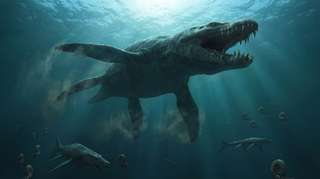
Life restoration of the German Jurassic ichthyosaur Suevoleviathan disinteger. The dorsal and caudal fins are loosely based on those of Stenopterygius.
References
Maisch, M.W. (2020). "The best-preserved skeleton of Suevoleviathan integer (Bronn, 1844)(Reptilia: Ichthyosauria) from the lower Jurassic of south-western Germany, with a discussion of the genus". Neues Jahrbuch für Geologie und Paläontologie, Abhandlungen 297 (2): 153–172.
Maisch, M.W. (1998). "A new ichthyosaur genus from the Posidonia Shale (Lower Toarcian, Jurassic) of Holzmaden, SW-Germany with comments on the phylogeny of post-Triassic ichthyosaurs". Neues Jahrbuch für Geologie und Paläontologie-Abhandlungen 209 (1): 47–78.
Taxons Suevoleviathan

Life restoration of the German Jurassic ichthyosaur Suevoleviathan disinteger. The dorsal and caudal fins are loosely based on those of Stenopterygius. References Maisch, M.W. (2020). "The best-preserved skeleton of Suevoleviathan integer (Bronn, 1844)(Reptilia: Ichthyosauria) from the lower Jurassic of south-western Germany, with a discussion of the genus". Neues Jahrbuch für Geologie und Paläontologie, Abhandlungen 297 (2): 153–172. Maisch, M.W. (1998). "A new ichthyosaur genus from the Posidonia Shale (Lower Toarcian, Jurassic) of Holzmaden, SW-Germany with comments on the phylogeny of post-Triassic ichthyosaurs". Neues Jahrbuch für Geologie und Paläontologie-Abhandlungen 209 (1): 47–78.

Allemagne Posidonia Shale Jurassique Toarcien +6
Highly derived mosasaur from the Moreno Formation that could grow to large sized. Converges with basal ichthyosaurs in bauplan- and has tuna-like swimming motion.

Highly derived mosasaur from the Moreno Formation that could grow to large sized. Converges with basal ichthyosaurs in bauplan- and has tuna-like swimming motion.

Ichthyosauria Plotosaurus formation
Precious opal replacing Ichthyosaur backbone; display specimen, South Australian Museum.
 Original filename = P2211104.JPG

Precious opal replacing Ichthyosaur backbone; display specimen, South Australian Museum. Original filename = P2211104.JPG

musée spécimen Ichthyosauria Platypterygius
Phylogeny of the Ichthyosauria according to Fischer et al. 2012.

Phylogeny of the Ichthyosauria according to Fischer et al. 2012.

Ichthyosauria Platypterygius phylogénie
Phylogeny of Ichthyosauria. Thin lines represent ghost lineages, thick black lines indicate the stratigraphic range of a species. Thick grey lines refer to the stratigraphic range of the corresponding genus.

Phylogeny of Ichthyosauria. Thin lines represent ghost lineages, thick black lines indicate the stratigraphic range of a species. Thick grey lines refer to the stratigraphic range of the corresponding genus.

Ichthyosauria Platypterygius phylogénie
Ichthyosaur Skeleton, Platypterygius longmani, in The Museum and Art Gallery of the Northern Territory at Darwin.

Ichthyosaur Skeleton, Platypterygius longmani, in The Museum and Art Gallery of the Northern Territory at Darwin.

musée Ichthyosauria Platypterygius squelette
Ichthyosaurus wervel (Platypterygius, Lêegr Kryt, teegn Darwin, Noord Australië).

Ichthyosaurus wervel (Platypterygius, Lêegr Kryt, teegn Darwin, Noord Australië).

Ichthyosauria Platypterygius
1 2 3

Actualités

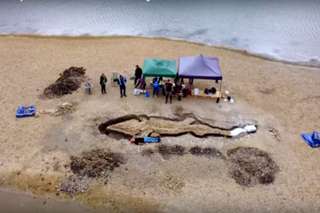
Un gigantesque « dragon des mers » vieux de 180 millions d’années découvert au Royaume-Uni
Royaume-Uni fossile Ichthyosauria découverte
180 millions d'années sous nos pieds. Un fossile d'ichtyosaure colossal vient d'être mis au jour en Angleterre, et il redessine ce que l'on croyait savoir sur ces reptiles marins préhistoriques. Une découverte qui a fait trembler le monde de la paléontologie britannique. 
16/06/2026 futura-terre
Un fossile de « Sword Dragon » vieux de 190 millions d’années réécrit l’histoire des ichtyosaures
Royaume-Uni Jurassique fossile Ichthyosauria évolution squelette
Un ichtyosaure nouvellement identifié de la côte jurassique du Royaume-Uni est en train de réécrire une partie du manuel préhistorique. Surnommé le « dragon-épée du Dorset », ce reptile marin de trois mètres de long a vécu pendant une période d’évolution mal comprise, au cours de laquelle les principaux groupes d’ichtyosaures disparaissaient et de nouveaux apparaissaient. Son squelette magnifiquement préservé – doté d’un museau en forme de lame et d’un éventuel dernier repas – permet de déterminer le moment où cette transition dramatique s’est produite.
24/02/2026 sciencedaily ⚙ Traduction automatique
1 2