←

feeding

Behavior & Physiology

4 image(s) · 11 News

Image gallery

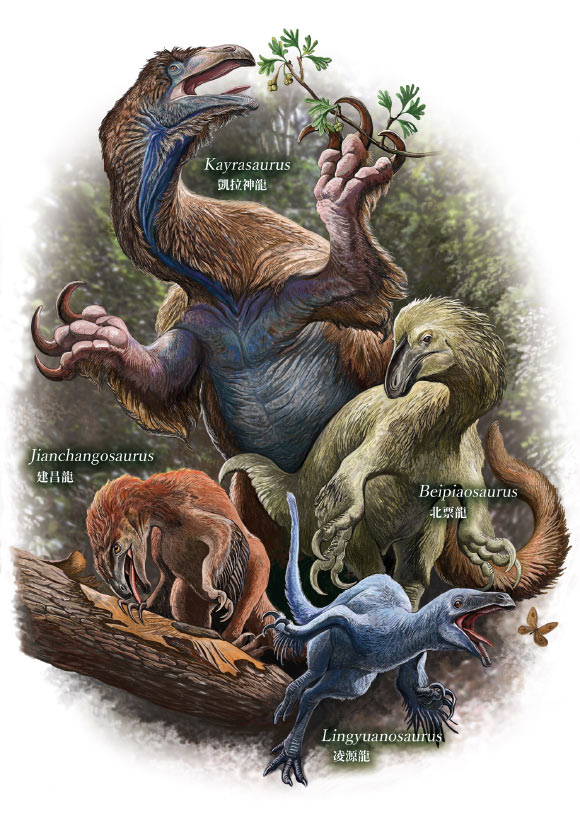
Life reconstruction of Jehol therizinosaurians, illustrating variation in body size, skeletal proportions and inferred ecological strategies among species (from bottom to top): Lingyuanosaurus sihedangensis is shown in a posture suggesting greater cursoriality; Jianchangosaurus yixianensis is depicted engaging in lingual-assisted feeding, consistent with its robust hyoid apparatus; Beipiaosaurus inexpectus exhibits a robust, less cursorial bauplan; and Kayrasaurus changliensis is reconstructed browsing on higher vegetation, reflecting its larger body size and inferred feeding strategy

Life reconstruction of Jehol therizinosaurians, illustrating variation in body size, skeletal proportions and inferred ecological strategies among species (from bottom to top): Lingyuanosaurus sihedangensis is shown in a posture suggesting greater cursoriality; Jianchangosaurus yixianensis is depicted engaging in lingual-assisted feeding, consistent with its robust hyoid apparatus; Beipiaosaurus inexpectus exhibits a robust, less cursorial bauplan; and Kayrasaurus changliensis is reconstructed browsing on higher vegetation, reflecting its larger body size and inferred feeding strategy

feeding reconstitution Beipiaosaurus Jianchangosaurus +3
Balaenognathus maeuseri gen. et sp. nov.: comparative interpretive drawings of the skulls of suspension feeding ctenochasmatoid pterosaurs in dorsal aspect. Balaenognathus this paper; Pterodaustro based on Bonaparte (1978); Plateleorhynchus based on Howse and Milner (1995); Gnathosaurus based on specimen JME-SOS 4580; Ctenochasma based on (2007 Fig. 2F)
Taxa Plataleorhynchus

Balaenognathus maeuseri gen. et sp. nov.: comparative interpretive drawings of the skulls of suspension feeding ctenochasmatoid pterosaurs in dorsal aspect. Balaenognathus this paper; Pterodaustro based on Bonaparte (1978); Plateleorhynchus based on Howse and Milner (1995); Gnathosaurus based on specimen JME-SOS 4580; Ctenochasma based on (2007 Fig. 2F)

feeding drawing specimen Balaenognathus +6
Kol ghuva restored as feeding from a termite mound, based on related animals.
Taxa Kol

Kol ghuva restored as feeding from a termite mound, based on related animals.

feeding
Classification: Saurischia, Tyrannosauroidea
Size: 2 meters (length)
Feeding: carnivore
Taxa Santanaraptor

Classification: Saurischia, Tyrannosauroidea Size: 2 meters (length) Feeding: carnivore

feeding Santanaraptor Saurischia Tyrannosauroidea

News

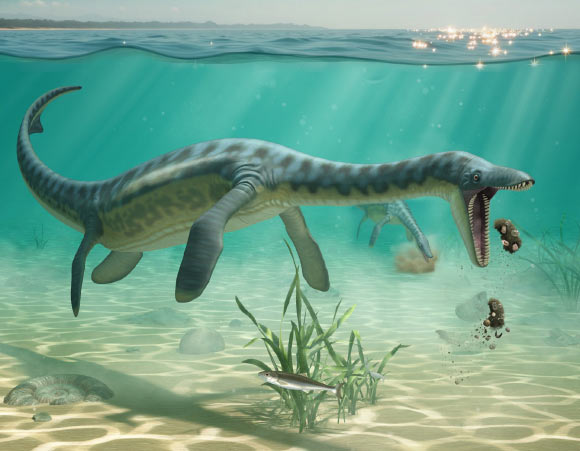
Fossilized Vomit Reveals How Plesiosaurs Dined on Jurassic Seafloor
feeding Jurassic Plesiosauria Plesiosaurus
Dr. Dirk Knaust, a geologist with the Norwegian energy company Equinor ASA, has identified plesiosaur regurgitalites -- the technical term for fossilized vomit -- from preserved in rock cores drilled beneath the North Sea, offering a rare window into how these long-necked marine reptiles fed in the Middle and Late Jurassic seas. The post Fossilized Vomit Reveals How Plesiosaurs Dined on Jurassic Seafloor appeared first on Sci.News: Breaking Science News.
23/09/2026 sci-news
Did T. rex leave these 66-million-year-old bite marks?
bone tooth feeding Dinosauria Tyrannosaurus behavior dating
Fossilized dinosaur bones from Wyoming are offering a rare glimpse into the feeding behavior of Tyrannosaurus rex. Researchers examined more than 3,000 bones dating back 72 to 66 million years and found just 12 with possible tooth traces, including four with patterns that closely matched the shape and spacing of T. rex teeth.
05/08/2026 sciencedaily
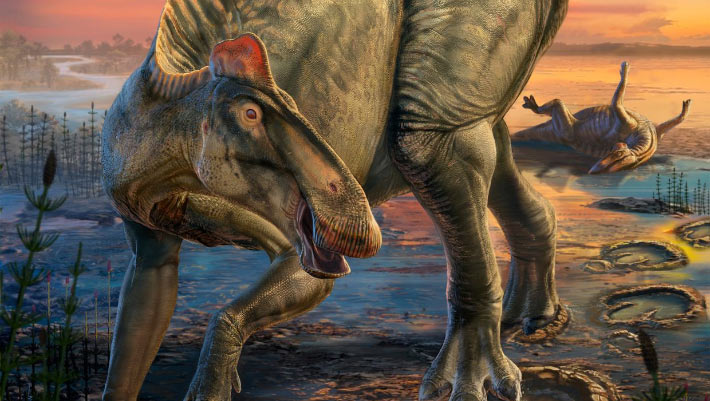
Tyrannosaurus rex Scavenged Duck-Billed Dinosaurs in Ancient Wyoming, Bite Marks Reveal
bone feeding hunting United States Cretaceous Canardia Dinosauria Edmontosaurus Tyrannosaurus behavior
Thousands of fossilized bones from a Cretaceous-period bonebed in Wyoming, the United States, offer rare physical evidence that Tyrannosaurus rex fed on the carcasses of a duck-billed dinosaur species called Edmontosaurus annectens. The post Tyrannosaurus rex Scavenged Duck-Billed Dinosaurs in Ancient Wyoming, Bite Marks Reveal appeared first on Sci.News: Breaking Science News.
16/07/2026 sci-news
Scientists discover what kept ancient campfires burning for generations
feeding Israel fish Homo sapiens
Nearly 800,000 years ago, early humans living beside a lake in what is now Israel may have chosen the location for one surprisingly practical reason: firewood. Researchers discovered that these ancient people regularly gathered driftwood washed up along the shoreline, giving them an easy, reliable fuel source for cooking fish, processing large animals, making tools, and organizing daily life around hearths.
15/07/2026 sciencedaily-paleo
5,000-year-old wolves found on remote island rewrite what we know about domestication
ecology feeding Homo sapiens mammals
Scientists discovered ancient wolves on a tiny Baltic island where they could only have been brought by humans, suggesting an unexpectedly close relationship between people and wolves thousands of years ago. Evidence indicates the wolves were fed, possibly cared for, and may even have been managed or selectively bred long before modern ideas of domestication.
05/07/2026 sciencedaily
1 2 3