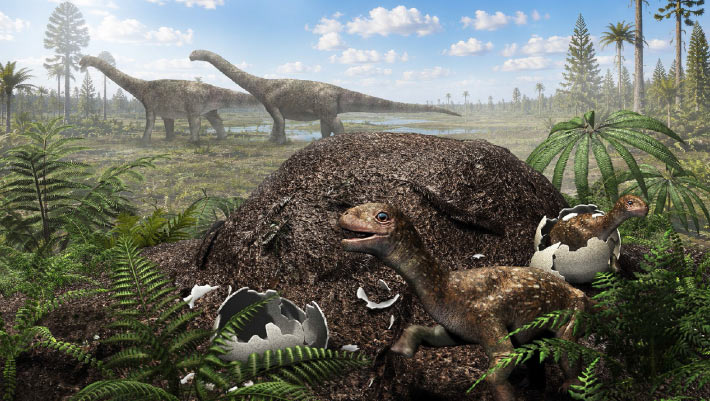
nest

Behavior & Physiology

2 image(s) · 3 News

Image gallery

A reconstruction of Parvicursor sitting on its nest.
Taxa Parvicursor

A reconstruction of Parvicursor sitting on its nest.

nest Parvicursor
Youngoolithus xiaguanensis nest on display at the Paleozoological Museum of China.
Taxa Youngoolithus

Youngoolithus xiaguanensis nest on display at the Paleozoological Museum of China.

nest museum China Youngoolithidae +1
Youngoolithus xiaguanensis nest on display at the Paleozoological Museum of China.
Taxa Youngoolithidae

Youngoolithus xiaguanensis nest on display at the Paleozoological Museum of China.

nest museum China Youngoolithidae +1

News

Goethe never knew this 40-million-year-old ant was hidden in his collection
nest fossil insect
Scientists examining amber from Goethe’s personal collection discovered three hidden fossil insects, including an extinct ant preserved in extraordinary detail. Advanced 3D imaging allowed researchers to see not only the ant’s outer features but also structures inside its body. The findings offer new clues about the species’ biology and suggest it likely built large nests in trees.
04/06/2026 sciencedaily-paleo
Ancient bees found nesting inside fossil bones in rare cave discovery
bone jaw nest prey fossil discovery
Thousands of years ago in a cave on Hispaniola, an unusual chain of events left behind a rare scientific treasure: bees nesting inside fossilized bones. After giant barn owls repeatedly brought prey like hutias into the cave, their remains accumulated in silt-rich chambers—creating a strange underground environment. Later, burrowing bees took advantage of the soft sediment and even reused tiny cavities in fossilized jaws and bones as ready-made nests, coating them with a smooth, waterproof linin
03/04/2026 sciencedaily
Scientists recreated a dinosaur nest to solve a 70-million-year-old mystery
nest Dinosauria Oviraptor bird
Scientists recreated a life-size oviraptor nest to understand how these dinosaurs hatched their eggs. Their experiments showed the parent likely couldn’t heat all the eggs directly, meaning sunlight played a key role. This uneven heating could cause eggs in the same nest to hatch at different times. The results suggest oviraptors used a hybrid incubation method unlike modern birds.
19/03/2026 sciencedaily