reproduction

Comportement & Physiologie

1 image(s) · 4 Actualités

Galerie d'images

Close-up of the traumatic lesion observed in the right squamosal bone of Big John, a fossilized specimen of the dinosaur species Triceratops horridus. This image shows plaque-like deposition of reactive bone (white arrows) and lytic lesions (black arrows) on the surface around the lesion. These suggest that the lesion was surrounded by newly-formed bone and, therefore, had started to heal.
This image was originally published as Figure 1c in the following journal article:
Ruggero D’Anastasio, Jacopo Cilli, Flavio Bacchia, Federico Fanti, Giacomo Gobbo & Luigi Capasso (2022) Histological and chemical diagnosis of a combat lesion in Triceratops Scientific Reports, 12, 3941 (2022). DOI: 10.1038/s41598-022-08033-2
This article was published with the following license:
"This article is licensed under a Creative Commons Attribution 4.0 International License, which permits use, sharing, adaptation, distribution and reproduction in any medium or format, as long as you give appropriate credit to the original author(s) and the source, provide a link to the Creative Commons licence, and indicate if changes were made. The images or other third party material in this article are included in the article's Creative Commons licence, unless indicated otherwise in a credit line to the material. If material is not included in the article's Creative Commons licence and your intended use is not permitted by statutory regulation or exceeds the permitted use, you will need to obtain permission directly from the copyright holder. To view a copy of this licence, visit http://creativecommons.org/licenses/by/4.0/."

Figure 1c is published without a credit line and, therefore, falls under the article's CC BY 4.0 licence.

Close-up of the traumatic lesion observed in the right squamosal bone of Big John, a fossilized specimen of the dinosaur species Triceratops horridus. This image shows plaque-like deposition of reactive bone (white arrows) and lytic lesions (black arrows) on the surface around the lesion. These suggest that the lesion was surrounded by newly-formed bone and, therefore, had started to heal. This image was originally published as Figure 1c in the following journal article: Ruggero D’Anastasio, Jacopo Cilli, Flavio Bacchia, Federico Fanti, Giacomo Gobbo & Luigi Capasso (2022) Histological and chemical diagnosis of a combat lesion in Triceratops Scientific Reports, 12, 3941 (2022). DOI: 10.1038/s41598-022-08033-2 This article was published with the following license: "This article is licensed under a Creative Commons Attribution 4.0 International License, which permits use, sharing, adaptation, distribution and reproduction in any medium or format, as long as you give appropriate credit to the original author(s) and the source, provide a link to the Creative Commons licence, and indicate if changes were made. The images or other third party material in this article are included in the article's Creative Commons licence, unless indicated otherwise in a credit line to the material. If material is not included in the article's Creative Commons licence and your intended use is not permitted by statutory regulation or exceeds the permitted use, you will need to obtain permission directly from the copyright holder. To view a copy of this licence, visit http://creativecommons.org/licenses/by/4.0/." Figure 1c is published without a credit line and, therefore, falls under the article's CC BY 4.0 licence.

os reproduction spécimen Dinosauria +1

Actualités

Des scientifiques ont recréé un nid de dinosaure et résolu un mystère vieux de 70 millions d'années
nid reproduction Dinosauria Oviraptor oiseau
Une équipe de chercheurs a recréé un nid d'oviraptors grandeur nature pour étudier comment ces dinosaures ressemblant à des oiseaux couvaient leurs œufs il y a des millions d'années. En combinant des expériences physiques avec des simulations de transfert de chaleur, ils ont découvert que les oviraptors dépendaient probablement à la fois de leur propre chaleur corporelle et de celle du soleil.
01/07/2026 sciencedaily ⚙ Traduction automatique
Earth’s Earliest Animals May Have Thrived Too Easily to Evolve
Les premiers animaux de la Terre ont peut-être prospéré trop facilement pour évoluer
reproduction Édiacarien fossile datation évolution
Les fossiles de certains des animaux les plus anciens connus sur Terre, datant d'il y a 574 millions d'années (période Édiacarienne), suggèrent que le clonage, et non la compétition, a dominé les mers de l'Édiacarien, ralentissant l'évolution jusqu'à ce que le stress environnemental contribue à l'essor de la reproduction sexuée et à un éclatement de la biodiversité. L’article Les premiers animaux de la Terre ont peut-être prospéré trop facilement pour évoluer est apparu en premier sur Sci.News : Breaking Science News.
10/06/2026 sci-news ⚙ Traduction automatique
Les premiers animaux de la Terre ont à peine évolué jusqu'à ce que le sexe change tout
reproduction Paléozoïque évolution
Les premiers animaux de la Terre ont peut-être freiné l’évolution parce qu’ils se sont reproduits de manière asexuée, créant ainsi des communautés peu compétitives qui ont très peu changé au fil du temps. Lorsque les pressions environnementales les ont poussés vers la reproduction sexuée, la biodiversité a explosé et l’évolution s’est considérablement accélérée.
10/06/2026 sciencedaily-paleo ⚙ Traduction automatique
Ce fossile prouve enfin une théorie vieille de 200 ans
reproduction fossile évolution mammifères
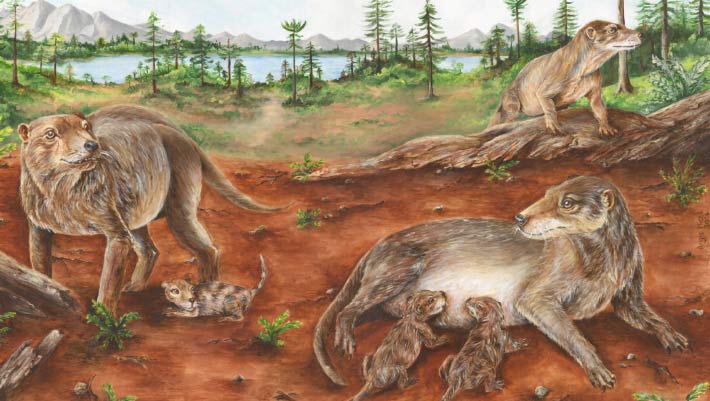
Ce petit nodule fossilisé a été découvert en 2008. Il vient seulement de livrer ses secrets : de quoi valider une théorie vieille de près de deux siècles sur l’évolution de la reproduction chez les ancêtres des mammifères.
28/04/2026 sciencesetavenir