←

Megaraptora

Taxon

8 image(s) · 2 Actualités

Voir la fiche

Galerie d'images

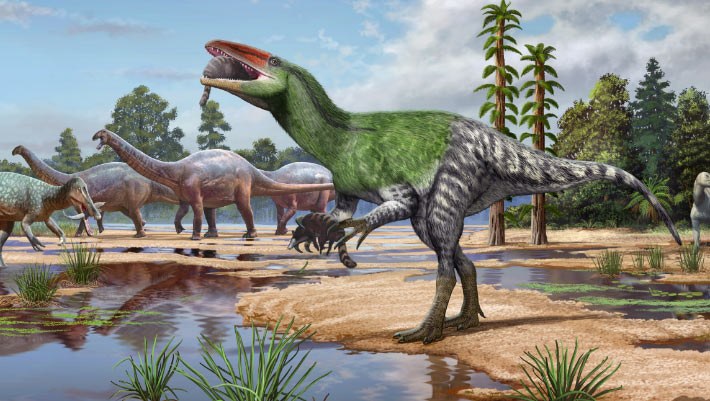
Rinconraptor is a medium-sized megaraptoran theropod dinosaur, growing to approximately 7 m in total body length. It was a bipedal carnivore with proportionately long arms, each ending in three long claws. An enigmatic group, Rinconraptor's discovery helped to reinforce the idea that megaraptorans were closely related to tyrannosaurs.
Taxons Rinconraptor

Rinconraptor is a medium-sized megaraptoran theropod dinosaur, growing to approximately 7 m in total body length. It was a bipedal carnivore with proportionately long arms, each ending in three long claws. An enigmatic group, Rinconraptor's discovery helped to reinforce the idea that megaraptorans were closely related to tyrannosaurs.

griffe Dinosauria Megaraptora Rinconraptor +1
Invictibellatrix is a megaraptoran theropod that lived during the Early Cretaceous period in what is now England. It is the first megaraptoran discovered in Europe, shedding light on how this group diversified and dispersed throughout the Cretaceous. Invictibellatrix is the smallest known megaraptoran, at an estimated 3-4 m in total body length.

Invictibellatrix is a megaraptoran theropod that lived during the Early Cretaceous period in what is now England. It is the first megaraptoran discovered in Europe, shedding light on how this group diversified and dispersed throughout the Cretaceous. Invictibellatrix is the smallest known megaraptoran, at an estimated 3-4 m in total body length.

Crétacé Crétacé inférieur Invictibellatrix Megaraptora
Speculative life restoration of Invictibellatrix amberina, the first megaraptoran dinosaur described from Europe, based off of T.K. Robinson’s composite megaraptoran skeletal: https://incinerox.artstation.com/projects/J9aV0d

Speculative life restoration of Invictibellatrix amberina, the first megaraptoran dinosaur described from Europe, based off of T.K. Robinson’s composite megaraptoran skeletal: https://incinerox.artstation.com/projects/J9aV0d

Dinosauria Invictibellatrix Megaraptora
Phylogenetic relationships, chronostratigraphic, and paleoecological implications of M. intrepidus. a Graphic illustrating temporal range of North American tyrannosauroids including species-level range prior to the discovery of M. intrepidus, extension of current range, and hypothesized range based on isolated teeth12. The current gap in the North American tyrannosauroid record spans from the Tithonian to the Aptian. Faunal composition of Late Cretaceous ecosystems was established between the Albian and Turonian, as recognized by the stratigraphic appearance of major clades (see refs. 7,12 and references therein). b generalized phylogenetic relationships of Tyrannosauroidea, showing the appearance of select traits related to cursoriality in tyrannosaurs that are newly optimized as a result of the discovery of M. intrepidus. Tree topology follows this study using the modified dataset of Carr and colleagues27. Coelurus and Tanycolagreus are grafted as basal tyrannosauroids following Brusatte and colleagues5. c Stratigraphic distribution of Allosauria in North America (incl. Megaraptora but see ref. 70 for alternative hypotheses regarding this clade) documents overlap with M. intrepidus in early Late Cretaceous ecosystems leading to (d) refined calibration on the origin of late diverging tyrannosauroids and clade-level faunal turnover within apex predator roles throughout the Late Jurassic–Late Cretaceous of North America. Colored polygons are stylized call-outs and are not intended to reflect two-dimensional data. Temporal data corresponding to this figure are available in Supplementary Table 5
Taxons Coelurus

Phylogenetic relationships, chronostratigraphic, and paleoecological implications of M. intrepidus. a Graphic illustrating temporal range of North American tyrannosauroids including species-level range prior to the discovery of M. intrepidus, extension of current range, and hypothesized range based on isolated teeth12. The current gap in the North American tyrannosauroid record spans from the Tithonian to the Aptian. Faunal composition of Late Cretaceous ecosystems was established between the Albian and Turonian, as recognized by the stratigraphic appearance of major clades (see refs. 7,12 and references therein). b generalized phylogenetic relationships of Tyrannosauroidea, showing the appearance of select traits related to cursoriality in tyrannosaurs that are newly optimized as a result of the discovery of M. intrepidus. Tree topology follows this study using the modified dataset of Carr and colleagues27. Coelurus and Tanycolagreus are grafted as basal tyrannosauroids following Brusatte and colleagues5. c Stratigraphic distribution of Allosauria in North America (incl. Megaraptora but see ref. 70 for alternative hypotheses regarding this clade) documents overlap with M. intrepidus in early Late Cretaceous ecosystems leading to (d) refined calibration on the origin of late diverging tyrannosauroids and clade-level faunal turnover within apex predator roles throughout the Late Jurassic–Late Cretaceous of North America. Colored polygons are stylized call-outs and are not intended to reflect two-dimensional data. Temporal data corresponding to this figure are available in Supplementary Table 5

prédateur Albien Aptien Crétacé +12
Speculative reconstruction of Aoniraptor'’ from the Late Cretaceous of Argentina, here restored as a megaraptoran as recovered by most studies
Taxons Aoniraptor

Speculative reconstruction of Aoniraptor'’ from the Late Cretaceous of Argentina, here restored as a megaraptoran as recovered by most studies

Argentine Crétacé Crétacé supérieur Aoniraptor +1
Reconstructed skeleton of a megaraptoran highlighting the known bones of Joaquinraptor casali in blue. Reconstruction by TK Robinson and Andrew McAfee. Scale bar=1 m.
Taxons Joaquinraptor

Reconstructed skeleton of a megaraptoran highlighting the known bones of Joaquinraptor casali in blue. Reconstruction by TK Robinson and Andrew McAfee. Scale bar=1 m.

os écaille Joaquinraptor Megaraptora +1
Phylogenetic relationships, chronostratigraphic, and paleoecological implications of M. intrepidus. a Graphic illustrating temporal range of North American tyrannosauroids including species-level range prior to the discovery of M. intrepidus, extension of current range, and hypothesized range based on isolated teeth12. The current gap in the North American tyrannosauroid record spans from the Tithonian to the Aptian. Faunal composition of Late Cretaceous ecosystems was established between the Albian and Turonian, as recognized by the stratigraphic appearance of major clades (see refs. 7,12 and references therein). b generalized phylogenetic relationships of Tyrannosauroidea, showing the appearance of select traits related to cursoriality in tyrannosaurs that are newly optimized as a result of the discovery of M. intrepidus. Tree topology follows this study using the modified dataset of Carr and colleagues27. Coelurus and Tanycolagreus are grafted as basal tyrannosauroids following Brusatte and colleagues5. c Stratigraphic distribution of Allosauria in North America (incl. Megaraptora but see ref. 70 for alternative hypotheses regarding this clade) documents overlap with M. intrepidus in early Late Cretaceous ecosystems leading to (d) refined calibration on the origin of late diverging tyrannosauroids and clade-level faunal turnover within apex predator roles throughout the Late Jurassic–Late Cretaceous of North America. Colored polygons are stylized call-outs and are not intended to reflect two-dimensional data. Temporal data corresponding to this figure are available in Supplementary Table 5

Phylogenetic relationships, chronostratigraphic, and paleoecological implications of M. intrepidus. a Graphic illustrating temporal range of North American tyrannosauroids including species-level range prior to the discovery of M. intrepidus, extension of current range, and hypothesized range based on isolated teeth12. The current gap in the North American tyrannosauroid record spans from the Tithonian to the Aptian. Faunal composition of Late Cretaceous ecosystems was established between the Albian and Turonian, as recognized by the stratigraphic appearance of major clades (see refs. 7,12 and references therein). b generalized phylogenetic relationships of Tyrannosauroidea, showing the appearance of select traits related to cursoriality in tyrannosaurs that are newly optimized as a result of the discovery of M. intrepidus. Tree topology follows this study using the modified dataset of Carr and colleagues27. Coelurus and Tanycolagreus are grafted as basal tyrannosauroids following Brusatte and colleagues5. c Stratigraphic distribution of Allosauria in North America (incl. Megaraptora but see ref. 70 for alternative hypotheses regarding this clade) documents overlap with M. intrepidus in early Late Cretaceous ecosystems leading to (d) refined calibration on the origin of late diverging tyrannosauroids and clade-level faunal turnover within apex predator roles throughout the Late Jurassic–Late Cretaceous of North America. Colored polygons are stylized call-outs and are not intended to reflect two-dimensional data. Temporal data corresponding to this figure are available in Supplementary Table 5

prédateur Albien Aptien Crétacé +12
A) Skull reconstruction of Murusraptor barrosaensis, MCF-PVPH-411. B) Body reconstruction of Murusraptor barrosaensis, MCF-PVPH-411.

Both illustrations show recovered elements in white. Scale bars: A = 10 cm, B = 1 m.
Taxons Murusraptor

A) Skull reconstruction of Murusraptor barrosaensis, MCF-PVPH-411. B) Body reconstruction of Murusraptor barrosaensis, MCF-PVPH-411. Both illustrations show recovered elements in white. Scale bars: A = 10 cm, B = 1 m.

écaille Megaraptora Megaraptoridae Murusraptor +1
A) Skull reconstruction of Murusraptor barrosaensis, MCF-PVPH-411. B) Body reconstruction of Murusraptor barrosaensis, MCF-PVPH-411.

Both illustrations show recovered elements in white. Scale bars: A = 10 cm, B = 1 m.
Taxons Megaraptora

A) Skull reconstruction of Murusraptor barrosaensis, MCF-PVPH-411. B) Body reconstruction of Murusraptor barrosaensis, MCF-PVPH-411. Both illustrations show recovered elements in white. Scale bars: A = 10 cm, B = 1 m.

écaille Megaraptora Megaraptoridae Murusraptor +1
A) Skull reconstruction of Murusraptor barrosaensis, MCF-PVPH-411. B) Body reconstruction of Murusraptor barrosaensis, MCF-PVPH-411.

Both illustrations show recovered elements in white. Scale bars: A = 10 cm, B = 1 m.
Taxons Megaraptoridae

A) Skull reconstruction of Murusraptor barrosaensis, MCF-PVPH-411. B) Body reconstruction of Murusraptor barrosaensis, MCF-PVPH-411. Both illustrations show recovered elements in white. Scale bars: A = 10 cm, B = 1 m.

écaille Megaraptora Megaraptoridae Murusraptor +1

Actualités

New Species of Predatory Dinosaur Identified in UK
Une nouvelle espèce de dinosaure prédateur identifiée au Royaume-Uni
musée Royaume-Uni Dinosauria Invictibellatrix Megaraptora nouvelle espèce
355 Une boîte crânienne fossilisée, conservée pendant un siècle dans les collections du Muséum d’histoire naturelle de Londres, a été identifiée comme appartenant au premier dinosaure mégaraptorien découvert en Europe – une lignée que l’on pensait jusqu’alors avoir principalement prospéré dans l’hémisphère sud. L’article « Une nouvelle espèce de dinosaure prédateur identifiée au Royaume-Uni » est paru initialement sur Sci.News : Actualités scientifiques.
14/10/2026 sci-news ⚙ Traduction automatique
Un fossile oublié révèle un redoutable dinosaure aux griffes géantes
griffe prédateur musée fossile Dinosauria Megaraptora
Un fossile vieux de 120 millions d'années oublié dans un musée depuis près d'un siècle a révélé un nouveau dinosaure terrifiant qui aurait pu être plus dangereux pour les humains qu'un T. rex. Ce prédateur de la taille d'un tigre fournit également la première preuve de la présence de mégaraptorans en Europe, aidant à expliquer comment ces mystérieux dinosaures sont finalement devenus de gigantesques chasseurs.
14/10/2026 sciencedaily ⚙ Traduction automatique