←

Pterosauria

Taxon

56 image(s) · 11 Actualités

Voir la fiche

Galerie d'images

Anhanguerid pterosaur Nicorhynchus capito gen. et comb. nov. (holotype),CAMSM B54625, Chesterton, Cambridgeshire, England, Albian.In anterior (A1), right lateral (A2), palatal (A3), and left lateral (A4) views.A1 and A3 modified from Rodrigues and Kellner (2013), A2 and A4 photographsby BH.
Taxons Nicorhynchus

Anhanguerid pterosaur Nicorhynchus capito gen. et comb. nov. (holotype),CAMSM B54625, Chesterton, Cambridgeshire, England, Albian.In anterior (A1), right lateral (A2), palatal (A3), and left lateral (A4) views.A1 and A3 modified from Rodrigues and Kellner (2013), A2 and A4 photographsby BH.

Albien holotype Anhangueridae Nicorhynchus +1
Fossil specimen BSP 1935.I.24 (Ctenochasma elegans), an extinct pterosaur
Taxons Ctenochasma

Fossil specimen BSP 1935.I.24 (Ctenochasma elegans), an extinct pterosaur

fossile spécimen Ctenochasma Pterodactylus +1
Photograph of Museo civico di scienze naturali di Bergamo (MCSNB) 2888, the holotype specimen of Eudimorphodon ranzii ZAMBELLI 1973, a basal pterosaur from the Norian (middle Upper Triassic) of the Italian Alps.[1]


↑ see fig. 8A in Silvio Renesto (2006): A reappraisal of the diversity and biogeographic significance of the Norian (Late Triassic) reptiles from the Calcare di Zorzino. In: Jerry D. Harris, Spencer G. Lucas, Justin A. Spielmann, Martin G. Lockley, Andrew R.C. Milner, James I. Kirkland (eds.): The Triassic-Jurassic Terrestrial Transition. New Mexico Museum of Natural History and Science Bulletin 37:445–456 (online)
Taxons Eudimorphodon

Photograph of Museo civico di scienze naturali di Bergamo (MCSNB) 2888, the holotype specimen of Eudimorphodon ranzii ZAMBELLI 1973, a basal pterosaur from the Norian (middle Upper Triassic) of the Italian Alps.[1] ↑ see fig. 8A in Silvio Renesto (2006): A reappraisal of the diversity and biogeographic significance of the Norian (Late Triassic) reptiles from the Calcare di Zorzino. In: Jerry D. Harris, Spencer G. Lucas, Justin A. Spielmann, Martin G. Lockley, Andrew R.C. Milner, James I. Kirkland (eds.): The Triassic-Jurassic Terrestrial Transition. New Mexico Museum of Natural History and Science Bulletin 37:445–456 (online)

musée Mexique Jurassique Trias supérieur +6
A cast of the pterosaur Dorygnathus banthensis at Göteborgs Naturhistoriska Museum, Gothenburg, Sweden.
Taxons Dorygnathus

A cast of the pterosaur Dorygnathus banthensis at Göteborgs Naturhistoriska Museum, Gothenburg, Sweden.

musée Suède moulage Dorygnathus +1
From the English Wikipedia. 
Original description: The pterodactyloid pterosaur Anhanguera piscator by John Conway,  [1]
Taxons Ptenodactylus

From the English Wikipedia. Original description: The pterodactyloid pterosaur Anhanguera piscator by John Conway, [1]

description Conway Anhanguera Ptenodactylus +1
Illustration of the holotype metacarpal of Dermodactylus montanus, a pterosaur from the Jurassic of Wyoming.  Reference 
Colbert EH (1969) A Jurassic Pterosaur from Cuba. American Museum Novitates 2370, 1-26
Taxons Dermodactylus

Illustration of the holotype metacarpal of Dermodactylus montanus, a pterosaur from the Jurassic of Wyoming. Reference Colbert EH (1969) A Jurassic Pterosaur from Cuba. American Museum Novitates 2370, 1-26

musée Cuba Jurassique holotype +2
‘Araripesaurus castilhoi’ A, B, holotype (DGM 549-R), the first pterosaur specimen from the Araripe basin, described by L. I. Price in 1971.
Taxons Araripesaurus

‘Araripesaurus castilhoi’ A, B, holotype (DGM 549-R), the first pterosaur specimen from the Araripe basin, described by L. I. Price in 1971.

holotype spécimen Araripesaurus Pterosauria
Tropeognathine pterosaur Siroccopteryx moroccensis Mader andKellner, 1999, LINHM FR016, Kem Kem beds, Morocco, ?Albian–lowerCenomanian. A. Photograph in anterior (A1), left lateral (A2), and dorsal(A3) views. B. Interpretation of the palatal view following Mader andKellner (1999). Photographs courtesy of Megan L. Jacobs. Drawing byRVP based on Mader and Kellner (1999).
Taxons Siroccopteryx

Tropeognathine pterosaur Siroccopteryx moroccensis Mader andKellner, 1999, LINHM FR016, Kem Kem beds, Morocco, ?Albian–lowerCenomanian. A. Photograph in anterior (A1), left lateral (A2), and dorsal(A3) views. B. Interpretation of the palatal view following Mader andKellner (1999). Photographs courtesy of Megan L. Jacobs. Drawing byRVP based on Mader and Kellner (1999).

dessin Maroc Albien Pterosauria +1
An illustration of the pterosaur Normannognathus wellnhoferi
Taxons Normannognathus

An illustration of the pterosaur Normannognathus wellnhoferi

Normannognathus Pterosauria
Azhdarchoid pterosaur Kariridraco dianae gen. et sp. nov. holotype (MPSC R 1056) from Lower Cretaceous of Northeastern Brazil. Skull in right lateral view. Photograph (A1), interpretative drawing (A2). Dark grey areas indicate remains of the carbonate matrix still attachaed to the skull.
Taxons Kariridraco

Azhdarchoid pterosaur Kariridraco dianae gen. et sp. nov. holotype (MPSC R 1056) from Lower Cretaceous of Northeastern Brazil. Skull in right lateral view. Photograph (A1), interpretative drawing (A2). Dark grey areas indicate remains of the carbonate matrix still attachaed to the skull.

dessin Brésil Crétacé holotype +3
Balaenognathus maeuseri gen. et sp. nov.: comparative interpretive drawings of the skulls of suspension feeding ctenochasmatoid pterosaurs in dorsal aspect. Balaenognathus this paper; Pterodaustro based on Bonaparte (1978); Plateleorhynchus based on Howse and Milner (1995); Gnathosaurus based on specimen JME-SOS 4580; Ctenochasma based on (2007 Fig. 2F)
Taxons Plataleorhynchus

Balaenognathus maeuseri gen. et sp. nov.: comparative interpretive drawings of the skulls of suspension feeding ctenochasmatoid pterosaurs in dorsal aspect. Balaenognathus this paper; Pterodaustro based on Bonaparte (1978); Plateleorhynchus based on Howse and Milner (1995); Gnathosaurus based on specimen JME-SOS 4580; Ctenochasma based on (2007 Fig. 2F)

alimentation dessin spécimen Balaenognathus +6
Samrukia nesovi was originally described as a giant bird, but is now considered a pterodactyloid pterosaur of uncertain placement and validity. 

References: 
Naish, D., Dyke, G., Cau, A., Escuillié, F., & Godefroit, P. (2011). A gigantic bird from the Upper Cretaceous of Central Asia. Biology Letters, 8(1), 97–100. doi:10.1098/rsbl.2011.0683

Buffetaut, E. (2011). Samrukia nessovi, from the Late Cretaceous of Kazakhstan: A large pterosaur, not a giant bird. Annales de Paléontologie, 97(3–4), 133–138. doi:10.1016/j.annpal.2011.10.001
Taxons Samrukia

Samrukia nesovi was originally described as a giant bird, but is now considered a pterodactyloid pterosaur of uncertain placement and validity. References: Naish, D., Dyke, G., Cau, A., Escuillié, F., & Godefroit, P. (2011). A gigantic bird from the Upper Cretaceous of Central Asia. Biology Letters, 8(1), 97–100. doi:10.1098/rsbl.2011.0683 Buffetaut, E. (2011). Samrukia nessovi, from the Late Cretaceous of Kazakhstan: A large pterosaur, not a giant bird. Annales de Paléontologie, 97(3–4), 133–138. doi:10.1016/j.annpal.2011.10.001

Kazakhstan Crétacé Crétacé supérieur Pterosauria +2
Crato Formation pterosaur diversity – the dawn of Araripe pterosaur era. We emphasize that the coexistence of the taxa is merely illustrative, since the lack of geological context for most pterosaur fossils from the Araripe Basin prevents a precise inference of contemporaneity.
Taxons Lacusovagus

Crato Formation pterosaur diversity – the dawn of Araripe pterosaur era. We emphasize that the coexistence of the taxa is merely illustrative, since the lack of geological context for most pterosaur fossils from the Araripe Basin prevents a precise inference of contemporaneity.

fossile Lacusovagus Pterosauria formation
Partial wing of a czech pterosaur Cretornis hlavaci, discovered in 1880 near Choceň. National Museum in Prague.
Taxons Cretornis

Partial wing of a czech pterosaur Cretornis hlavaci, discovered in 1880 near Choceň. National Museum in Prague.

musée Cretornis Pterosauria partiel
(A)Alligator prenasalis, pterosaurs (B)Liaoxipterus brachycephalus and (C)Ludodactylus sibbicki, (D)basal ornithischian Jeholosaurus shangyuanensis, (E)tyrannosaur Yutyrannus huali (F) Sinosauropteryx prima.
Taxons Liaoxipterus

(A)Alligator prenasalis, pterosaurs (B)Liaoxipterus brachycephalus and (C)Ludodactylus sibbicki, (D)basal ornithischian Jeholosaurus shangyuanensis, (E)tyrannosaur Yutyrannus huali (F) Sinosauropteryx prima.

Jeholosaurus Liaoxipterus Ludodactylus Ornithischia +3
Australian Mesozoic pterosaurs. A, Aussiedraco molnari (QM F10613; holotype) mandible in dorsal view. Scale = 1 cm. B, Mythunga camara (QM F18896; holotype) partial skull and mandible in left lateral view. Scale = 5 cm. C, Thapunngaka shawi (KK F494; holotype) mandible in left lateral view. Scale = 5 cm. D, Ferrodraco lentoni (AODF 0876; holotype [part]) partial skull and mandible in left lateral view. Scale = 5 cm.
Taxons Aussiedraco

Australian Mesozoic pterosaurs. A, Aussiedraco molnari (QM F10613; holotype) mandible in dorsal view. Scale = 1 cm. B, Mythunga camara (QM F18896; holotype) partial skull and mandible in left lateral view. Scale = 5 cm. C, Thapunngaka shawi (KK F494; holotype) mandible in left lateral view. Scale = 5 cm. D, Ferrodraco lentoni (AODF 0876; holotype [part]) partial skull and mandible in left lateral view. Scale = 5 cm.

écaille Mésozoïque holotype Aussiedraco +6
1 2 3 4

Actualités

Geosternbergia: Beast of the Week
Geosternbergia : la bête de la semaine
fossile Geosternbergia Pteranodon Pterosauria taxonomie
 Cette semaine, nous regardons un célèbre ptérosaure.  Découvrez Geosternbergia sterngergi !  Je vais commencer cet article en soulignant que Geosternbergia est considérée comme simplement une espèce distincte au sein du genre Pteranodon, par de nombreux experts, ce qui donnerait son nom Pteranodon sternbergi.  Ceci étant dit, puisque j'ai déjà fait un article sur Pteranodon longiceps, je choisis d'appeler ce ptérosaure Geosternbergia.  (la taxonomie est compliquée et également sujette à changement, notamment avec les fossiles)
31/05/2026 prehistoricbeastoftheweek ⚙ Traduction automatique
Quelle est la différence entre un ptérosaure et un dinosaure ?
Dinosauria Pterosauria
Quelle est la différence entre un ptérosaure et un dinosaure ? Beaucoup de gens pensent que les ptérosaures étaient des dinosaures, mais ce n’est pas exact. Les ptérosaures étaient des reptiles volants qui vivaient en même temps que les dinosaures.  Bien que les ptérosaures et les dinosaures soient tous deux des reptiles et appartiennent à un groupe plus large appelé Archosauria, les ptérosaures ont évolué séparément et
27/05/2026 everythingdinosaur ⚙ Traduction automatique
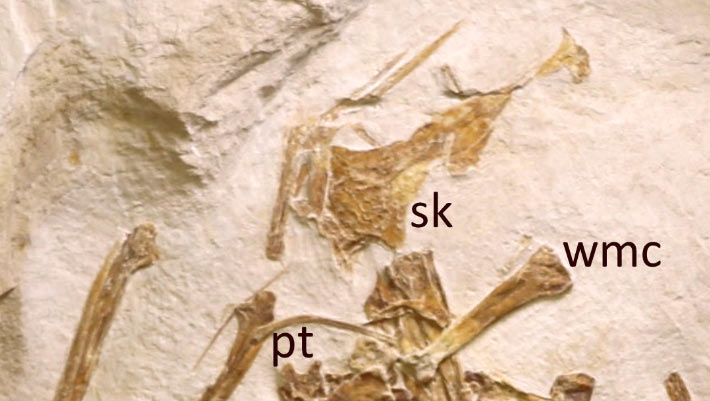
New Jurassic Pterosaur Unearthed in Germany
Un nouveau ptérosaure du Jurassique découvert en Allemagne
Allemagne Jurassique fossile Monofenestrata Pterosauria nouvelle espèce squelette
Les paléontologues ont décrit un nouveau genre et une nouvelle espèce de ptérosaure monofenestratan précoce sur la base d'un squelette fossile presque complet et bien conservé découvert en Bavière, en Allemagne. L'article Un nouveau ptérosaure jurassique découvert en Allemagne est apparu en premier sur Sci.News : Breaking Science News.
19/05/2026 sci-news ⚙ Traduction automatique
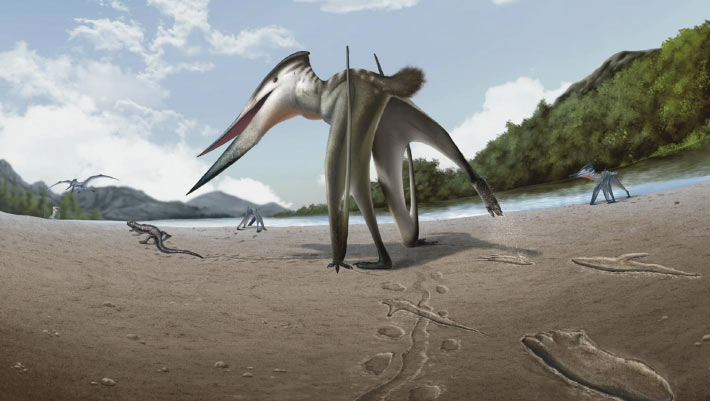
106-Million-Year-Old Pterosaur Footprints Discovered in Korea
Des empreintes de ptérosaures vieilles de 106 millions d'années découvertes en Corée
Corée du Sud empreintes Neoazhdarchia Pterosauria découverte
Un ensemble d'empreintes de ptérosaures néoazdarchiens découvertes en Corée du Sud offre un rare aperçu de la façon dont certains des plus grands reptiles volants auraient pu chasser sur terre. L'article Des empreintes de ptérosaures vieilles de 106 millions d'années découvertes en Corée sont apparues en premier sur Sci.News : Breaking Science News.
01/05/2026 sci-news ⚙ Traduction automatique
Anurognathus: Beast of the Week
Anurognathus : la bête de la semaine
Allemagne Jurassique Jurassique supérieur Anurognathus Pterosauria crâne
Cette semaine, nous allons découvrir un petit ptérosaure unique, Anurognathus ammoni !  Anurognathus vivait dans ce qui est aujourd'hui l'Allemagne à la fin du Jurassique, il y a environ 150 millions d'années.  Il était minuscule, avait une envergure de 35,5 cm (14 pouces) et aurait probablement mangé des insectes.  Son nom de genre se traduit par "Frog Jaw" puisque son crâne ressemblait à celui d'une grenouille, étant extrêmement émoussé avec une bouche large.  Reconstitution à l'aquarelle d'Anurognathus ammoni par Christopher DiPiazza.Sku d'Anurognathus
14/12/2025 prehistoricbeastoftheweek ⚙ Traduction automatique
1 2 3