oiseau
Thématique18 image(s) · 32 Actualités
Galerie d'images

Fossil specimen RTMP 82.19.23 - A lacrimal, postorbitals, squamosals, frontals, parietals, and braincase referred to Latenivenatrix mcmasterae, but formerly assigned to Stenonychosaurus inequalis (=Troodon inequalis). Described by Currie, 1985. "Cranial anatomy of Stenonychosaurus inequalis (Saurischia, Theropoda) and its bearing on the origin of birds." Canadian Journal of Earth Sciences, 22(1), 643-658. 5d-dinosaur-camp-day2-20120802-15.jpg

Megapnosaurus is a coelophysid theropod dinosaur from the Early Jurassic Period of Africa. It was a lightly built bipedal carnivore that grew to just over 2 m long and 13 kg in body mass. Its close relation to Coelophysis has caused some confusion in classifying the genus - it had a slender build and curved S-shaped neck, but was more robust. Comparisons between the scleral rings of Megapnosaurus and modern birds and reptiles indicate that it may have been nocturnal.

Samrukia nesovi was originally described as a giant bird, but is now considered a pterodactyloid pterosaur of uncertain placement and validity. References: Naish, D., Dyke, G., Cau, A., Escuillié, F., & Godefroit, P. (2011). A gigantic bird from the Upper Cretaceous of Central Asia. Biology Letters, 8(1), 97–100. doi:10.1098/rsbl.2011.0683 Buffetaut, E. (2011). Samrukia nessovi, from the Late Cretaceous of Kazakhstan: A large pterosaur, not a giant bird. Annales de Paléontologie, 97(3–4), 133–138. doi:10.1016/j.annpal.2011.10.001

Fujianvenator is an anchiornithid avialan from the Late Jurassic of China, whose discovery gave important insight to the evolution of birds. It had proportionately long legs, with the tibia twice the length of the femur. This suggests it may have been a strong runner, and possibly had a terrestrial or wading lifestyle. Fujianvenator was a small dinosaur, weighing about 640 g. As an avialan, it was almost certainly covered in feathers, though it does not seem likely to have been capable of flight.
![Diagram depicting the currently named Dinosauria from the Late Cretaceous Allen Formation of Argentina. Dinosaur taxa:
Aeolosaurus sp. → Salitral Moreno locality, Río Negro Province.[1] Length = 15 meters.[2]
Austroraptor cabazai → Santa Rosa Basin locality, Río Negro Province.[3][4] Length = 6 meters.[2]
Bonapartenykus ultimus → Salitral Ojo de Agua locality, Río Negro Province.[5] Length = 2.5 meters.[5]
Bonapartesaurus rionegrensis → Salitral Moreno locality, Río Negro Province.[6] Length = ∼6 meters.[1]
Bonatitan reigi → Salitral de Santa Rosa locality, Río Negro Province.[7] Length = Extrapolated after relatives.
Kelumapusaura machi → Cerro Matadero locality, Río Negro Province.[8] 9 meters.[8]
Lamarqueavis australis → Cerro Tortugas locality, Río Negro Province.[9] Length = ∼House sparrow-sized.[9]
Lapampasaurus cholinoi → Islas Malvinas locality, La Pampa Province.[10] Length = ∼7 meters.[2]
Limenavis patagonica → Salitral Moreno locality, Río Negro Province.[11] Length = Extrapolated after relatives.
Menucocelsior arriagadai → Salitral Ojo de Agua locality, Río Negro Province.
Niebla antiqua → Cerro Matadero locality, Río Negro Province.[12] Length = 4.5 meters.[12]
Panamericansaurus schroederi → Bodega Familia Schroeder locality, Neuquén Province.[13] Length = 11 meters.[2]
Patagopelta cristata → Salitral Moreno locality, Río Negro Province.
Quilmesaurus curriei → Salitral Ojo de Agua locality, Río Negro Province.[14] Length = 5.3 meters.[12]
Rocasaurus muniozi → Salitral Moreno locality, Río Negro Province.[15] Length = Extrapolated after relatives.
Excluded taxa:
Willinakaqe salitralensis is considered a nomen dubium,[16] and its paratype has been reassigned to Bonapartesaurus rionegrensis.[6]
Laplatasaurus araukanicus has been restricted to its lectotype which hails from the Anacleto Formation.[17]
Abelisaurus comahuensis could either belong to the Allen or Anacleto formations.[12]
Pellegrinisaurus powelli could either belong to the Allen or Anacleto formations.[18][19]
References
↑ (2013). "The titanosaur sauropods from the late Campanian-early Maastrichtian Allen Formation of Salitral Moreno, Río Negro, Argentina". Acta Palaeontologica Polonica 58 (2): 269–284. DOI:10.4202/app.2011.0055.
↑ a b c (2007) Dinosaurs: The Most Complete, Up-to-Date Encyclopedia for Dinosaur Lovers of All Ages, Random House ISBN: 9780375824197. Genus List for Holtz 2012 Weight Information
↑ (2008). "A bizarre Cretaceous theropod dinosaur from Patagonia and the evolution of Gondwanan dromaeosaurids". Proceedings of the Royal Society B: Biological Sciences 276 (1659): 1101–7. DOI:10.1098/rspb.2008.1554. ISSN 1471-2954.
↑ (2012). "A New Specimen of Austroraptor cabazai Novas, Pol, Canale, Porfiri and Calvo, 2008 (Dinosauria, Theropoda, Unenlagiidae) from the Latest Cretaceous (Maastrichtian) of Río Negro, Argentina". Ameghiniana 49 (4): 662–667. DOI:10.5710/AMGH.30.8.2012.574.
↑ a b Federico L. Agnolin (2012). "New alvarezsaurid (Dinosauria, Theropoda) from uppermost Cretaceous of north-western Patagonia with associated eggs". Cretaceous Research 35: 33–56. DOI:10.1016/j.cretres.2011.11.014.
↑ a b (2017). "Bonapartesaurus rionegrensis, a new hadrosaurine dinosaur from South America: implications for phylogenetic and biogeographic relations with North America". Journal of Vertebrate Paleontology 37 (2): 1–16. DOI:10.1080/02724634.2017.1289381.
↑ Salgado L., Gallina P.A. and Paulina Carabajal A. 2014. "Redescription of Bonatitan reigi (Sauropoda: Titanosauria), from the Campanian–Maastrichtian of the Río Negro Province (Argentina)". Historical Biology: An International Journal of Paleobiology 27(5): 525-548
↑ a b (2022). "A new hadrosaurid (Dinosauria: Ornithischia) from the Late Cretaceous of northern Patagonia and the radiation of South American hadrosaurids". Journal of Systematic Palaeontology. DOI:10.1080/14772019.2021.2020917.
↑ a b (2010). "[https://pdfs.semanticscholar.org/f6f4/c6eb05d224719916c0b20634f54dfeb37d3f.pdf An avian coracoid from the Upper
Cretaceous of Patagonia, Argentina]". Studia Geologica Salmanticensia 46 (2): 99-119. ISSN 0211-8327.
↑ Rodolfo A. Coria, Bernardo González Riga and Silvio Casadío (2012). "Un nuevo hadrosáurido (Dinosauria, Ornithopoda) de la Formación Allen, provincia de La Pampa, Argentina". Ameghiniana 49 (4): 552–572.
↑ Clarke and Chiappe, 2001. A new carinate bird from the Late Cretaceous of Patagonia (Argentina). American Museum Novitates. 3323, 1-23.
↑ a b c d (in English) Aranciaga Rolando, Mauro (2020). "A new medium-sized abelisaurid (Theropoda, Dinosauria) from the late cretaceous (Maastrichtian) Allen Formation of Northern Patagonia, Argentina". Journal of South American Earth Sciences: 102915. DOI:10.1016/j.jsames.2020.102915. ISSN 0895-9811.
↑ (2010). "Panamericansaurus schroederi gen. nov. sp. nov. Un nuevo Sauropoda (Titanosauridae-Aeolosaurini) de la Provincia del Neuquén, Cretácico Superior de Patagonia, Argentina". Brazilian Geographical Journal: Geosciences and Humanities research medium 1: 100–115.
↑ Coria, R.A. (2001) "A new theropod from the Late Cretaceous of Patagonia" in Tanke, Darren H., ed. Mesozoic Vertebrate Life, Life of the Past, Indiana University Press, pp. 3–9 ISBN: 978-0-253-33907-2.
↑ Salgado, L. and C. Azpilicueta. 2000. Un nuevo saltasaurino (Sauropoda, Titanosauridae) de la provincia de Río Negro (Formacíon Allen, Cretácico Superior), Patagonia, Argentina archive copy at the Wayback Machine. Ameghiniana 37 (3):259-264.
↑ (2016). "Revisiting the hadrosaurid diversity of the Allen Fm.: Re-evaluation of the taxonomic validity of Willinakaqe salitralensis (Ornithopoda, Hadrosauridae) from Salitral Moreno, Río Negro Province, Argentina". Ameghiniana 53 (2): 231–237. DOI:10.5710/AMGH.25.09.2015.2943.
↑ Pablo A. Gallina & Alejandro Otero (2015) Reassessment of Laplatasaurus araukanicus (SAUROPODA: TITANOSAURIA), from the Late Cretaceous of Patagonia, Argentina. Ameghiniana 52 (5):487–501. doi:10.5710/AMGH.08.06.2015.2911.
↑ (1996). "Pellegrinisaurus powelli nov. gen. et sp. (Sauropoda, Titanosauridae) from the Upper Cretaceous of Lago Pellegrini, Northwestern Patagonia, Argentina". Ameghiniana 33 (4): 355–365. ISSN 1851-8044.
↑ Heredia, S., & Salgado, L. (2014). Posición estratigráfica de los estratos supracretácicos portadores de dinosaurios en Lago Pellegrini, Patagonia septentrional, Argentina. Ameghiniana, 36(2), 229-234.](https://thumb.wikimedia.org/wikipedia/commons/thumb/4/48/Allen_Formation_Fauna.png/960px-Allen_Formation_Fauna.png?utm_source=commons.wikimedia.org&utm_campaign=imageinfo&utm_content=thumbnail)
Diagram depicting the currently named Dinosauria from the Late Cretaceous Allen Formation of Argentina. Dinosaur taxa: Aeolosaurus sp. → Salitral Moreno locality, Río Negro Province.[1] Length = 15 meters.[2] Austroraptor cabazai → Santa Rosa Basin locality, Río Negro Province.[3][4] Length = 6 meters.[2] Bonapartenykus ultimus → Salitral Ojo de Agua locality, Río Negro Province.[5] Length = 2.5 meters.[5] Bonapartesaurus rionegrensis → Salitral Moreno locality, Río Negro Province.[6] Length = ∼6 meters.[1] Bonatitan reigi → Salitral de Santa Rosa locality, Río Negro Province.[7] Length = Extrapolated after relatives. Kelumapusaura machi → Cerro Matadero locality, Río Negro Province.[8] 9 meters.[8] Lamarqueavis australis → Cerro Tortugas locality, Río Negro Province.[9] Length = ∼House sparrow-sized.[9] Lapampasaurus cholinoi → Islas Malvinas locality, La Pampa Province.[10] Length = ∼7 meters.[2] Limenavis patagonica → Salitral Moreno locality, Río Negro Province.[11] Length = Extrapolated after relatives. Menucocelsior arriagadai → Salitral Ojo de Agua locality, Río Negro Province. Niebla antiqua → Cerro Matadero locality, Río Negro Province.[12] Length = 4.5 meters.[12] Panamericansaurus schroederi → Bodega Familia Schroeder locality, Neuquén Province.[13] Length = 11 meters.[2] Patagopelta cristata → Salitral Moreno locality, Río Negro Province. Quilmesaurus curriei → Salitral Ojo de Agua locality, Río Negro Province.[14] Length = 5.3 meters.[12] Rocasaurus muniozi → Salitral Moreno locality, Río Negro Province.[15] Length = Extrapolated after relatives. Excluded taxa: Willinakaqe salitralensis is considered a nomen dubium,[16] and its paratype has been reassigned to Bonapartesaurus rionegrensis.[6] Laplatasaurus araukanicus has been restricted to its lectotype which hails from the Anacleto Formation.[17] Abelisaurus comahuensis could either belong to the Allen or Anacleto formations.[12] Pellegrinisaurus powelli could either belong to the Allen or Anacleto formations.[18][19] References ↑ (2013). "The titanosaur sauropods from the late Campanian-early Maastrichtian Allen Formation of Salitral Moreno, Río Negro, Argentina". Acta Palaeontologica Polonica 58 (2): 269–284. DOI:10.4202/app.2011.0055. ↑ a b c (2007) Dinosaurs: The Most Complete, Up-to-Date Encyclopedia for Dinosaur Lovers of All Ages, Random House ISBN: 9780375824197. Genus List for Holtz 2012 Weight Information ↑ (2008). "A bizarre Cretaceous theropod dinosaur from Patagonia and the evolution of Gondwanan dromaeosaurids". Proceedings of the Royal Society B: Biological Sciences 276 (1659): 1101–7. DOI:10.1098/rspb.2008.1554. ISSN 1471-2954. ↑ (2012). "A New Specimen of Austroraptor cabazai Novas, Pol, Canale, Porfiri and Calvo, 2008 (Dinosauria, Theropoda, Unenlagiidae) from the Latest Cretaceous (Maastrichtian) of Río Negro, Argentina". Ameghiniana 49 (4): 662–667. DOI:10.5710/AMGH.30.8.2012.574. ↑ a b Federico L. Agnolin (2012). "New alvarezsaurid (Dinosauria, Theropoda) from uppermost Cretaceous of north-western Patagonia with associated eggs". Cretaceous Research 35: 33–56. DOI:10.1016/j.cretres.2011.11.014. ↑ a b (2017). "Bonapartesaurus rionegrensis, a new hadrosaurine dinosaur from South America: implications for phylogenetic and biogeographic relations with North America". Journal of Vertebrate Paleontology 37 (2): 1–16. DOI:10.1080/02724634.2017.1289381. ↑ Salgado L., Gallina P.A. and Paulina Carabajal A. 2014. "Redescription of Bonatitan reigi (Sauropoda: Titanosauria), from the Campanian–Maastrichtian of the Río Negro Province (Argentina)". Historical Biology: An International Journal of Paleobiology 27(5): 525-548 ↑ a b (2022). "A new hadrosaurid (Dinosauria: Ornithischia) from the Late Cretaceous of northern Patagonia and the radiation of South American hadrosaurids". Journal of Systematic Palaeontology. DOI:10.1080/14772019.2021.2020917. ↑ a b (2010). "[https://pdfs.semanticscholar.org/f6f4/c6eb05d224719916c0b20634f54dfeb37d3f.pdf An avian coracoid from the Upper Cretaceous of Patagonia, Argentina]". Studia Geologica Salmanticensia 46 (2): 99-119. ISSN 0211-8327. ↑ Rodolfo A. Coria, Bernardo González Riga and Silvio Casadío (2012). "Un nuevo hadrosáurido (Dinosauria, Ornithopoda) de la Formación Allen, provincia de La Pampa, Argentina". Ameghiniana 49 (4): 552–572. ↑ Clarke and Chiappe, 2001. A new carinate bird from the Late Cretaceous of Patagonia (Argentina). American Museum Novitates. 3323, 1-23. ↑ a b c d (in English) Aranciaga Rolando, Mauro (2020). "A new medium-sized abelisaurid (Theropoda, Dinosauria) from the late cretaceous (Maastrichtian) Allen Formation of Northern Patagonia, Argentina". Journal of South American Earth Sciences: 102915. DOI:10.1016/j.jsames.2020.102915. ISSN 0895-9811. ↑ (2010). "Panamericansaurus schroederi gen. nov. sp. nov. Un nuevo Sauropoda (Titanosauridae-Aeolosaurini) de la Provincia del Neuquén, Cretácico Superior de Patagonia, Argentina". Brazilian Geographical Journal: Geosciences and Humanities research medium 1: 100–115. ↑ Coria, R.A. (2001) "A new theropod from the Late Cretaceous of Patagonia" in Tanke, Darren H., ed. Mesozoic Vertebrate Life, Life of the Past, Indiana University Press, pp. 3–9 ISBN: 978-0-253-33907-2. ↑ Salgado, L. and C. Azpilicueta. 2000. Un nuevo saltasaurino (Sauropoda, Titanosauridae) de la provincia de Río Negro (Formacíon Allen, Cretácico Superior), Patagonia, Argentina archive copy at the Wayback Machine. Ameghiniana 37 (3):259-264. ↑ (2016). "Revisiting the hadrosaurid diversity of the Allen Fm.: Re-evaluation of the taxonomic validity of Willinakaqe salitralensis (Ornithopoda, Hadrosauridae) from Salitral Moreno, Río Negro Province, Argentina". Ameghiniana 53 (2): 231–237. DOI:10.5710/AMGH.25.09.2015.2943. ↑ Pablo A. Gallina & Alejandro Otero (2015) Reassessment of Laplatasaurus araukanicus (SAUROPODA: TITANOSAURIA), from the Late Cretaceous of Patagonia, Argentina. Ameghiniana 52 (5):487–501. doi:10.5710/AMGH.08.06.2015.2911. ↑ (1996). "Pellegrinisaurus powelli nov. gen. et sp. (Sauropoda, Titanosauridae) from the Upper Cretaceous of Lago Pellegrini, Northwestern Patagonia, Argentina". Ameghiniana 33 (4): 355–365. ISSN 1851-8044. ↑ Heredia, S., & Salgado, L. (2014). Posición estratigráfica de los estratos supracretácicos portadores de dinosaurios en Lago Pellegrini, Patagonia septentrional, Argentina. Ameghiniana, 36(2), 229-234.
Diagram depicting the currently named Dinosauria from the Late Cretaceous Allen Formation of Argentina. Dinosaur taxa: Aeolosaurus sp. → Salitral Moreno locality, Río Negro Province.[1] Length = 15 meters.[2] Austroraptor cabazai → Santa Rosa Basin locality, Río Negro Province.[3][4] Length = 6 meters.[2] Bonapartenykus ultimus → Salitral Ojo de Agua locality, Río Negro Province.[5] Length = 2.5 meters.[5] Bonapartesaurus rionegrensis → Salitral Moreno locality, Río Negro Province.[6] Length = ∼6 meters.[1] Bonatitan reigi → Salitral de Santa Rosa locality, Río Negro Province.[7] Length = Extrapolated after relatives. Kelumapusaura machi → Cerro Matadero locality, Río Negro Province.[8] 9 meters.[8] Lamarqueavis australis → Cerro Tortugas locality, Río Negro Province.[9] Length = ∼House sparrow-sized.[9] Lapampasaurus cholinoi → Islas Malvinas locality, La Pampa Province.[10] Length = ∼7 meters.[2] Limenavis patagonica → Salitral Moreno locality, Río Negro Province.[11] Length = Extrapolated after relatives. Menucocelsior arriagadai → Salitral Ojo de Agua locality, Río Negro Province. Niebla antiqua → Cerro Matadero locality, Río Negro Province.[12] Length = 4.5 meters.[12] Panamericansaurus schroederi → Bodega Familia Schroeder locality, Neuquén Province.[13] Length = 11 meters.[2] Patagopelta cristata → Salitral Moreno locality, Río Negro Province. Quilmesaurus curriei → Salitral Ojo de Agua locality, Río Negro Province.[14] Length = 5.3 meters.[12] Rocasaurus muniozi → Salitral Moreno locality, Río Negro Province.[15] Length = Extrapolated after relatives. Excluded taxa: Willinakaqe salitralensis is considered a nomen dubium,[16] and its paratype has been reassigned to Bonapartesaurus rionegrensis.[6] Laplatasaurus araukanicus has been restricted to its lectotype which hails from the Anacleto Formation.[17] Abelisaurus comahuensis could either belong to the Allen or Anacleto formations.[12] Pellegrinisaurus powelli could either belong to the Allen or Anacleto formations.[18][19] References ↑ (2013). "The titanosaur sauropods from the late Campanian-early Maastrichtian Allen Formation of Salitral Moreno, Río Negro, Argentina". Acta Palaeontologica Polonica 58 (2): 269–284. DOI:10.4202/app.2011.0055. ↑ a b c (2007) Dinosaurs: The Most Complete, Up-to-Date Encyclopedia for Dinosaur Lovers of All Ages, Random House ISBN: 9780375824197. Genus List for Holtz 2012 Weight Information ↑ (2008). "A bizarre Cretaceous theropod dinosaur from Patagonia and the evolution of Gondwanan dromaeosaurids". Proceedings of the Royal Society B: Biological Sciences 276 (1659): 1101–7. DOI:10.1098/rspb.2008.1554. ISSN 1471-2954. ↑ (2012). "A New Specimen of Austroraptor cabazai Novas, Pol, Canale, Porfiri and Calvo, 2008 (Dinosauria, Theropoda, Unenlagiidae) from the Latest Cretaceous (Maastrichtian) of Río Negro, Argentina". Ameghiniana 49 (4): 662–667. DOI:10.5710/AMGH.30.8.2012.574. ↑ a b Federico L. Agnolin (2012). "New alvarezsaurid (Dinosauria, Theropoda) from uppermost Cretaceous of north-western Patagonia with associated eggs". Cretaceous Research 35: 33–56. DOI:10.1016/j.cretres.2011.11.014. ↑ a b (2017). "Bonapartesaurus rionegrensis, a new hadrosaurine dinosaur from South America: implications for phylogenetic and biogeographic relations with North America". Journal of Vertebrate Paleontology 37 (2): 1–16. DOI:10.1080/02724634.2017.1289381. ↑ Salgado L., Gallina P.A. and Paulina Carabajal A. 2014. "Redescription of Bonatitan reigi (Sauropoda: Titanosauria), from the Campanian–Maastrichtian of the Río Negro Province (Argentina)". Historical Biology: An International Journal of Paleobiology 27(5): 525-548 ↑ a b (2022). "A new hadrosaurid (Dinosauria: Ornithischia) from the Late Cretaceous of northern Patagonia and the radiation of South American hadrosaurids". Journal of Systematic Palaeontology. DOI:10.1080/14772019.2021.2020917. ↑ a b (2010). "[https://pdfs.semanticscholar.org/f6f4/c6eb05d224719916c0b20634f54dfeb37d3f.pdf An avian coracoid from the Upper Cretaceous of Patagonia, Argentina]". Studia Geologica Salmanticensia 46 (2): 99-119. ISSN 0211-8327. ↑ Rodolfo A. Coria, Bernardo González Riga and Silvio Casadío (2012). "Un nuevo hadrosáurido (Dinosauria, Ornithopoda) de la Formación Allen, provincia de La Pampa, Argentina". Ameghiniana 49 (4): 552–572. ↑ Clarke and Chiappe, 2001. A new carinate bird from the Late Cretaceous of Patagonia (Argentina). American Museum Novitates. 3323, 1-23. ↑ a b c d (in English) Aranciaga Rolando, Mauro (2020). "A new medium-sized abelisaurid (Theropoda, Dinosauria) from the late cretaceous (Maastrichtian) Allen Formation of Northern Patagonia, Argentina". Journal of South American Earth Sciences: 102915. DOI:10.1016/j.jsames.2020.102915. ISSN 0895-9811. ↑ (2010). "Panamericansaurus schroederi gen. nov. sp. nov. Un nuevo Sauropoda (Titanosauridae-Aeolosaurini) de la Provincia del Neuquén, Cretácico Superior de Patagonia, Argentina". Brazilian Geographical Journal: Geosciences and Humanities research medium 1: 100–115. ↑ Coria, R.A. (2001) "A new theropod from the Late Cretaceous of Patagonia" in Tanke, Darren H., ed. Mesozoic Vertebrate Life, Life of the Past, Indiana University Press, pp. 3–9 ISBN: 978-0-253-33907-2. ↑ Salgado, L. and C. Azpilicueta. 2000. Un nuevo saltasaurino (Sauropoda, Titanosauridae) de la provincia de Río Negro (Formacíon Allen, Cretácico Superior), Patagonia, Argentina archive copy at the Wayback Machine. Ameghiniana 37 (3):259-264. ↑ (2016). "Revisiting the hadrosaurid diversity of the Allen Fm.: Re-evaluation of the taxonomic validity of Willinakaqe salitralensis (Ornithopoda, Hadrosauridae) from Salitral Moreno, Río Negro Province, Argentina". Ameghiniana 53 (2): 231–237. DOI:10.5710/AMGH.25.09.2015.2943. ↑ Pablo A. Gallina & Alejandro Otero (2015) Reassessment of Laplatasaurus araukanicus (SAUROPODA: TITANOSAURIA), from the Late Cretaceous of Patagonia, Argentina. Ameghiniana 52 (5):487–501. doi:10.5710/AMGH.08.06.2015.2911. ↑ (1996). "Pellegrinisaurus powelli nov. gen. et sp. (Sauropoda, Titanosauridae) from the Upper Cretaceous of Lago Pellegrini, Northwestern Patagonia, Argentina". Ameghiniana 33 (4): 355–365. ISSN 1851-8044. ↑ Heredia, S., & Salgado, L. (2014). Posición estratigráfica de los estratos supracretácicos portadores de dinosaurios en Lago Pellegrini, Patagonia septentrional, Argentina. Ameghiniana, 36(2), 229-234.
Diagram depicting the currently named Dinosauria from the Late Cretaceous Allen Formation of Argentina. Dinosaur taxa: Aeolosaurus sp. → Salitral Moreno locality, Río Negro Province.[1] Length = 15 meters.[2] Austroraptor cabazai → Santa Rosa Basin locality, Río Negro Province.[3][4] Length = 6 meters.[2] Bonapartenykus ultimus → Salitral Ojo de Agua locality, Río Negro Province.[5] Length = 2.5 meters.[5] Bonapartesaurus rionegrensis → Salitral Moreno locality, Río Negro Province.[6] Length = ∼6 meters.[1] Bonatitan reigi → Salitral de Santa Rosa locality, Río Negro Province.[7] Length = Extrapolated after relatives. Kelumapusaura machi → Cerro Matadero locality, Río Negro Province.[8] 9 meters.[8] Lamarqueavis australis → Cerro Tortugas locality, Río Negro Province.[9] Length = ∼House sparrow-sized.[9] Lapampasaurus cholinoi → Islas Malvinas locality, La Pampa Province.[10] Length = ∼7 meters.[2] Limenavis patagonica → Salitral Moreno locality, Río Negro Province.[11] Length = Extrapolated after relatives. Menucocelsior arriagadai → Salitral Ojo de Agua locality, Río Negro Province. Niebla antiqua → Cerro Matadero locality, Río Negro Province.[12] Length = 4.5 meters.[12] Panamericansaurus schroederi → Bodega Familia Schroeder locality, Neuquén Province.[13] Length = 11 meters.[2] Patagopelta cristata → Salitral Moreno locality, Río Negro Province. Quilmesaurus curriei → Salitral Ojo de Agua locality, Río Negro Province.[14] Length = 5.3 meters.[12] Rocasaurus muniozi → Salitral Moreno locality, Río Negro Province.[15] Length = Extrapolated after relatives. Excluded taxa: Willinakaqe salitralensis is considered a nomen dubium,[16] and its paratype has been reassigned to Bonapartesaurus rionegrensis.[6] Laplatasaurus araukanicus has been restricted to its lectotype which hails from the Anacleto Formation.[17] Abelisaurus comahuensis could either belong to the Allen or Anacleto formations.[12] Pellegrinisaurus powelli could either belong to the Allen or Anacleto formations.[18][19] References ↑ (2013). "The titanosaur sauropods from the late Campanian-early Maastrichtian Allen Formation of Salitral Moreno, Río Negro, Argentina". Acta Palaeontologica Polonica 58 (2): 269–284. DOI:10.4202/app.2011.0055. ↑ a b c (2007) Dinosaurs: The Most Complete, Up-to-Date Encyclopedia for Dinosaur Lovers of All Ages, Random House ISBN: 9780375824197. Genus List for Holtz 2012 Weight Information ↑ (2008). "A bizarre Cretaceous theropod dinosaur from Patagonia and the evolution of Gondwanan dromaeosaurids". Proceedings of the Royal Society B: Biological Sciences 276 (1659): 1101–7. DOI:10.1098/rspb.2008.1554. ISSN 1471-2954. ↑ (2012). "A New Specimen of Austroraptor cabazai Novas, Pol, Canale, Porfiri and Calvo, 2008 (Dinosauria, Theropoda, Unenlagiidae) from the Latest Cretaceous (Maastrichtian) of Río Negro, Argentina". Ameghiniana 49 (4): 662–667. DOI:10.5710/AMGH.30.8.2012.574. ↑ a b Federico L. Agnolin (2012). "New alvarezsaurid (Dinosauria, Theropoda) from uppermost Cretaceous of north-western Patagonia with associated eggs". Cretaceous Research 35: 33–56. DOI:10.1016/j.cretres.2011.11.014. ↑ a b (2017). "Bonapartesaurus rionegrensis, a new hadrosaurine dinosaur from South America: implications for phylogenetic and biogeographic relations with North America". Journal of Vertebrate Paleontology 37 (2): 1–16. DOI:10.1080/02724634.2017.1289381. ↑ Salgado L., Gallina P.A. and Paulina Carabajal A. 2014. "Redescription of Bonatitan reigi (Sauropoda: Titanosauria), from the Campanian–Maastrichtian of the Río Negro Province (Argentina)". Historical Biology: An International Journal of Paleobiology 27(5): 525-548 ↑ a b (2022). "A new hadrosaurid (Dinosauria: Ornithischia) from the Late Cretaceous of northern Patagonia and the radiation of South American hadrosaurids". Journal of Systematic Palaeontology. DOI:10.1080/14772019.2021.2020917. ↑ a b (2010). "[https://pdfs.semanticscholar.org/f6f4/c6eb05d224719916c0b20634f54dfeb37d3f.pdf An avian coracoid from the Upper Cretaceous of Patagonia, Argentina]". Studia Geologica Salmanticensia 46 (2): 99-119. ISSN 0211-8327. ↑ Rodolfo A. Coria, Bernardo González Riga and Silvio Casadío (2012). "Un nuevo hadrosáurido (Dinosauria, Ornithopoda) de la Formación Allen, provincia de La Pampa, Argentina". Ameghiniana 49 (4): 552–572. ↑ Clarke and Chiappe, 2001. A new carinate bird from the Late Cretaceous of Patagonia (Argentina). American Museum Novitates. 3323, 1-23. ↑ a b c d (in English) Aranciaga Rolando, Mauro (2020). "A new medium-sized abelisaurid (Theropoda, Dinosauria) from the late cretaceous (Maastrichtian) Allen Formation of Northern Patagonia, Argentina". Journal of South American Earth Sciences: 102915. DOI:10.1016/j.jsames.2020.102915. ISSN 0895-9811. ↑ (2010). "Panamericansaurus schroederi gen. nov. sp. nov. Un nuevo Sauropoda (Titanosauridae-Aeolosaurini) de la Provincia del Neuquén, Cretácico Superior de Patagonia, Argentina". Brazilian Geographical Journal: Geosciences and Humanities research medium 1: 100–115. ↑ Coria, R.A. (2001) "A new theropod from the Late Cretaceous of Patagonia" in Tanke, Darren H., ed. Mesozoic Vertebrate Life, Life of the Past, Indiana University Press, pp. 3–9 ISBN: 978-0-253-33907-2. ↑ Salgado, L. and C. Azpilicueta. 2000. Un nuevo saltasaurino (Sauropoda, Titanosauridae) de la provincia de Río Negro (Formacíon Allen, Cretácico Superior), Patagonia, Argentina archive copy at the Wayback Machine. Ameghiniana 37 (3):259-264. ↑ (2016). "Revisiting the hadrosaurid diversity of the Allen Fm.: Re-evaluation of the taxonomic validity of Willinakaqe salitralensis (Ornithopoda, Hadrosauridae) from Salitral Moreno, Río Negro Province, Argentina". Ameghiniana 53 (2): 231–237. DOI:10.5710/AMGH.25.09.2015.2943. ↑ Pablo A. Gallina & Alejandro Otero (2015) Reassessment of Laplatasaurus araukanicus (SAUROPODA: TITANOSAURIA), from the Late Cretaceous of Patagonia, Argentina. Ameghiniana 52 (5):487–501. doi:10.5710/AMGH.08.06.2015.2911. ↑ (1996). "Pellegrinisaurus powelli nov. gen. et sp. (Sauropoda, Titanosauridae) from the Upper Cretaceous of Lago Pellegrini, Northwestern Patagonia, Argentina". Ameghiniana 33 (4): 355–365. ISSN 1851-8044. ↑ Heredia, S., & Salgado, L. (2014). Posición estratigráfica de los estratos supracretácicos portadores de dinosaurios en Lago Pellegrini, Patagonia septentrional, Argentina. Ameghiniana, 36(2), 229-234.


Baminornis is the oldest known bird with a fused pygostyle, a skeletal feature that implies tail feathers. Its discovery pushed back current understanding of bird evolution and global distribution by 20 million years. Baminornis was about 15 cm in length, had many features in common with modern birds, including the capability for powered flight.
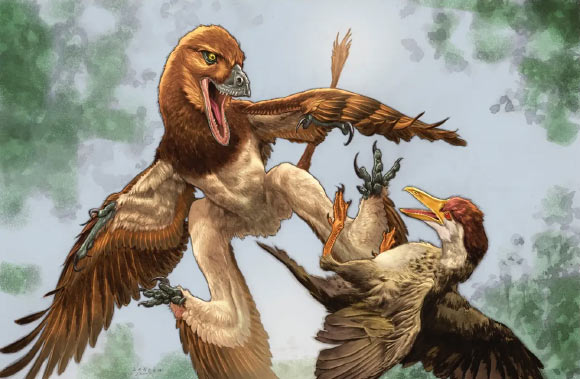

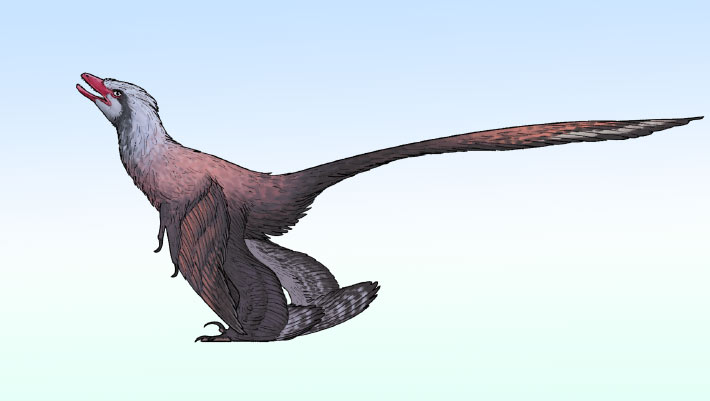
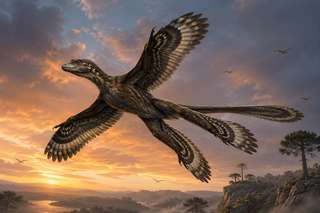
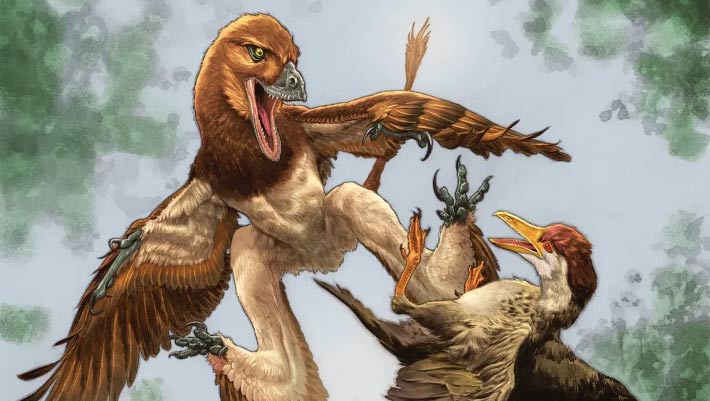
The "dromaeo-avemorphs", as they are informally known (Paul, 2002), represent a group of early paravian theropods with asymmetrical feathers and an Archaeopteryx-like body. According to Hartman et al. (2019), the animals shown in this image might, together, form a clade (monophyletic group) without modern birds.

Figure 1. Evolution of macroecological traits in Dinosauria. Large scale event in dinosaur evolution (a); the origin of dinosaurs (star), hyperthermals (volcano), the earliest fossil Avialae (bird), the earliest fossil angiosperm (flower), the Cretaceous/Palaeogene mass extinction (asteroid). Phylogeny of dinosaurs (b) redrawn from Sereno and adapted to the current consensus and upon which an ancestral state reconstruction of temperature niche (mean annual temperature) after Chiarenza et al. is plotted; Mesozoic palaeogeographies (c) for Triassic (T), Jurassic (J) and Cretaceous (K). Silhouette colours symbolize body mass for each of the taxa represented; information on dietary habits are plotted after Barrett and Zanno & Makovicky; numbers represent clades discussed through this study: 1, Ornithischia; 2, Thyreophora; 3, Ornithopoda; 4, Hadrosauroidea; 5, Marginocephalia; 6, Ceratopsia; 7, Saurischia; 8, Sauropodomorpha; 9, Sauropoda; 10, Theropoda; 11, Ceratosauria; 12, Tetanurae; 13, Coelurosauria; 14, Maniraptoriformes; 15, Maniraptora; 16, Deinonychosauria; 17, Avialae; 18, Ornithothoraces. Palaeogeographies modified from original plots via R package ‘mapast’ using plate models by Scotese.

Diagram illustrating the "Temporal paradox" in paleontology. First given it's nickname by Alan Feduccia, the paradox is made up by the fact that almost all feathered dinosaurs are dated to have lived millions of years after Archaeopteryx, the oldest bird (late Jurassic, believed to have existed about 150 million years ago). Only a few of the feathered dinosaurs/birdlike dinosaurs are given an older date than Archaeopteryx.

Restoration of Early Jurassic environment preserved at the SGDS, with the theropod Dilophosaurus wetherilli in bird-like resting pose, demonstrating the manufacture of SGDS.18.T1 resting trace.

Diagram made to illustrate the debate over the hands of theropod dinosaurs and their alleged descendants, the birds ( Aves ). In the last years, the difference between the hands of theropods and birds have been an important thing when it comes question the theory that birds evolved from dinosaurs, even though some scientists may could refute it. In the diagram, a Neotheropoda ( 1 ), basal tetanurae ( 2 ), a coelurosaurian ( 3 ), the bird (?)Archaeopteryx ( 4 ) and modern bird ( 5 ). In 1997, birdexpert Alan Feduccia at University of North Carolina discovered that birds develop hands with the digits II, III and IV ( see The Cincinnati Enquirer, 25 - 10 - 1997 ). This is in contrast with the hands of tetanurae, which seems to have the digits I, II and III. This make it almost impossible for dinosaurs and birds to be closely related, according to Feduccia. Since the discovery by Feduccia, scientific research have came up with a possible explanation to the mystery of the dinosaur - bird hand difference, called The frame shift hypothesis ( see http://scienceblogs.com/tetrapodzoology/2009/06/limusaurus_is_awesome.php ). This hypothesis is based on a discovery which shows that although bird embryos develop the fingers II, III and IV, the genes which is coding for the external appearance of the digits seems to be from the fingers I, II and III. Based on this, scientists belive this: when neotheropods evolved into tetanurae, the losed digit I ( not digit IV, as earlier suggested ). During this process, the genes which coded for how the digits should looks like ( the number of phalanges, for example ) became refurnished ( see the color spots in th upper section in the diagram to understan ). The discovery of Limusaurus has been said to support this theory ( see https://www.livescience.com/animals/090617-dinosaur-hands.html ). One thing is that may can be used to refute that Limusaurus should support the Frame shift hypothesis is that Limusaurus was a ceratosaurian, and is dated to be much younger than the oldest tetanurae's. Also, some tetanure´s may had 4 digits' like the Archaeornithomimus ( see number 4 in the diagram ) ( see also http://dml.cmnh.org/1998Oct/msg00443.html and the Allosaurus hand in the image here: http://upload.wikimedia.org/wikipedia/commons/6/69/Allosaurus-mounted.jpg ). If this is the digits I, II, III and IV. If so, it shows that tetanurae had the digits I, II and III, and not II, II and IV, like birds. For more in this debate, see text section to my picture Raptor-Archaeopteryx-bird hands differens.JPG at http://commons.wikimedia.org/wiki/File:Raptor-Archaeopteryx-bird_hands_differens.JPG.

The Chicago specimen of Archaeopteryx (PA 830), a well-preserved fossil highlighting the transitional features between non-avian dinosaurs and birds, housed at the Field Museum of Natural History.
Actualités