vol

Comportement & Physiologie

6 image(s) · 3 Actualités

Galerie d'images

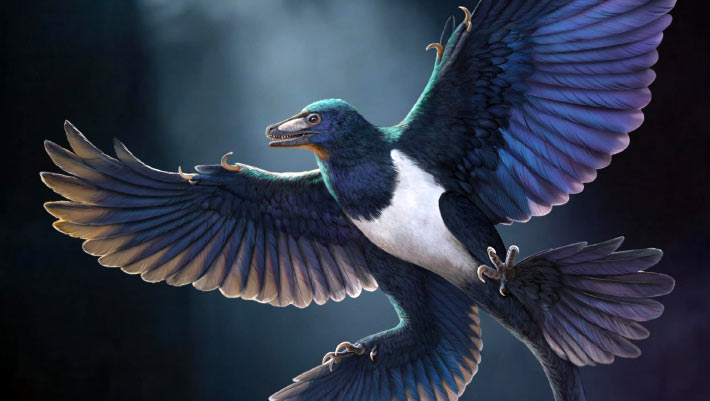
Baminornis is the oldest known bird with a fused pygostyle, a skeletal feature that implies tail feathers. Its discovery pushed back current understanding of bird evolution and global distribution by 20 million years. Baminornis was about 15 cm in length, had many features in common with modern birds, including the capability for powered flight.
Taxons Baminornis

Baminornis is the oldest known bird with a fused pygostyle, a skeletal feature that implies tail feathers. Its discovery pushed back current understanding of bird evolution and global distribution by 20 million years. Baminornis was about 15 cm in length, had many features in common with modern birds, including the capability for powered flight.

plume vol Baminornis oiseau +2
Fujianvenator is an anchiornithid avialan from the Late Jurassic of China, whose discovery gave important insight to the evolution of birds. It had proportionately long legs, with the tibia twice the length of the femur. This suggests it may have been a strong runner, and possibly had a terrestrial or wading lifestyle. Fujianvenator was a small dinosaur, weighing about 640 g. As an avialan, it was almost certainly covered in feathers, though it does not seem likely to have been capable of flight.
Taxons Fujianvenator

Fujianvenator is an anchiornithid avialan from the Late Jurassic of China, whose discovery gave important insight to the evolution of birds. It had proportionately long legs, with the tibia twice the length of the femur. This suggests it may have been a strong runner, and possibly had a terrestrial or wading lifestyle. Fujianvenator was a small dinosaur, weighing about 640 g. As an avialan, it was almost certainly covered in feathers, though it does not seem likely to have been capable of flight.

plume vol Chine Jurassique +7
cast of Quetzalcoatlus northropi humerus 03 - Pterosaurs Flight in the Age of Dinosaurs

cast of Quetzalcoatlus northropi humerus 03 - Pterosaurs Flight in the Age of Dinosaurs

humérus vol États-Unis moulage +3
cast of Quetzalcoatlus northropi humerus 02 - Pterosaurs Flight in the Age of Dinosaurs

cast of Quetzalcoatlus northropi humerus 02 - Pterosaurs Flight in the Age of Dinosaurs

humérus vol États-Unis moulage +3
Cast of Quetzalcoatlus northropi humerus 01 - Pterosaurs Flight in the Age of Dinosaurs

Cast of Quetzalcoatlus northropi humerus 01 - Pterosaurs Flight in the Age of Dinosaurs

humérus vol moulage Dinosauria +2
Cast of a Scaphognathus crassirostris, a kind of pterosaur. On display as part of the exhibit "Pterosaurs: Flight in the Age of Dinosaurs" at the Cleveland Natural History Museum in Cleveland, Ohio, in the United States.
This animal lived about 150 million years ago. This fossil was found in the Solnhofen formation in Germany. This is a cast; the fossil itself is held by the Institute of Geology and Paleontology at the University of Bonn.
Taxons Scaphognathus

Cast of a Scaphognathus crassirostris, a kind of pterosaur. On display as part of the exhibit "Pterosaurs: Flight in the Age of Dinosaurs" at the Cleveland Natural History Museum in Cleveland, Ohio, in the United States. This animal lived about 150 million years ago. This fossil was found in the Solnhofen formation in Germany. This is a cast; the fossil itself is held by the Institute of Geology and Paleontology at the University of Bonn.

vol musée Allemagne États-Unis +7

Actualités

Pterosaurs May Have Sported Far More Varied Wings than Paleontologists Imagined
Les ptérosaures auraient pu arborer des ailes beaucoup plus variées que ce que les paléontologues avaient imaginé
vol fossile Pterosauria biomécanique évolution
De nouvelles recherches de l'Université de Bristol suggèrent que les ptérosaures - les premiers vertébrés à voler propulsé - présentaient probablement un éventail de formes d'ailes et de styles de vol beaucoup plus large que ce que les reconstructions basées sur des fossiles ont décrit. L'article Les ptérosaures auraient pu arborer des ailes beaucoup plus variées que ce que les paléontologues avaient imaginé est apparu en premier sur Sci.News : Breaking Science News.
30/06/2026 sci-news ⚙ Traduction automatique
Après tout, les insectes préhistoriques géants n’avaient pas besoin de beaucoup d’oxygène, selon une étude
vol prédateur étude
La Terre antique regorgeait autrefois d’énormes insectes ressemblant à des libellules, et les scientifiques ont longtemps pensé que des niveaux élevés d’oxygène rendaient leur taille possible. Une nouvelle étude renverse cette idée, révélant que les muscles de vol des insectes n’étaient finalement pas limités par l’oxygène. Leur système respiratoire dispose de suffisamment d’espace pour se développer, ce qui signifie que l’oxygène à lui seul ne peut pas expliquer leurs formes géantes. Aujourd’hui, les chercheurs recherchent de nouvelles réponses, comme les prédateurs ou les limites physiques de leur corps.
25/04/2026 sciencedaily-fossils ⚙ Traduction automatique
Des analyses du cerveau fossile montrent que les ptérosaures ont évolué en un éclair
vol fossile Pterosauria oiseau découverte évolution
Les anciens ptérosaures ont peut-être pris leur envol bien plus tôt et de manière plus explosive que les oiseaux, développant le vol dès leur origine malgré leur cerveau relativement petit. Grâce à l'imagerie CT avancée, les scientifiques ont reconstruit les cavités cérébrales de fossiles de ptérosaures et de leurs proches parents, découvrant des indices surprenants, tels que des lobes optiques élargis, qui suggèrent un saut rapide vers le vol motorisé. Leurs découvertes contrastent fortement avec l'évolution lente et par étapes observée chez les oiseaux, dont le cerveau s'est développé au fil du temps.
09/12/2025 sciencedaily ⚙ Traduction automatique