←

flight

Behavior & Physiology

7 image(s) · 6 News

Image gallery

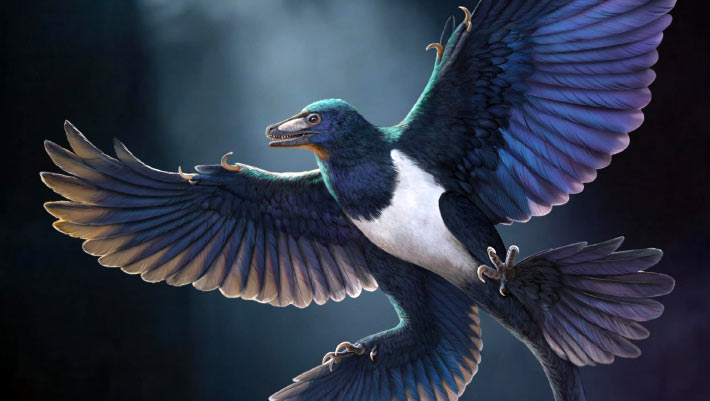
Norellraptor is a microraptorian dinosaur known from a specimen with exceptionally well-preserved feathers. Its discovery supports evidence that gliding and flight-related traits evolved independently in multiple dinosaur groups. Norellraptor had long feathers on its arms and legs, typical of microraptorians, resulting in a four-winged body plan.
Taxa Norellraptor

Norellraptor is a microraptorian dinosaur known from a specimen with exceptionally well-preserved feathers. Its discovery supports evidence that gliding and flight-related traits evolved independently in multiple dinosaur groups. Norellraptor had long feathers on its arms and legs, typical of microraptorians, resulting in a four-winged body plan.

feather flight specimen Dinosauria +2
Fujianvenator is an anchiornithid avialan from the Late Jurassic of China, whose discovery gave important insight to the evolution of birds. It had proportionately long legs, with the tibia twice the length of the femur. This suggests it may have been a strong runner, and possibly had a terrestrial or wading lifestyle. Fujianvenator was a small dinosaur, weighing about 640 g. As an avialan, it was almost certainly covered in feathers, though it does not seem likely to have been capable of flight.
Taxa Fujianvenator

Fujianvenator is an anchiornithid avialan from the Late Jurassic of China, whose discovery gave important insight to the evolution of birds. It had proportionately long legs, with the tibia twice the length of the femur. This suggests it may have been a strong runner, and possibly had a terrestrial or wading lifestyle. Fujianvenator was a small dinosaur, weighing about 640 g. As an avialan, it was almost certainly covered in feathers, though it does not seem likely to have been capable of flight.

feather flight China Jurassic +7
Cast of a Scaphognathus crassirostris, a kind of pterosaur. On display as part of the exhibit "Pterosaurs: Flight in the Age of Dinosaurs" at the Cleveland Natural History Museum in Cleveland, Ohio, in the United States.
This animal lived about 150 million years ago. This fossil was found in the Solnhofen formation in Germany. This is a cast; the fossil itself is held by the Institute of Geology and Paleontology at the University of Bonn.
Taxa Scaphognathus

Cast of a Scaphognathus crassirostris, a kind of pterosaur. On display as part of the exhibit "Pterosaurs: Flight in the Age of Dinosaurs" at the Cleveland Natural History Museum in Cleveland, Ohio, in the United States. This animal lived about 150 million years ago. This fossil was found in the Solnhofen formation in Germany. This is a cast; the fossil itself is held by the Institute of Geology and Paleontology at the University of Bonn.

flight museum Germany United States +7
Baminornis is the oldest known bird with a fused pygostyle, a skeletal feature that implies tail feathers. Its discovery pushed back current understanding of bird evolution and global distribution by 20 million years. Baminornis was about 15 cm in length, had many features in common with modern birds, including the capability for powered flight.
Taxa Baminornis

Baminornis is the oldest known bird with a fused pygostyle, a skeletal feature that implies tail feathers. Its discovery pushed back current understanding of bird evolution and global distribution by 20 million years. Baminornis was about 15 cm in length, had many features in common with modern birds, including the capability for powered flight.

feather flight Baminornis bird +2
cast of Quetzalcoatlus northropi humerus 03 - Pterosaurs Flight in the Age of Dinosaurs

cast of Quetzalcoatlus northropi humerus 03 - Pterosaurs Flight in the Age of Dinosaurs

humerus flight United States cast +3
cast of Quetzalcoatlus northropi humerus 02 - Pterosaurs Flight in the Age of Dinosaurs

cast of Quetzalcoatlus northropi humerus 02 - Pterosaurs Flight in the Age of Dinosaurs

humerus flight United States cast +3
Cast of Quetzalcoatlus northropi humerus 01 - Pterosaurs Flight in the Age of Dinosaurs

Cast of Quetzalcoatlus northropi humerus 01 - Pterosaurs Flight in the Age of Dinosaurs

humerus flight cast Dinosauria +2

News

New Feathered Dinosaur Suggests Flight Evolved More Than Once among Birds’ Closest Relatives
flight China Dinosauria Norellraptor bird new species
Norellraptor barsboldi, a new species of small microraptorine dinosaur from the 120-million-year-old rock beds of China’s Liaoning province, challenges the idea that the earliest fliers shared a common blueprint for taking to the air. The post New Feathered Dinosaur Suggests Flight Evolved More Than Once among Birds’ Closest Relatives appeared first on Sci.News: Breaking Science News.
01/10/2026 sci-news
Bats may have first evolved in Europe 65 million years ago
flight fossil communication evolution mammals study
A huge genomic and fossil study suggests bats first evolved in Europe around 65 to 60 million years ago before spreading across the globe. The findings also indicate that flight and echolocation emerged near the beginning of bat evolution, potentially helping explain how bats became one of the most successful mammal groups on Earth.
30/09/2026 sciencedaily-paleo
Remarkable Study Reveals the Origins of Bat Evolution
flight fossil evolution study
A huge international study has shed new light on bat evolution. The research suggests that bats originated in Europe around 65 million years ago. Moreover, both powered flight and echolocation appear to have evolved very early in their history. The study represents the largest investigation yet to combine bat genomes with evidence from the fossil
23/09/2026 everythingdinosaur
Pterosaurs May Have Sported Far More Varied Wings than Paleontologists Imagined
flight fossil Pterosauria biomechanics evolution
New research from the University of Bristol suggests that pterosaurs -- the first vertebrates to achieve powered flight -- probably displayed a much wider array of wing shapes and flying styles than fossil-based reconstructions have depicted. The post Pterosaurs May Have Sported Far More Varied Wings than Paleontologists Imagined appeared first on Sci.News: Breaking Science News.
30/06/2026 sci-news
Giant prehistoric insects didn’t need high oxygen after all, study finds
flight predator study
Ancient Earth once buzzed with enormous dragonfly-like insects, and scientists long thought high oxygen levels made their size possible. A new study overturns that idea, revealing insect flight muscles weren’t constrained by oxygen after all. Their breathing system has plenty of room to expand, meaning oxygen alone can’t explain their giant forms. Now, researchers are searching for new answers—like predators or physical limits of their bodies.
25/04/2026 sciencedaily-fossils
1 2