←

fossile

Nature du spécimen

226 image(s) · 215 Actualités

Galerie d'images

Sable riche en coquilles fossiles provenant de l'intérieur de puits de dissolution du site de l'Ariey. On y voit des coraux, oursins plats (Amphiope), gastéropodes (Melongena, Conus, Cypraea) et des bivalves (Lucina & Barbatia)

Sable riche en coquilles fossiles provenant de l'intérieur de puits de dissolution du site de l'Ariey. On y voit des coraux, oursins plats (Amphiope), gastéropodes (Melongena, Conus, Cypraea) et des bivalves (Lucina & Barbatia)

fossile
Figure 1. Evolution of macroecological traits in Dinosauria. Large scale event in dinosaur evolution (a); the origin of dinosaurs (star), hyperthermals (volcano), the earliest fossil Avialae (bird), the earliest fossil angiosperm (flower), the Cretaceous/Palaeogene mass extinction (asteroid). Phylogeny of dinosaurs (b) redrawn from Sereno and adapted to the current consensus and upon which an ancestral state reconstruction of temperature niche (mean annual temperature) after Chiarenza et al. is plotted; Mesozoic palaeogeographies (c) for Triassic (T), Jurassic (J) and Cretaceous (K). Silhouette colours symbolize body mass for each of the taxa represented; information on dietary habits are plotted after Barrett and Zanno & Makovicky; numbers represent clades discussed through this study: 1, Ornithischia; 2, Thyreophora; 3, Ornithopoda; 4, Hadrosauroidea; 5, Marginocephalia; 6, Ceratopsia; 7, Saurischia; 8, Sauropodomorpha; 9, Sauropoda; 10, Theropoda; 11, Ceratosauria; 12, Tetanurae; 13, Coelurosauria; 14, Maniraptoriformes; 15, Maniraptora; 16, Deinonychosauria; 17, Avialae; 18, Ornithothoraces. Palaeogeographies modified from original plots via R package ‘mapast’ using plate models by Scotese.

Figure 1. Evolution of macroecological traits in Dinosauria. Large scale event in dinosaur evolution (a); the origin of dinosaurs (star), hyperthermals (volcano), the earliest fossil Avialae (bird), the earliest fossil angiosperm (flower), the Cretaceous/Palaeogene mass extinction (asteroid). Phylogeny of dinosaurs (b) redrawn from Sereno and adapted to the current consensus and upon which an ancestral state reconstruction of temperature niche (mean annual temperature) after Chiarenza et al. is plotted; Mesozoic palaeogeographies (c) for Triassic (T), Jurassic (J) and Cretaceous (K). Silhouette colours symbolize body mass for each of the taxa represented; information on dietary habits are plotted after Barrett and Zanno & Makovicky; numbers represent clades discussed through this study: 1, Ornithischia; 2, Thyreophora; 3, Ornithopoda; 4, Hadrosauroidea; 5, Marginocephalia; 6, Ceratopsia; 7, Saurischia; 8, Sauropodomorpha; 9, Sauropoda; 10, Theropoda; 11, Ceratosauria; 12, Tetanurae; 13, Coelurosauria; 14, Maniraptoriformes; 15, Maniraptora; 16, Deinonychosauria; 17, Avialae; 18, Ornithothoraces. Palaeogeographies modified from original plots via R package ‘mapast’ using plate models by Scotese.

écaille Crétacé Jurassique Mésozoïque +23
Simplified cladogram of Dinosauria with the distribution of feathers according to the fossil record. Despite its more ancient origin, it
was only in maniraptoriformes that modern-type feathers (pennaceous feathers) have arisen (Based in Xu & Guo, 2009; Clarke,

2013; Godefroit et al., 2013; Han et al., 2014; Koshchowitz et al., 2014).

Simplified cladogram of Dinosauria with the distribution of feathers according to the fossil record. Despite its more ancient origin, it was only in maniraptoriformes that modern-type feathers (pennaceous feathers) have arisen (Based in Xu & Guo, 2009; Clarke, 2013; Godefroit et al., 2013; Han et al., 2014; Koshchowitz et al., 2014).

plume fossile Dinosauria Maniraptoriformes +1
Photographer: User:Ballista

Edited in Adobe PhotoShop: User:Firsfron
Photographed object is in fact a cast of a real fossil. It's part of a hands-on exhibit of the NHM in London.

Photographer: User:Ballista Edited in Adobe PhotoShop: User:Firsfron Photographed object is in fact a cast of a real fossil. It's part of a hands-on exhibit of the NHM in London.

moulage fossile Neotheropoda
The Chicago specimen of Archaeopteryx (PA 830), a well-preserved fossil highlighting the transitional features between non-avian dinosaurs and birds, housed at the Field Museum of Natural History.

The Chicago specimen of Archaeopteryx (PA 830), a well-preserved fossil highlighting the transitional features between non-avian dinosaurs and birds, housed at the Field Museum of Natural History.

musée fossile spécimen Archaeopteryx +2
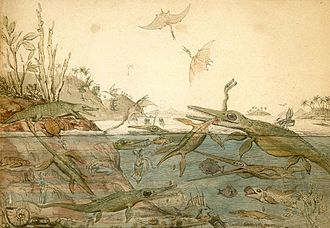
Duria Antiquior, célèbre aquarelle du géologue Henry de la Beche représentant la vie dans l'ancien Dorset d'après des fossiles trouvés par Mary Anning.

Duria Antiquior, célèbre aquarelle du géologue Henry de la Beche représentant la vie dans l'ancien Dorset d'après des fossiles trouvés par Mary Anning.

old school fossile Ichthyosaurus Plesiosaurus +1
Geographic and geologic map showing the location and involved strata of the studied fossil sites in the Xinhe Formation. (A, B) location of the fossiliferous localities in the Gansu Province. (C) Geological map of the involved strata of the studied fossil site (from State Bureau of Surveying and Mapping, GS (2016)2884). White star=Jinchuanloong niedu. Black star=plesiosaur fossils. (D) Stratigraphic chart of the Jurassic at the localities.

Geographic and geologic map showing the location and involved strata of the studied fossil sites in the Xinhe Formation. (A, B) location of the fossiliferous localities in the Gansu Province. (C) Geological map of the involved strata of the studied fossil site (from State Bureau of Surveying and Mapping, GS (2016)2884). White star=Jinchuanloong niedu. Black star=plesiosaur fossils. (D) Stratigraphic chart of the Jurassic at the localities.

Jurassique fossile Jinchuanloong Plesiosauria +1
Jinchuanloong is a relatively basal sauropod that measured an estimated 10 m in length. Sauropod skulls typically don't preserve well in the fossil record, but Jinchuanloong is known mainly from the skull, and parts of the neck and tail. Like all sauropods, Jinchuanloong was a quadrupedal herbivore that used its long neck to reach the vegetation that it fed on.

Jinchuanloong is a relatively basal sauropod that measured an estimated 10 m in length. Sauropod skulls typically don't preserve well in the fossil record, but Jinchuanloong is known mainly from the skull, and parts of the neck and tail. Like all sauropods, Jinchuanloong was a quadrupedal herbivore that used its long neck to reach the vegetation that it fed on.

fossile Jinchuanloong crâne
Artists’ reconstruction of the living Sarabosaurus dahli swimming with ammonites and fish in southern Utah, 94 million years ago. Artwork by Andrey Atuchin. On June 23, 2023, the following link will go live for more information, www.blm.gov/press-release/94-million-year-old-fossil-prov...

Artists’ reconstruction of the living Sarabosaurus dahli swimming with ammonites and fish in southern Utah, 94 million years ago. Artwork by Andrey Atuchin. On June 23, 2023, the following link will go live for more information, www.blm.gov/press-release/94-million-year-old-fossil-prov...

fossile Sarabosaurus Selmasaurini
Various fossils pertaining to the holotype of the Triassic ichthyosaur Toretocnemus (originally Leptocheirus, also Merriamia) zitteli. This image is derived from plate 23 in Merriam (1903), done by an uncredited artist. The arrangement of the individual figures has been modified from the original (most notably, figures 3 and 4 were swapped to minimize confusion).
Original description:
Leptocheirus zitteli n. gen. and sp.
Figures reproduced natural size from the type specimen.

Fig. 1.— Right side of skull.
Fig. 2. — Cross-section of posterior portion of the lower jaw, taken above the point marked A on the lateral view of the skull.
Fig. 3. — Cross-section of the upper and lower jaws, taken at the break immediately behind the point marked Sp on the lateral view of the skull.
Fig. 4. — Lateral view of an anterior caudal centrum.
Legend (modified from original):

Ar - articular
A - angular
D - dentary
J - jugal
L - lacrimal
Mx - maxilla
Po - postorbital
Sa - surangular
Se - sclerotic ring
Sp - spenial
T - cross-section of tooth
X - doubtful element

Various fossils pertaining to the holotype of the Triassic ichthyosaur Toretocnemus (originally Leptocheirus, also Merriamia) zitteli. This image is derived from plate 23 in Merriam (1903), done by an uncredited artist. The arrangement of the individual figures has been modified from the original (most notably, figures 3 and 4 were swapped to minimize confusion). Original description: Leptocheirus zitteli n. gen. and sp. Figures reproduced natural size from the type specimen. Fig. 1.— Right side of skull. Fig. 2. — Cross-section of posterior portion of the lower jaw, taken above the point marked A on the lateral view of the skull. Fig. 3. — Cross-section of the upper and lower jaws, taken at the break immediately behind the point marked Sp on the lateral view of the skull. Fig. 4. — Lateral view of an anterior caudal centrum. Legend (modified from original): Ar - articular A - angular D - dentary J - jugal L - lacrimal Mx - maxilla Po - postorbital Sa - surangular Se - sclerotic ring Sp - spenial T - cross-section of tooth X - doubtful element

description Trias fossile holotype +7
Photograph of a fossil cast of a Tanycolagreus topwilsoni skeleton taken at the North American Museum of Ancient Life.

Photograph of a fossil cast of a Tanycolagreus topwilsoni skeleton taken at the North American Museum of Ancient Life.

musée moulage fossile Coeluridae +2
Tanycolagreus fossil holotype TPII 2000-09-29, North American Museum of Ancient Life.

Tanycolagreus fossil holotype TPII 2000-09-29, North American Museum of Ancient Life.

musée États-Unis fossile holotype +2
Diagram of the skull of Taniwhasaurus antarcticus, the areas in black being the known fossil material.
Reference source:

Álvarez–Herrera, Agnolin & Novas (2020) "A rostral neurovascular system in the mosasaur Taniwhasaurus antarcticus"

Diagram of the skull of Taniwhasaurus antarcticus, the areas in black being the known fossil material. Reference source: Álvarez–Herrera, Agnolin & Novas (2020) "A rostral neurovascular system in the mosasaur Taniwhasaurus antarcticus"

fossile Plioplatecarpinae Taniwhasaurus crâne
Ctenochasma elegans (syn. Pterodactylus elegans) fossil from Solnhofen, Germany

American Museum of Natural History, New York, FR-5147
Received in exchange from the Paläontologisches Museum München, 1909
Taxons Ctenochasmatidae

Ctenochasma elegans (syn. Pterodactylus elegans) fossil from Solnhofen, Germany American Museum of Natural History, New York, FR-5147 Received in exchange from the Paläontologisches Museum München, 1909

musée Allemagne fossile Ctenochasma +5
Ctenochasma elegans (syn. Pterodactylus elegans) fossil from Solnhofen, Germany

American Museum of Natural History, New York, FR-5147
Received in exchange from the Paläontologisches Museum München, 1909
Taxons Gnathosaurinae

Ctenochasma elegans (syn. Pterodactylus elegans) fossil from Solnhofen, Germany American Museum of Natural History, New York, FR-5147 Received in exchange from the Paläontologisches Museum München, 1909

musée Allemagne fossile Ctenochasma +5
Ctenochasma elegans (syn. Pterodactylus elegans) fossil from Solnhofen, Germany

American Museum of Natural History, New York, FR-5147
Received in exchange from the Paläontologisches Museum München, 1909
Taxons Moganopterinae

Ctenochasma elegans (syn. Pterodactylus elegans) fossil from Solnhofen, Germany American Museum of Natural History, New York, FR-5147 Received in exchange from the Paläontologisches Museum München, 1909

musée Allemagne fossile Ctenochasma +5
1 2 3 4 5 6 7 8 9 10 11 12 13 14 15

Actualités

Ajkaceratops: Beast of the Week
Ajkaceratops : la bête de la semaine
Hongrie Crétacé Crétacé supérieur fossile Ajkaceratops Dinosauria
Cette semaine, nous allons découvrir un dinosaure unique qui vivait dans un environnement encore plus unique.  Parlons d'Ajkaceratops kozmai ! Ajkaceratops était un petit dinosaure herbivore qui vivait dans ce qui est aujourd'hui la Hongrie à la fin du Crétacé, il y a environ 85 millions d'années.  Du bec à la queue, il mesurait probablement un peu plus de 1 m de long.  Le nom du genre se traduit par « Ajka Horned Face », faisant référence à la ville de Hongrie près de l'endroit où ses fossiles ont été trouvés.  Aquarelle d'Ajkaceratops par C
18/01/2026 prehistoricbeastoftheweek ⚙ Traduction automatique
Un fossile légendaire oblige les scientifiques à repenser les origines humaines
Afrique du Sud fossile origine humaine nouvelle espèce squelette
L'un des fossiles d'ancêtres humains les plus complets jamais découverts pourrait appartenir à une espèce entièrement nouvelle, selon une équipe de recherche internationale. Le célèbre squelette du « Little Foot » d’Afrique du Sud a longtemps été débattu, mais de nouvelles analyses suggèrent qu’il ne correspond vraiment à aucune espèce d’australopithèque connue. Au lieu de cela, les chercheurs affirment que son mélange unique de caractéristiques pointe vers un parent humain jusqu’alors non identifié, remodelant les idées sur la diversité humaine primitive.
05/01/2026 sciencedaily-human-evo ⚙ Traduction automatique
Cet ancien fossile pourrait réécrire l'histoire des origines humaines
fossile découverte origine humaine étude
Les scientifiques ont peut-être résolu la question de savoir si un fossile vieux de sept millions d’années pouvait marcher debout. Une nouvelle étude a trouvé des preuves anatomiques solides que Sahelanthropus tchadensis était bipède, y compris une attache ligamentaire observée uniquement chez les ancêtres humains. Malgré son apparence simiesque et son petit cerveau, la structure de ses pattes et de ses hanches suggère qu'il se déplaçait avec assurance sur deux pattes. Cette découverte place la bipédie à la racine même de l’arbre généalogique humain.
03/01/2026 sciencedaily-human-evo ⚙ Traduction automatique
Des os fossilisés révèlent les secrets d'un monde perdu
os fossile
Les chercheurs ont découvert des milliers de molécules métaboliques préservées à l’intérieur d’os fossilisés vieux de plusieurs millions d’années, offrant ainsi une nouvelle fenêtre surprenante sur la vie préhistorique. Les résultats révèlent le régime alimentaire des animaux, leurs maladies et même le climat qui les entoure, y compris des preuves d’environnements plus chauds et plus humides. Un fossile présentait même des signes d'un parasite encore connu aujourd'hui. Cette approche pourrait transformer la façon dont les scientifiques reconstruisent les écosystèmes anciens.
03/01/2026 sciencedaily ⚙ Traduction automatique
Cet étrange serpent ancien se cachait dans un musée depuis des décennies
os musée fossile découverte
Un étrange petit fossile de serpent trouvé sur la côte sud de l’Angleterre a enfin révélé ses secrets, plus de 40 ans après sa découverte. Le nouveau Paradoxophidion richardoweni vivait il y a environ 37 millions d’années, à une époque où la Grande-Bretagne était plus chaude et regorgeait de reptiles. Bien que connu uniquement à partir de minuscules os de la colonne vertébrale, ce « serpent paradoxal » présente un mélange surprenant de traits observés chez les serpents modernes, le plaçant près des racines mêmes du groupe de serpents le plus diversifié d’aujourd’hui.
31/12/2025 sciencedaily ⚙ Traduction automatique
1 2 3 4 5 6 7 8 9 10 11 12 13 14 15 16 17 18 19 20 21 22 23 24 25 26 27 28 29 30 31 32 33 34 35 36 37 38 39 40 41 42 43