←

fossile

Nature du spécimen

226 image(s) · 216 Actualités

Galerie d'images

Sable riche en coquilles fossiles provenant de l'intérieur de puits de dissolution du site de l'Ariey. On y voit des coraux, oursins plats (Amphiope), gastéropodes (Melongena, Conus, Cypraea) et des bivalves (Lucina & Barbatia)

Sable riche en coquilles fossiles provenant de l'intérieur de puits de dissolution du site de l'Ariey. On y voit des coraux, oursins plats (Amphiope), gastéropodes (Melongena, Conus, Cypraea) et des bivalves (Lucina & Barbatia)

fossile
Figure 1. Evolution of macroecological traits in Dinosauria. Large scale event in dinosaur evolution (a); the origin of dinosaurs (star), hyperthermals (volcano), the earliest fossil Avialae (bird), the earliest fossil angiosperm (flower), the Cretaceous/Palaeogene mass extinction (asteroid). Phylogeny of dinosaurs (b) redrawn from Sereno and adapted to the current consensus and upon which an ancestral state reconstruction of temperature niche (mean annual temperature) after Chiarenza et al. is plotted; Mesozoic palaeogeographies (c) for Triassic (T), Jurassic (J) and Cretaceous (K). Silhouette colours symbolize body mass for each of the taxa represented; information on dietary habits are plotted after Barrett and Zanno & Makovicky; numbers represent clades discussed through this study: 1, Ornithischia; 2, Thyreophora; 3, Ornithopoda; 4, Hadrosauroidea; 5, Marginocephalia; 6, Ceratopsia; 7, Saurischia; 8, Sauropodomorpha; 9, Sauropoda; 10, Theropoda; 11, Ceratosauria; 12, Tetanurae; 13, Coelurosauria; 14, Maniraptoriformes; 15, Maniraptora; 16, Deinonychosauria; 17, Avialae; 18, Ornithothoraces. Palaeogeographies modified from original plots via R package ‘mapast’ using plate models by Scotese.

Figure 1. Evolution of macroecological traits in Dinosauria. Large scale event in dinosaur evolution (a); the origin of dinosaurs (star), hyperthermals (volcano), the earliest fossil Avialae (bird), the earliest fossil angiosperm (flower), the Cretaceous/Palaeogene mass extinction (asteroid). Phylogeny of dinosaurs (b) redrawn from Sereno and adapted to the current consensus and upon which an ancestral state reconstruction of temperature niche (mean annual temperature) after Chiarenza et al. is plotted; Mesozoic palaeogeographies (c) for Triassic (T), Jurassic (J) and Cretaceous (K). Silhouette colours symbolize body mass for each of the taxa represented; information on dietary habits are plotted after Barrett and Zanno & Makovicky; numbers represent clades discussed through this study: 1, Ornithischia; 2, Thyreophora; 3, Ornithopoda; 4, Hadrosauroidea; 5, Marginocephalia; 6, Ceratopsia; 7, Saurischia; 8, Sauropodomorpha; 9, Sauropoda; 10, Theropoda; 11, Ceratosauria; 12, Tetanurae; 13, Coelurosauria; 14, Maniraptoriformes; 15, Maniraptora; 16, Deinonychosauria; 17, Avialae; 18, Ornithothoraces. Palaeogeographies modified from original plots via R package ‘mapast’ using plate models by Scotese.

écaille Crétacé Jurassique Mésozoïque +23
Simplified cladogram of Dinosauria with the distribution of feathers according to the fossil record. Despite its more ancient origin, it
was only in maniraptoriformes that modern-type feathers (pennaceous feathers) have arisen (Based in Xu & Guo, 2009; Clarke,

2013; Godefroit et al., 2013; Han et al., 2014; Koshchowitz et al., 2014).

Simplified cladogram of Dinosauria with the distribution of feathers according to the fossil record. Despite its more ancient origin, it was only in maniraptoriformes that modern-type feathers (pennaceous feathers) have arisen (Based in Xu & Guo, 2009; Clarke, 2013; Godefroit et al., 2013; Han et al., 2014; Koshchowitz et al., 2014).

plume fossile Dinosauria Maniraptoriformes +1
Photographer: User:Ballista

Edited in Adobe PhotoShop: User:Firsfron
Photographed object is in fact a cast of a real fossil. It's part of a hands-on exhibit of the NHM in London.

Photographer: User:Ballista Edited in Adobe PhotoShop: User:Firsfron Photographed object is in fact a cast of a real fossil. It's part of a hands-on exhibit of the NHM in London.

moulage fossile Neotheropoda
The Chicago specimen of Archaeopteryx (PA 830), a well-preserved fossil highlighting the transitional features between non-avian dinosaurs and birds, housed at the Field Museum of Natural History.

The Chicago specimen of Archaeopteryx (PA 830), a well-preserved fossil highlighting the transitional features between non-avian dinosaurs and birds, housed at the Field Museum of Natural History.

musée fossile spécimen Archaeopteryx +2
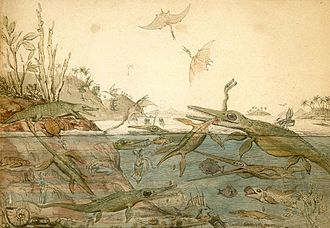
Duria Antiquior, célèbre aquarelle du géologue Henry de la Beche représentant la vie dans l'ancien Dorset d'après des fossiles trouvés par Mary Anning.

Duria Antiquior, célèbre aquarelle du géologue Henry de la Beche représentant la vie dans l'ancien Dorset d'après des fossiles trouvés par Mary Anning.

old school fossile Ichthyosaurus Plesiosaurus +1
Geographic and geologic map showing the location and involved strata of the studied fossil sites in the Xinhe Formation. (A, B) location of the fossiliferous localities in the Gansu Province. (C) Geological map of the involved strata of the studied fossil site (from State Bureau of Surveying and Mapping, GS (2016)2884). White star=Jinchuanloong niedu. Black star=plesiosaur fossils. (D) Stratigraphic chart of the Jurassic at the localities.

Geographic and geologic map showing the location and involved strata of the studied fossil sites in the Xinhe Formation. (A, B) location of the fossiliferous localities in the Gansu Province. (C) Geological map of the involved strata of the studied fossil site (from State Bureau of Surveying and Mapping, GS (2016)2884). White star=Jinchuanloong niedu. Black star=plesiosaur fossils. (D) Stratigraphic chart of the Jurassic at the localities.

Jurassique fossile Jinchuanloong Plesiosauria +1
Jinchuanloong is a relatively basal sauropod that measured an estimated 10 m in length. Sauropod skulls typically don't preserve well in the fossil record, but Jinchuanloong is known mainly from the skull, and parts of the neck and tail. Like all sauropods, Jinchuanloong was a quadrupedal herbivore that used its long neck to reach the vegetation that it fed on.

Jinchuanloong is a relatively basal sauropod that measured an estimated 10 m in length. Sauropod skulls typically don't preserve well in the fossil record, but Jinchuanloong is known mainly from the skull, and parts of the neck and tail. Like all sauropods, Jinchuanloong was a quadrupedal herbivore that used its long neck to reach the vegetation that it fed on.

fossile Jinchuanloong crâne
Artists’ reconstruction of the living Sarabosaurus dahli swimming with ammonites and fish in southern Utah, 94 million years ago. Artwork by Andrey Atuchin. On June 23, 2023, the following link will go live for more information, www.blm.gov/press-release/94-million-year-old-fossil-prov...

Artists’ reconstruction of the living Sarabosaurus dahli swimming with ammonites and fish in southern Utah, 94 million years ago. Artwork by Andrey Atuchin. On June 23, 2023, the following link will go live for more information, www.blm.gov/press-release/94-million-year-old-fossil-prov...

fossile Sarabosaurus Selmasaurini
Various fossils pertaining to the holotype of the Triassic ichthyosaur Toretocnemus (originally Leptocheirus, also Merriamia) zitteli. This image is derived from plate 23 in Merriam (1903), done by an uncredited artist. The arrangement of the individual figures has been modified from the original (most notably, figures 3 and 4 were swapped to minimize confusion).
Original description:
Leptocheirus zitteli n. gen. and sp.
Figures reproduced natural size from the type specimen.

Fig. 1.— Right side of skull.
Fig. 2. — Cross-section of posterior portion of the lower jaw, taken above the point marked A on the lateral view of the skull.
Fig. 3. — Cross-section of the upper and lower jaws, taken at the break immediately behind the point marked Sp on the lateral view of the skull.
Fig. 4. — Lateral view of an anterior caudal centrum.
Legend (modified from original):

Ar - articular
A - angular
D - dentary
J - jugal
L - lacrimal
Mx - maxilla
Po - postorbital
Sa - surangular
Se - sclerotic ring
Sp - spenial
T - cross-section of tooth
X - doubtful element

Various fossils pertaining to the holotype of the Triassic ichthyosaur Toretocnemus (originally Leptocheirus, also Merriamia) zitteli. This image is derived from plate 23 in Merriam (1903), done by an uncredited artist. The arrangement of the individual figures has been modified from the original (most notably, figures 3 and 4 were swapped to minimize confusion). Original description: Leptocheirus zitteli n. gen. and sp. Figures reproduced natural size from the type specimen. Fig. 1.— Right side of skull. Fig. 2. — Cross-section of posterior portion of the lower jaw, taken above the point marked A on the lateral view of the skull. Fig. 3. — Cross-section of the upper and lower jaws, taken at the break immediately behind the point marked Sp on the lateral view of the skull. Fig. 4. — Lateral view of an anterior caudal centrum. Legend (modified from original): Ar - articular A - angular D - dentary J - jugal L - lacrimal Mx - maxilla Po - postorbital Sa - surangular Se - sclerotic ring Sp - spenial T - cross-section of tooth X - doubtful element

description Trias fossile holotype +7
Photograph of a fossil cast of a Tanycolagreus topwilsoni skeleton taken at the North American Museum of Ancient Life.

Photograph of a fossil cast of a Tanycolagreus topwilsoni skeleton taken at the North American Museum of Ancient Life.

musée moulage fossile Coeluridae +2
Tanycolagreus fossil holotype TPII 2000-09-29, North American Museum of Ancient Life.

Tanycolagreus fossil holotype TPII 2000-09-29, North American Museum of Ancient Life.

musée États-Unis fossile holotype +2
Diagram of the skull of Taniwhasaurus antarcticus, the areas in black being the known fossil material.
Reference source:

Álvarez–Herrera, Agnolin & Novas (2020) "A rostral neurovascular system in the mosasaur Taniwhasaurus antarcticus"

Diagram of the skull of Taniwhasaurus antarcticus, the areas in black being the known fossil material. Reference source: Álvarez–Herrera, Agnolin & Novas (2020) "A rostral neurovascular system in the mosasaur Taniwhasaurus antarcticus"

fossile Plioplatecarpinae Taniwhasaurus crâne
Ctenochasma elegans (syn. Pterodactylus elegans) fossil from Solnhofen, Germany

American Museum of Natural History, New York, FR-5147
Received in exchange from the Paläontologisches Museum München, 1909
Taxons Ctenochasmatidae

Ctenochasma elegans (syn. Pterodactylus elegans) fossil from Solnhofen, Germany American Museum of Natural History, New York, FR-5147 Received in exchange from the Paläontologisches Museum München, 1909

musée Allemagne fossile Ctenochasma +5
Ctenochasma elegans (syn. Pterodactylus elegans) fossil from Solnhofen, Germany

American Museum of Natural History, New York, FR-5147
Received in exchange from the Paläontologisches Museum München, 1909
Taxons Gnathosaurinae

Ctenochasma elegans (syn. Pterodactylus elegans) fossil from Solnhofen, Germany American Museum of Natural History, New York, FR-5147 Received in exchange from the Paläontologisches Museum München, 1909

musée Allemagne fossile Ctenochasma +5
Ctenochasma elegans (syn. Pterodactylus elegans) fossil from Solnhofen, Germany

American Museum of Natural History, New York, FR-5147
Received in exchange from the Paläontologisches Museum München, 1909
Taxons Moganopterinae

Ctenochasma elegans (syn. Pterodactylus elegans) fossil from Solnhofen, Germany American Museum of Natural History, New York, FR-5147 Received in exchange from the Paläontologisches Museum München, 1909

musée Allemagne fossile Ctenochasma +5
1 2 3 4 5 6 7 8 9 10 11 12 13 14 15

Actualités

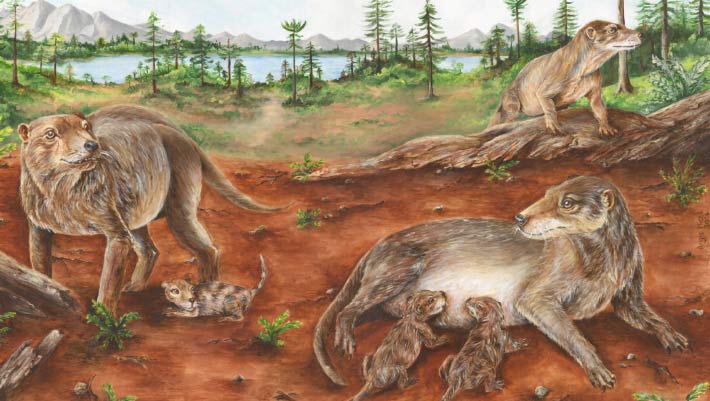
Fossil Evidence Pushes Back Origin of Live Birth by 90 Million Years
Les preuves fossiles repoussent l’origine des naissances vivantes de 90 millions d’années
reproduction Argentine fossile mammifères
Les paléontologues étudiant un fossile de cynodonte d'Argentine vieux de 236 millions d'années affirment avoir trouvé la première preuve de viviparité (naissance vivante) dans la lignée évolutive qui mène aux mammifères, repoussant l'origine de cette stratégie de reproduction de 90 à 95 millions d'années. L'article Les preuves fossiles repoussent l'origine des naissances vivantes de 90 millions d'années est apparu en premier sur Sci.News : Breaking Science News.
13/08/2026 sci-news ⚙ Traduction automatique
Un nouveau genre de dinosaure troodontidé du Nouveau-Mexique
os Mexique Campanien Crétacé Crétacé supérieur fossile Dinevenator Dinosauria Troodontidae nouvelle espèce crâne
Les paléontologues ont nommé une nouvelle espèce de dinosaure théropode du Nouveau-Mexique. Le dinosaure, Dinevenator Robustus, vivait il y a environ 73 millions d'années (stade faunique campanien du Crétacé supérieur). Les chercheurs ont identifié le dinosaure à partir d’un os fossile du crâne (un frontal) trouvé dans le nord-ouest du Nouveau-Mexique. Il représente un nouveau genre et une nouvelle espèce de troodontidé. Troodontidés
13/08/2026 everythingdinosaur ⚙ Traduction automatique
Germany’s Famous Fossil Beds Yield New Species of Jurassic Ichthyosaur
Les célèbres gisements de fossiles d’Allemagne donnent naissance à de nouvelles espèces d’ichtyosaures jurassiques
musée Allemagne Jurassique fossile Ichthyosauria Ichthyosaurus Jabalisaurus nouvelle espèce
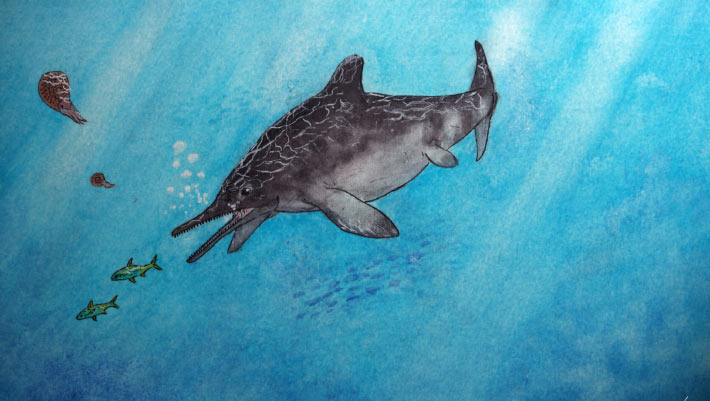
Le Dr Erin Maxwell du Staatliches Museum für Naturkunde Stuttgart et ses collègues ont identifié une deuxième espèce dans les gisements calcaires allemands de Plattenkalk : Jabalisaurus tethyensis. L’article Les célèbres gisements de fossiles d’Allemagne produisent de nouvelles espèces d’ichtyosaures jurassiques est apparu en premier sur Sci.News : Breaking Science News.
11/08/2026 sci-news ⚙ Traduction automatique
Un fossile de reptile vieux de 240 millions d'années révèle un chapitre perdu avant les dinosaures et les crocodiles
prédateur Brésil Trias fossile Dinosauria évolution autres reptiles
Un reptile vieux de 240 millions d'années découvert au Brésil révèle à quoi ressemblait l'évolution juste avant l'avènement des dinosaures et des crocodiles. Le petit prédateur avait des pattes inhabituellement positionnées qui lui permettaient peut-être de se déplacer plus efficacement que de nombreux reptiles antérieurs. Ses proches parents étaient auparavant connus principalement sur d’autres continents, ce qui suggère que ces animaux anciens se sont répandus beaucoup plus loin dans le monde du Trias que les scientifiques ne le pensaient.
10/08/2026 sciencedaily ⚙ Traduction automatique
New Troodontid Dinosaur Genus Identified from Fossil Bone Found Decades Ago in New Mexico
Un nouveau genre de dinosaure troodontidé identifié à partir d'un os fossile découvert il y a plusieurs décennies au Nouveau-Mexique
os Mexique fossile Dinevenator Dinosauria Troodontidae oiseau
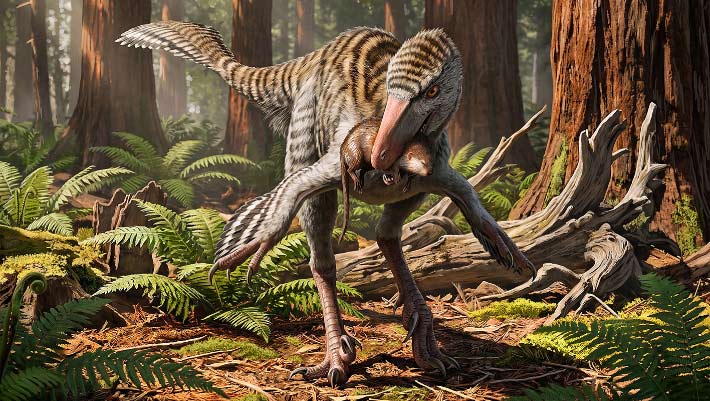
Les paléontologues ont décrit un nouveau genre de petit dinosaure ressemblant à un oiseau qui vivait dans ce qui est aujourd'hui le Nouveau-Mexique il y a environ 73 millions d'années. L'article Nouveau genre de dinosaures troodontidés identifié à partir d'os fossiles trouvés il y a des décennies au Nouveau-Mexique est apparu en premier sur Sci.News : Breaking Science News.
07/08/2026 sci-news ⚙ Traduction automatique
1 2 3 4 5 6 7 8 9 10 11 12 13 14 15 16 17 18 19 20 21 22 23 24 25 26 27 28 29 30 31 32 33 34 35 36 37 38 39 40 41 42 43 44