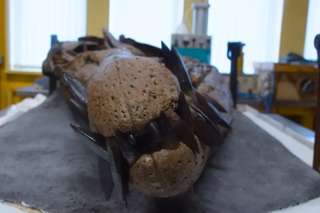
dent

Partie anatomique

55 image(s) · 28 Actualités

Galerie d'images

natural silicone cast of the holotype of Lycorhinus angustidens (UCRC PVC10). Abbreviations: 3-10 dentary tooth 3-10 Fa-j tooth-to-tooth wear facet a-j f accessory facet. Scale bars equal 1 cm in C and 3 cm in D.
Taxons Lycorhinus

natural silicone cast of the holotype of Lycorhinus angustidens (UCRC PVC10). Abbreviations: 3-10 dentary tooth 3-10 Fa-j tooth-to-tooth wear facet a-j f accessory facet. Scale bars equal 1 cm in C and 3 cm in D.

écaille dent moulage holotype +1
Tooth of cf. Zapsalis, with close up of denticles. Specimen UALVP 49582 from the Milk River Formation.
Taxons Zapsalis

Tooth of cf. Zapsalis, with close up of denticles. Specimen UALVP 49582 from the Milk River Formation.

dent Milk River spécimen Zapsalis +1
Genus—Nuthetes. (Lacertilia).
Fig. 13 and 14. Portions of mandible and teeth of Nuthetes destructor.
Fig. 15. Five detached teeth of do.

Fig. 16. Side view of crown of a tooth of do., magn.
Taxons Nuthetes

Genus—Nuthetes. (Lacertilia). Fig. 13 and 14. Portions of mandible and teeth of Nuthetes destructor. Fig. 15. Five detached teeth of do. Fig. 16. Side view of crown of a tooth of do., magn.

dent Nuthetes
Tooth of cf. Pectinodon.
Taxons Pectinodon

Tooth of cf. Pectinodon.

dent Pectinodon
Partial skull of Shastasaurus pacificus (UCMP 9017) from the Late Triassic of California, USA, in (A) lateral, (B) dorsal, and (C) anterolateral view.

Based on this skull, Shastasaurus has repeatedly been reconstructed with a long, tooth-bearing rostrum. However, note the slenderness of the lower jaw (B, C) and the strong anterior taper of the snout (B), both of which are more consistent with the abbreviated and toothless snout of Shastasaurus liangae comb. nov. than with the traditional long-snouted reconstruction of this skull (as, e.g., in references [22] and [23]).
Taxons Shastasaurus

Partial skull of Shastasaurus pacificus (UCMP 9017) from the Late Triassic of California, USA, in (A) lateral, (B) dorsal, and (C) anterolateral view. Based on this skull, Shastasaurus has repeatedly been reconstructed with a long, tooth-bearing rostrum. However, note the slenderness of the lower jaw (B, C) and the strong anterior taper of the snout (B), both of which are more consistent with the abbreviated and toothless snout of Shastasaurus liangae comb. nov. than with the traditional long-snouted reconstruction of this skull (as, e.g., in references [22] and [23]).

dent États-Unis Trias supérieur Trias +5
Partial skull of Shastasaurus pacificus (UCMP 9017) from the Late Triassic of California, USA, in (A) lateral, (B) dorsal, and (C) anterolateral view.

Based on this skull, Shastasaurus has repeatedly been reconstructed with a long, tooth-bearing rostrum. However, note the slenderness of the lower jaw (B, C) and the strong anterior taper of the snout (B), both of which are more consistent with the abbreviated and toothless snout of Shastasaurus liangae comb. nov. than with the traditional long-snouted reconstruction of this skull (as, e.g., in references [22] and [23]).
Taxons Merriamosauria

Partial skull of Shastasaurus pacificus (UCMP 9017) from the Late Triassic of California, USA, in (A) lateral, (B) dorsal, and (C) anterolateral view. Based on this skull, Shastasaurus has repeatedly been reconstructed with a long, tooth-bearing rostrum. However, note the slenderness of the lower jaw (B, C) and the strong anterior taper of the snout (B), both of which are more consistent with the abbreviated and toothless snout of Shastasaurus liangae comb. nov. than with the traditional long-snouted reconstruction of this skull (as, e.g., in references [22] and [23]).

dent États-Unis Trias supérieur Trias +5
Partial skull of Shastasaurus pacificus (UCMP 9017) from the Late Triassic of California, USA, in (A) lateral, (B) dorsal, and (C) anterolateral view.

Based on this skull, Shastasaurus has repeatedly been reconstructed with a long, tooth-bearing rostrum. However, note the slenderness of the lower jaw (B, C) and the strong anterior taper of the snout (B), both of which are more consistent with the abbreviated and toothless snout of Shastasaurus liangae comb. nov. than with the traditional long-snouted reconstruction of this skull (as, e.g., in references [22] and [23]).
Taxons Euichthyosauria

Partial skull of Shastasaurus pacificus (UCMP 9017) from the Late Triassic of California, USA, in (A) lateral, (B) dorsal, and (C) anterolateral view. Based on this skull, Shastasaurus has repeatedly been reconstructed with a long, tooth-bearing rostrum. However, note the slenderness of the lower jaw (B, C) and the strong anterior taper of the snout (B), both of which are more consistent with the abbreviated and toothless snout of Shastasaurus liangae comb. nov. than with the traditional long-snouted reconstruction of this skull (as, e.g., in references [22] and [23]).

dent États-Unis Trias supérieur Trias +5
A–C, tooth of “Paronychodon” (NMMNH P-30233) showing lingual (A), labial (B), and basal (C) views; D–F, tooth of “Paronychodon” (NMMNH P-30218), showing lingual (D), labial (E), and basal (F) views;
Taxons Paronychodon

A–C, tooth of “Paronychodon” (NMMNH P-30233) showing lingual (A), labial (B), and basal (C) views; D–F, tooth of “Paronychodon” (NMMNH P-30218), showing lingual (D), labial (E), and basal (F) views;

dent Paronychodon
Tooth of cf. Richardoestesia gilmorei with close up of denticles.
Taxons Richardoestesia

Tooth of cf. Richardoestesia gilmorei with close up of denticles.

dent Richardoestesia
1 2 3 4

Actualités

Les abeilles anciennes ont transformé les alvéoles dentaires en minuscules pépinières il y a 20 000 ans
os dent nid fossile découverte mammifères
Une étonnante découverte de fossiles montre que d'anciennes abeilles utilisaient les alvéoles vides des os de mammifères comme de minuscules nids après que des hiboux aient dispersé les os sur le sol d'une grotte il y a 20 000 ans. Il s’agit de la première preuve connue de nidification d’abeilles dans des os d’animaux, révélant une stratégie de survie étonnamment créative.
05/07/2026 sciencedaily ⚙ Traduction automatique
Early Saber-Toothed Cat Gets New Face after Decades of Mystery
Le premier chat à dents de sabre obtient un nouveau visage après des décennies de mystère
dent paléoart reconstitution États-Unis Pliocène mammifères crâne
Un crâne presque complet découvert il y a plusieurs décennies en Arizona a donné aux paléontologues leur aperçu le plus clair à ce jour d'Adelphailurus kansensis, une espèce énigmatique de félidés qui habitait l'Amérique du Nord il y a plus de 5 millions d'années et occupait une des premières branches de l'arbre généalogique des chats à dents de sabre. L'article Le premier chat à dents de sabre obtient un nouveau visage après des décennies de mystère est apparu en premier sur Sci.News : Breaking Science News.
29/06/2026 sci-news ⚙ Traduction automatique
Que mangeaient les dinosaures ? Un guide utile sur les régimes alimentaires des dinosaures
os mâchoire dent fossile Dinosauria étude
Vous êtes-vous déjà demandé ce que mangeaient les dinosaures ? C’est l’une des questions les plus fréquemment posées chez Everything Dinosaur. La réponse est étonnamment variée. Certains dinosaures étaient de féroces mangeurs de viande, tandis que d’autres se nourrissaient de plantes. D'autres étaient omnivores (mangant à la fois des plantes et de la viande). Les scientifiques étudient les dents fossiles, les os de la mâchoire, le contenu de l'estomac et même les fossiles
22/06/2026 everythingdinosaur ⚙ Traduction automatique
On le croyait roi des océans au Jurassique : une vertèbre percée raconte un combat d’une violence extrême
os dent vertèbre chasse musée Jurassique fossile Ichthyosauria Ichthyosaurus Pliosaurus comportement
Oublié pendant plus d’un siècle dans les tiroirs d’un musée, un fossile refait aujourd’hui surface et raconte une scène de violence extrême dans les océans du Jurassique. Une vertèbre d’ichtyosaure, marquée par l’impact d’une dent brisée, révèle peut-être l’attaque d’un des plus redoutables...
17/06/2026 futura-terre
Fossils from Chinese Cave Fill Crucial Gap in History of Gigantopithecus blacki
Des fossiles provenant d'une grotte chinoise comblent une lacune cruciale dans l'histoire du Gigantopithecus blacki
dent Chine fossile origine humaine mammifères
Au fond d'une grotte calcaire du sud de la Chine, des paléontologues ont découvert un assemblage de treize dents fossilisées appartenant à Gigantopithecus blacki, la plus grande espèce de primate jamais connue. L'article Les fossiles des grottes chinoises comblent une lacune cruciale dans l'histoire de Gigantopithecus blacki apparaît en premier sur Sci.News : Breaking Science News.
15/06/2026 sci-news ⚙ Traduction automatique
1 2 3 4 5 6