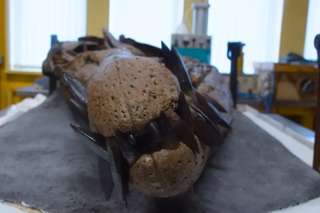
dent

Partie anatomique

47 image(s) · 4 Actualités

Galerie d'images

A tooth tip from the theropod dinosaur Nuthetes destructor from the Lulworth Formation, England

dent Coeluridae Nuthetes formation
Taxons Piratosaurus

Piratosaurus holotype tooth USNM V 1000

dent holotype Piratosaurus
Taxons Melkamter

Photographs of Melkamter pateko (MPEF-PV 11530), visible in medial views on the main block (1) with inset of the tooth (1B) and counterslab (2);. Rendered CT scan detail images (dashed areas represent visible bone that was too thin to be captured by CT scan) of the cranial fragment (1A), manual metacarpal (1C) and dorsal vertebrae (1D–F). Abbreviations: a = alveoli; if = infratemporal fenestra; j = jugal; l = lacrimal; m = maxilla; o = orbit; naof = Nnasoantorbital fenestra; np = nasal process; pm = premaxilla; po = postorbital; q = quadrate; qj = quadratojugal; s = squamosal; t = tooth; vas = vestigial ascending process.

os dent Melkamter tomographie
Taxons Gladocephaloideus

Photograph (A) and line drawings (B) of Gladocephaloideus jingangshanensis (JPM 2014–004). Abbreviations: ca, carpals; cr, coracoids; cv, cervical vertebrae; d, dentray; dg, deep groove along the mid-line of the mandibular symphysis; dv, dorsal vertebrae; dr, dorsal ribs; etp, extensor tendon process; f, frontal; fc, fifth carpal; fe, femur; fi, fibula; fin, fingers; h, humerus; il, ilium; m, maxilla; mmttsI-IV, metatrals I-IV; mttv, metatarsal V; nao, nasoantorbital opening; or, orbital; pcr, parietal crest; pm, premaxilla; pt, pteroid; ra, radius; rdl, radiale; sc, scapula; st, sternum; sl, sclerotic rings; t, teeth; tc, tooth sockets; ti, tibia; ul, ulna; wm, wing metacarpal; wph1-4, wing phalanges 1–4. Scale bar = 5 cm.

crête humérus écaille dent +1
Taxons Haliskia

Haliskia peterseni gen. et sp. nov., holotype specimen KK F1426. (A) dorsal vertebra, ribs, gastralium, left scapulocoracoid, left and right manual phalanx IV-2, right manual phalanx IV-3, left femur, left tibia, metatarsals and pedal phalanges, (B) mandible, teeth, ceratobranchials, cervical vertebra, rib, gastralium, right syncarpus, right lateral carpal, right pteroid, metacarpals, manual digits, right manual phalanx IV-1, left manual phalanx IV-4, (C) premaxilla with teeth, (D) isolated tooth, (E) isolated tooth, (F) left lateral carpal, (G) left metacarpal IV. Scale bar = 50 mm.

écaille dent vertèbre holotype +2
Taxons Saltriovenator

Selected elements used in the diagnosis of Saltriovenator zanellai n. gen. n. sp. Right humerus in medial (A), frontal (B) and distal (C) views; (D) left scapula, medial view; (E) right scapular glenoid and coracoid, lateral view; (F) furcula, ventral view; tooth, labial (G) and apical (H) views; (I) left humerus, medial view; right second metacarpal in dorsal (J), lateral (L) and distal (N) views; first phalanx of the right second digit in dorsal (K), lateral (M) and proximal (O) views; (P–T) right third digit in proximal, dorsal and lateral views; (U) right distal tarsal IV, proximal view; third right metatarsal in proximal (V) and frontal (X) views; second right metatarsal, proximal (W) and frontal (Y) views; (Z) reconstructed skeleton showing identified elements (red). Abbreviations as in text, asterisks mark autapomorphic traits. Scale bars: 10 cm in (A)–(E), (I), and (U)–(Y); two cm in (F), and (J)–(T); one cm in (G).

humérus écaille dent Saltriovenator +1
Taxons Oxalaia

Specimen MN 6117-V, holotype of Oxalaia quilombensis. A, Left lateral view. B, Right lateral view. C, Dorsal view. D, Slightly oblique ventral view, emphasizing the sculptured condition of the palatal portion of the left premaxilla. Abbreviations for teeth follow Hendrickx et al. [58]. Additional abbreviations: am.p, anteromedial process of maxilla; pm, premaxilla; r.t, replacement tooth; s.p, secondary palate.

dent holotype spécimen Oxalaia
Taxons Kelmayisaurus

Left maxilla (A) and left dentary (B) of carcharodontosaurid theropod Kelmayisaurus petrolicus Dong, 1973 (IVPP V 4022, China, Lianmugin For− mation, Lower Cretaceous). Photographs in lateral (A1, B1), medial (A2, B2), ventral (A3), and dorsal (B3) views. Scale bars 5 cm. Designation “d” refers to dentary tooth, designation “m” refers to maxillary tooth position. Dorsal view of dentary shows tooth row only.

écaille dent Chine Crétacé +2
Taxons Dromaeosauroides

Cast of the holotype tooth (MGUH DK No. 315) of Dromaeosauroides bornholmensis at the Natural History Museum, London.

dent musée moulage holotype +1
Taxons Bicentenaria

Fig. 2. Selected cranial elements of Bicentenaria argentina nov. gen. et nov. sp. A, left lateral view of preserved caudal half of skull and jaws; B, right lateral view of preserved caudal half of skull and jaws; C, left quadrate and lower jaw in caudal view; D, fragmentary premaxillae with teeth in left lateral view; E, fragmentary left maxilla with tooth in lateral view. Abbreviations: an, angular; antf, antorbital fossa; art, articular; bs, basipterygoid process of basisphenoid; ch, notch for the chorda tympanica; gl, glenoid fossa; j, jugal; lc, lateral condyle of quadrate; lr, longitudinal ridge; ect, ectopterygoid; prar, right prearticular; pral, left prearticular; ptq, pterygoid ramus of quadrate; q, quadrate; qj, quadratojugal; sanl, left surangular; sanr, right surangular; rart, retroarticular process; t, tooth. Scale bars = 1 centimeter.

écaille dent Argentine Bicentenaria +1
Taxons Asiatyrannus

Photograph (A) and line drawing (B) of the skull of Asiatyrannus xui (ZMNH M30360) in right lateral view. The inset box in (A) indicates the position of the detailed jugal accessory horn in (C). acf accessory fossa of maxilla; ang angular; aof antorbital fenestra; cor cornual process; d dentary; d.t dentary tooth; emf external mandibular fenestra; en external naris; f frontal; gr groove; itf infratemporal fenestra; j jugal; jah jugal accessory horn; L left; la lacrimal; mf maxillary fenestra; mnvf maxillary neurovascular foramina; mx maxilla; nas nasal; nr nasal ridge; orb orbit; par parietal; pal palatine; pmx premaxilla; po postorbital; q quadrate; qj quadratojugal; R right; sa surangular; sf surangular foramen; snf subnarial foramen; sq squamosal; t1–6 maxillary tooth 1–6.

dent dessin Asiatyrannus crâne
Taxons Kinnareemimus

Reconstruction of the terrestrial paleoenvironmental setting of the Sao Khua Formation by Renata Cunha. In the center, a generalized spinosaurid feeds on a sauropod. This trophic relationship is hypothesized based on isolated tooth crowns found in association with a sauropod skeleton [67]. In the background, a small pack of the ornithomimosaur theropod Kinnareemimus. Both sauropods and ornithomimosaurs (as part of the “herbivorous” theropods) were found to be positively associated with terrestrial paleoenvironments by Butler and Barrett [15]. (cropped from File:Spinosaurid and Kinnareemimus.PNG)

dent reconstitution Sao Khua Kinnareemimus +3
Taxons Ampelognathus

DMNH 2021-05-02, holotype left dentary of Ampelognathus coheni, photos and labeled outline drawings in A, lateral; B, medial; C, dorsal; D, ventral; E, anterior; and F, posterior views. Abbreviations: a#, alveolus and numerical position in tooth row; anf, angular facet; cof, coronoid facet; cop, coronoid process; d6, dentary tooth 6 base; ds, dentary symphysis; mc, Meckelian canal; mg, Meckelian groove; pdd, dorsal facet for predentary; pdv, ventral facet for predentary; saf, surangular facet. Gray fill indicates recessed surfaces. Stippling indicates visible sediment. Cross-hatching indicates broken bone surface. Scale bars equal 5 mm.

os écaille dent holotype +1
Taxons Arenysaurus

D. Dentary tooth crowns of Arenysaurus ardevoli (MPZ 2008/258) in lingual view. E. Caudal region of the skull roof of A. ardevoli (MPZ 2008/1) in dorsal view. F. Left dentary of A. ardevoli (MPZ 2008/258) in medial view.

dent Arenysaurus crâne
Taxons Fylax

Dentary of the hadrosauroid dinosaur Fylax thyrakolasus gen. et sp. nov. (IPS-36338, holotype) from the uppermost Maastrichtian Fontllonga-R locality; in posterior (A1), medial (A2), dorsal (A4), anterior (A5), lateral (A6), and ventral (A7) views. A detailed lingual view of the tooth crowns appears in A3.

dent Maastrichtien holotype Fylax
Taxons Siamodon

Tooth of Siamodon nimngami in the rock

dent Siamodon
1 2 3

Actualités

'T. Le mosasaure de Rex régnait sur les mers il y a 80 millions d'années
dent Tylosaurus nouvelle espèce
Les paléontologues ont décrit une nouvelle espèce gigantesque de mosasaure – s'étendant jusqu'à 13,2 m (43 pieds) de long et armé de dents dentelées – et lui ont donné un nom inattendu : T. rex (abréviation de Tylosaurus rex). Le message ‘T. Le Mosasaure de Rex régnait sur les mers il y a 80 millions d'années est apparu en premier sur Sci.News : Breaking Science News.
21/05/2026 sci-news ⚙ Traduction automatique
Des paléontologues découvrent un monde perdu de la période glaciaire dans une grotte inondée du Texas
dent fossile
Les fossiles d'une tortue géante, d'un paresseux terrestre, d'un tatou de la taille d'un lion appelé pampathere, de chats à dents de cimeterre, de chevaux, de chameaux et de mastodontes trouvés dans la grotte de Bender sur le plateau d'Edwards au Texas pourraient révéler une période chaude jusqu'alors inconnue dans la région il y a environ 100 000 ans. L'article Des paléontologues trouvent le monde perdu de la période glaciaire dans une grotte inondée du Texas apparaît en premier sur Sci.News : Breaking Science News.
14/05/2026 sci-news ⚙ Traduction automatique
Une nouvelle étude suggère que le jeune Maiasaura mangeait des aliments différents de ceux des adultes
dent alimentation fossile juvénile Maiasaura étude
Un article scientifique récemment publié a fourni de nouvelles informations sur les habitudes alimentaires du célèbre hadrosaure Maiasaura peeblesorum. L'analyse de l'usure des dents chez les Maiasaura juvéniles par rapport aux hadrosaures adultes suggère que les jeunes Maiasaura se nourrissaient différemment des animaux adultes. Les chercheurs ont examiné l’usure dentaire associée aux dents fossiles de Maiasaura peeblesorum.  Des informations sur l'alimentation peuvent aider à
13/05/2026 everythingdinosaur ⚙ Traduction automatique
Des monstres marins géants vivaient dans les rivières à la fin de l'ère des dinosaures
dent alimentation isotope
Les mosasaures géants, autrefois considérés comme des prédateurs strictement océaniques, ont peut-être passé leur dernier chapitre à rôder dans les rivières d'eau douce aux côtés de dinosaures et de crocodiles. Une dent massive trouvée dans le Dakota du Nord, analysée à l'aide de techniques isotopiques chimiques, révèle que certains mosasaures se sont adaptés aux systèmes fluviaux à mesure que les mers se rafraîchissaient progressivement vers la fin de l'ère des dinosaures. Ces énormes reptiles, peut-être aussi longs qu'un bus, semblent avoir chassé près de la surface, se nourrissant peut-être même de dinosaures noyés.
15/12/2025 sciencedaily ⚙ Traduction automatique