dent

Partie anatomique

55 image(s) · 28 Actualités

Galerie d'images

Silhouette of M.intrepidus showing recovered elements. Isolated indet. tyrannosauroid premaxillary tooth (NCSM 33393) recovered from nearby strata in (d) occlusal, (e) mesiodistal, and (f) lingual views. Holotype specimen of M.intrepidus (NCSM 33392) composed of (g) femur, (h) tibia, (i) fourth metatarsal, (j) second metatarsal, and (k) pedal phalanges of the fourth digit. Scale bar (c) 1 m, (g–k) 5 mm. (d–f) Enlarged to show detail, not to scale
Taxons Moros

Silhouette of M.intrepidus showing recovered elements. Isolated indet. tyrannosauroid premaxillary tooth (NCSM 33393) recovered from nearby strata in (d) occlusal, (e) mesiodistal, and (f) lingual views. Holotype specimen of M.intrepidus (NCSM 33392) composed of (g) femur, (h) tibia, (i) fourth metatarsal, (j) second metatarsal, and (k) pedal phalanges of the fourth digit. Scale bar (c) 1 m, (g–k) 5 mm. (d–f) Enlarged to show detail, not to scale

écaille dent holotype spécimen +1
Solitary tooth of a sauropod from Angeac-Charente in France. Based on its morphology, it is not from an unnamed titanosaur like other material from this site, but from an unnamed titanosauriform similar to Ligabuesaurus or Veneosaurus.
Taxons Ligabuesaurus

Solitary tooth of a sauropod from Angeac-Charente in France. Based on its morphology, it is not from an unnamed titanosaur like other material from this site, but from an unnamed titanosauriform similar to Ligabuesaurus or Veneosaurus.

dent France Ligabuesaurus Titanosauria +1
The Holotype batomorph tooth of Antiquaobatis grimmenensis from the Late Pliensbachian (spinatum) of Grimmen (Mecklenburg-Western Pomerania, Germany).
Intervalles Pliensbachian

The Holotype batomorph tooth of Antiquaobatis grimmenensis from the Late Pliensbachian (spinatum) of Grimmen (Mecklenburg-Western Pomerania, Germany).

dent Allemagne Pliensbachien holotype
Tooth of extinct Hybodontidae

View: Occlusal
Datation: Jurássic Sup., Kimmerdgian/Tithonian ~150 Millions years
Geologic horizon: Sub bacia Bombarral-Alcobaça / Lourinhã Fm. - PORTUGAL
Deposit Number: PE02-VET-00087 in CCN Coll.
Scale:  1 mm

Tooth of extinct Hybodontidae View: Occlusal Datation: Jurássic Sup., Kimmerdgian/Tithonian ~150 Millions years Geologic horizon: Sub bacia Bombarral-Alcobaça / Lourinhã Fm. - PORTUGAL Deposit Number: PE02-VET-00087 in CCN Coll. Scale: 1 mm

écaille dent Portugal Alcobaça +3
Identifier: ridpathshistoryo01ridp (find matches)
Title: Ridpath's history of the world; being an account of the ethnic origin, primitive estate, early migrations, social conditions and present promise of the principal families of men ..
Year: 1897 (1890s)
Authors:  Ridpath, John Clark, 1840-1900
Subjects:  World history Ethnology
Publisher:  New York, Merrill & Baker
Contributing Library:  Mugar Memorial Library, Boston University
Digitizing Sponsor:  Boston University

View Book Page: Book Viewer
About This Book: Catalog Entry
View All Images: All Images From Book
Click here to view book online to see this illustration in context in a browseable online version of this book.

Text Appearing Before Image:
the belief that the ap-pearance of man on the planet wouldoccur at the earliest practicable moment(so to speak), and that mankind wouldcontinue to nourish to the latest practi-cable date. It is one of the novel con- 82 GREAT RACES OF MANKIND. tradictions in the philosophy of a certainschool of thinkers that they would haveus believe that the earth, fitted up as itwere for the dwelling place of man, laygreen and virgin, waiting for his ap-pearance through eons of useless time—all this for no better reason than to sat-isfy the preconceptions of some impossi-ble system of chronology. Such short-sighted views of nature consistent with the astronomical andgeological preparation of the globe.Reason and fact alike require us to ac-cept as early a date for the appearanceof man as the design of the world andits conditions of habitability will admit.The results of reason must be acceptedin a world governed by law. That thedate of mans appearance was coinci-dent, or nearly coincident, with the
Text Appearing After Image:
.ANDSCAPE OF THE LOWER OOLITE (BEFORE THE AGE OF MAN).—Drawn by Riou. and of man we may at once dismiss asbelonging to the ignorance and blindnessRight reason de- of a former age. WhiledaTeforappS- the demands of right reason anceofman. ft0 not call for a limitless extension of man-life into the past, andwhile such a view is contradicted by sci-entific data which may not be doubted,a rational concept of the human race inrelation with the planetary life uponwhich it is maintained does call for aswide and far-reaching an arena as is astronomical changes in the characterof the earths orbit heretofore described,can not well be doubted by any onewhose mind has been freed from nar-row preconceptions on the subject.That our race career, measuring back-ward through the brief historical andtraditional periods of our ethnic life, hasextended far enough into the past tocover a considerable part of the planetlife with which it is associated, is a con-clusion warranted by every condition of TIME

Note About Images

Please note that these images are extracted from scanned page images that may have been digitally enhanced for readability - coloration and appearance of these illustrations may not perfectly resemble the original work.

Identifier: ridpathshistoryo01ridp (find matches) Title: Ridpath's history of the world; being an account of the ethnic origin, primitive estate, early migrations, social conditions and present promise of the principal families of men .. Year: 1897 (1890s) Authors: Ridpath, John Clark, 1840-1900 Subjects: World history Ethnology Publisher: New York, Merrill & Baker Contributing Library: Mugar Memorial Library, Boston University Digitizing Sponsor: Boston University View Book Page: Book Viewer About This Book: Catalog Entry View All Images: All Images From Book Click here to view book online to see this illustration in context in a browseable online version of this book. Text Appearing Before Image: the belief that the ap-pearance of man on the planet wouldoccur at the earliest practicable moment(so to speak), and that mankind wouldcontinue to nourish to the latest practi-cable date. It is one of the novel con- 82 GREAT RACES OF MANKIND. tradictions in the philosophy of a certainschool of thinkers that they would haveus believe that the earth, fitted up as itwere for the dwelling place of man, laygreen and virgin, waiting for his ap-pearance through eons of useless time—all this for no better reason than to sat-isfy the preconceptions of some impossi-ble system of chronology. Such short-sighted views of nature consistent with the astronomical andgeological preparation of the globe.Reason and fact alike require us to ac-cept as early a date for the appearanceof man as the design of the world andits conditions of habitability will admit.The results of reason must be acceptedin a world governed by law. That thedate of mans appearance was coinci-dent, or nearly coincident, with the Text Appearing After Image: .ANDSCAPE OF THE LOWER OOLITE (BEFORE THE AGE OF MAN).—Drawn by Riou. and of man we may at once dismiss asbelonging to the ignorance and blindnessRight reason de- of a former age. WhiledaTeforappS- the demands of right reason anceofman. ft0 not call for a limitless extension of man-life into the past, andwhile such a view is contradicted by sci-entific data which may not be doubted,a rational concept of the human race inrelation with the planetary life uponwhich it is maintained does call for aswide and far-reaching an arena as is astronomical changes in the characterof the earths orbit heretofore described,can not well be doubted by any onewhose mind has been freed from nar-row preconceptions on the subject.That our race career, measuring back-ward through the brief historical andtraditional periods of our ethnic life, hasextended far enough into the past tocover a considerable part of the planetlife with which it is associated, is a con-clusion warranted by every condition of TIME Note About Images Please note that these images are extracted from scanned page images that may have been digitally enhanced for readability - coloration and appearance of these illustrations may not perfectly resemble the original work.

dent migration
Comparaison de la deuxième dent prémaxillaire d'Oromycter (A) et d'Arisierpeton (B) vue au microscope électronique à balayage

Comparaison de la deuxième dent prémaxillaire d'Oromycter (A) et d'Arisierpeton (B) vue au microscope électronique à balayage

dent
Representative taxa from the Santonian Iharkút fauna from the Csehbánya Formation, Bakony Mountains, western Hungary. A Pannoniasaurus inexpectatus (Squamata, Mosasauroidea), dorsal vertebra (MTM uncatalogued) in dorsal view (photo by Réka Kalmár) B Foxemys trabanti (Pleurodira, Bothremydidae), skull (MTM V 2010.215.1.) in dorsal view (photo by Márton Rabi). C Bicuspidon aff. hatzegiensis (Squamata, Borioteiioidea), left dentary (MTM 2006.112.1.) in medial view (photo by László Makádi) D Basal tetanuran (Theropoda, Tetanurae), tooth (MTM V.01.54) in ?lingual view E Indeterminate abelisaurid (Theropoda, Abelisauridae), pedal ungual phalanx (MTM V 2008.43.1.) in lateral view F Pneumatoraptor fodori (Theropoda, Paraves), left scapulocoracoid (holotype, MTM V 2008.38.1.) in lateral view G Mochlodon vorosi (Ornithopoda, Rhabdodontidae), left dentary (holotype, MTM V 2010.105.1) in lateral view H Bakonydraco galaczi (Pterosauria, Azhdarchidae), mandible (holotype, MTM 2007.110.1) in dorsal view I Iharkutosuchus makadii (Eusuchia, Hylaeochampsidae), skull (holotype, MTM 2006.52.1) in dorsal view J Hungarosaurus tormai (Ankylosauria, Nodosauridae), right dentary (MTM 2007.25.2) in lateral view K Bauxitornis mindszentyae (Aves, Enantiornithes), left tarsometatarsus (holotype, MTM V 2009.38.1) in anterior view L Ajkaceratops kozmai (Ceratopsia), fused rostral and premaxillae (holotype, MTM V 2009.192.1) in lateral view. Scale bars: 2 cm in A, V, G, H, I, J; 1 cm in D, E, F, K, L; 1 mm in C.

Representative taxa from the Santonian Iharkút fauna from the Csehbánya Formation, Bakony Mountains, western Hungary. A Pannoniasaurus inexpectatus (Squamata, Mosasauroidea), dorsal vertebra (MTM uncatalogued) in dorsal view (photo by Réka Kalmár) B Foxemys trabanti (Pleurodira, Bothremydidae), skull (MTM V 2010.215.1.) in dorsal view (photo by Márton Rabi). C Bicuspidon aff. hatzegiensis (Squamata, Borioteiioidea), left dentary (MTM 2006.112.1.) in medial view (photo by László Makádi) D Basal tetanuran (Theropoda, Tetanurae), tooth (MTM V.01.54) in ?lingual view E Indeterminate abelisaurid (Theropoda, Abelisauridae), pedal ungual phalanx (MTM V 2008.43.1.) in lateral view F Pneumatoraptor fodori (Theropoda, Paraves), left scapulocoracoid (holotype, MTM V 2008.38.1.) in lateral view G Mochlodon vorosi (Ornithopoda, Rhabdodontidae), left dentary (holotype, MTM V 2010.105.1) in lateral view H Bakonydraco galaczi (Pterosauria, Azhdarchidae), mandible (holotype, MTM 2007.110.1) in dorsal view I Iharkutosuchus makadii (Eusuchia, Hylaeochampsidae), skull (holotype, MTM 2006.52.1) in dorsal view J Hungarosaurus tormai (Ankylosauria, Nodosauridae), right dentary (MTM 2007.25.2) in lateral view K Bauxitornis mindszentyae (Aves, Enantiornithes), left tarsometatarsus (holotype, MTM V 2009.38.1) in anterior view L Ajkaceratops kozmai (Ceratopsia), fused rostral and premaxillae (holotype, MTM V 2009.192.1) in lateral view. Scale bars: 2 cm in A, V, G, H, I, J; 1 cm in D, E, F, K, L; 1 mm in C.

dent vertèbre Hongrie Santonien +15
Comparisons of Victorian ornithopod maxillae in lateral view and schematics, showing dorsalmost extent of the maxillary ramus (indicated by large arrows): (1) Galleonosaurus dorisae n. gen. n sp., holotypic left maxilla (NMV P229196); (2) Atlascopcosaurus loadsi Rich and Rich, 1989, left maxilla (NMV P157390); (3) cast of original holotypic left maxilla of Atlascopcosaurus loadsi (NMV P166409). alv = alveolus; bur = buccal ridge; lpf = lateral palatine flange of maxilla; m#’ = maxillary tooth position (from posterior end) and replacement number; ml = medial lamina of maxilla; mra = maxillary ramus; nvt = neurovascular tract; plp = posterolateral process of maxilla; pmp = posteromedial process of maxilla; sal = supralveolar lamina of maxilla. Scale bars = 10 mm.

Comparisons of Victorian ornithopod maxillae in lateral view and schematics, showing dorsalmost extent of the maxillary ramus (indicated by large arrows): (1) Galleonosaurus dorisae n. gen. n sp., holotypic left maxilla (NMV P229196); (2) Atlascopcosaurus loadsi Rich and Rich, 1989, left maxilla (NMV P157390); (3) cast of original holotypic left maxilla of Atlascopcosaurus loadsi (NMV P166409). alv = alveolus; bur = buccal ridge; lpf = lateral palatine flange of maxilla; m#’ = maxillary tooth position (from posterior end) and replacement number; ml = medial lamina of maxilla; mra = maxillary ramus; nvt = neurovascular tract; plp = posterolateral process of maxilla; pmp = posteromedial process of maxilla; sal = supralveolar lamina of maxilla. Scale bars = 10 mm.

écaille dent moulage Atlascopcosaurus +1
A tooth tip from the theropod dinosaur Nuthetes destructor from the Lulworth Formation, England

A tooth tip from the theropod dinosaur Nuthetes destructor from the Lulworth Formation, England

dent Coeluridae Dinosauria Nuthetes +1
Piratosaurus holotype tooth USNM V 1000
Taxons Piratosaurus

Piratosaurus holotype tooth USNM V 1000

dent holotype Piratosaurus
Photographs of Melkamter pateko (MPEF-PV 11530), visible in medial views on the main block (1) with inset of the tooth (1B) and counterslab (2);. Rendered CT scan detail images (dashed areas represent visible bone that was too thin to be captured by CT scan) of the cranial fragment (1A), manual metacarpal (1C) and dorsal vertebrae (1D–F). Abbreviations: a = alveoli; if = infratemporal fenestra; j = jugal; l = lacrimal; m = maxilla; o = orbit; naof = Nnasoantorbital fenestra; np = nasal process; pm = premaxilla; po = postorbital; q = quadrate; qj = quadratojugal; s = squamosal; t = tooth; vas = vestigial ascending process.
Taxons Melkamter

Photographs of Melkamter pateko (MPEF-PV 11530), visible in medial views on the main block (1) with inset of the tooth (1B) and counterslab (2);. Rendered CT scan detail images (dashed areas represent visible bone that was too thin to be captured by CT scan) of the cranial fragment (1A), manual metacarpal (1C) and dorsal vertebrae (1D–F). Abbreviations: a = alveoli; if = infratemporal fenestra; j = jugal; l = lacrimal; m = maxilla; o = orbit; naof = Nnasoantorbital fenestra; np = nasal process; pm = premaxilla; po = postorbital; q = quadrate; qj = quadratojugal; s = squamosal; t = tooth; vas = vestigial ascending process.

os dent Melkamter tomographie
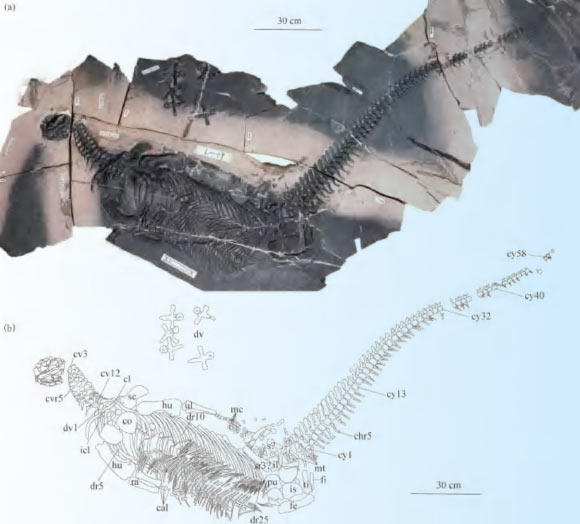
Photograph (A) and line drawings (B) of Gladocephaloideus jingangshanensis (JPM 2014–004). Abbreviations: ca, carpals; cr, coracoids; cv, cervical vertebrae; d, dentray; dg, deep groove along the mid-line of the mandibular symphysis; dv, dorsal vertebrae; dr, dorsal ribs; etp, extensor tendon process; f, frontal; fc, fifth carpal; fe, femur; fi, fibula; fin, fingers; h, humerus; il, ilium; m, maxilla; mmttsI-IV, metatrals I-IV; mttv, metatarsal V; nao, nasoantorbital opening; or, orbital; pcr, parietal crest; pm, premaxilla; pt, pteroid; ra, radius; rdl, radiale; sc, scapula; st, sternum; sl, sclerotic rings; t, teeth; tc, tooth sockets; ti, tibia; ul, ulna; wm, wing metacarpal; wph1-4, wing phalanges 1–4. Scale bar = 5 cm.
Taxons Gladocephaloideus

Photograph (A) and line drawings (B) of Gladocephaloideus jingangshanensis (JPM 2014–004). Abbreviations: ca, carpals; cr, coracoids; cv, cervical vertebrae; d, dentray; dg, deep groove along the mid-line of the mandibular symphysis; dv, dorsal vertebrae; dr, dorsal ribs; etp, extensor tendon process; f, frontal; fc, fifth carpal; fe, femur; fi, fibula; fin, fingers; h, humerus; il, ilium; m, maxilla; mmttsI-IV, metatrals I-IV; mttv, metatarsal V; nao, nasoantorbital opening; or, orbital; pcr, parietal crest; pm, premaxilla; pt, pteroid; ra, radius; rdl, radiale; sc, scapula; st, sternum; sl, sclerotic rings; t, teeth; tc, tooth sockets; ti, tibia; ul, ulna; wm, wing metacarpal; wph1-4, wing phalanges 1–4. Scale bar = 5 cm.

crête humérus écaille dent +2
Haliskia peterseni gen. et sp. nov., holotype specimen KK F1426. (A) dorsal vertebra, ribs, gastralium, left scapulocoracoid, left and right manual phalanx IV-2, right manual phalanx IV-3, left femur, left tibia, metatarsals and pedal phalanges, (B) mandible, teeth, ceratobranchials, cervical vertebra, rib, gastralium, right syncarpus, right lateral carpal, right pteroid, metacarpals, manual digits, right manual phalanx IV-1, left manual phalanx IV-4, (C) premaxilla with teeth, (D) isolated tooth, (E) isolated tooth, (F) left lateral carpal, (G) left metacarpal IV. Scale bar = 50 mm.
Taxons Haliskia

Haliskia peterseni gen. et sp. nov., holotype specimen KK F1426. (A) dorsal vertebra, ribs, gastralium, left scapulocoracoid, left and right manual phalanx IV-2, right manual phalanx IV-3, left femur, left tibia, metatarsals and pedal phalanges, (B) mandible, teeth, ceratobranchials, cervical vertebra, rib, gastralium, right syncarpus, right lateral carpal, right pteroid, metacarpals, manual digits, right manual phalanx IV-1, left manual phalanx IV-4, (C) premaxilla with teeth, (D) isolated tooth, (E) isolated tooth, (F) left lateral carpal, (G) left metacarpal IV. Scale bar = 50 mm.

écaille dent vertèbre holotype +2
Selected elements used in the diagnosis of Saltriovenator zanellai n. gen. n. sp.

Right humerus in medial (A), frontal (B) and distal (C) views; (D) left scapula, medial view; (E) right scapular glenoid and coracoid, lateral view; (F) furcula, ventral view; tooth, labial (G) and apical (H) views; (I) left humerus, medial view; right second metacarpal in dorsal (J), lateral (L) and distal (N) views; first phalanx of the right second digit in dorsal (K), lateral (M) and proximal (O) views; (P–T) right third digit in proximal, dorsal and lateral views; (U) right distal tarsal IV, proximal view; third right metatarsal in proximal (V) and frontal (X) views; second right metatarsal, proximal (W) and frontal (Y) views; (Z) reconstructed skeleton showing identified elements (red). Abbreviations as in text, asterisks mark autapomorphic traits. Scale bars: 10 cm in (A)–(E), (I), and (U)–(Y); two cm in (F), and (J)–(T); one cm in (G).
Taxons Saltriovenator

Selected elements used in the diagnosis of Saltriovenator zanellai n. gen. n. sp. Right humerus in medial (A), frontal (B) and distal (C) views; (D) left scapula, medial view; (E) right scapular glenoid and coracoid, lateral view; (F) furcula, ventral view; tooth, labial (G) and apical (H) views; (I) left humerus, medial view; right second metacarpal in dorsal (J), lateral (L) and distal (N) views; first phalanx of the right second digit in dorsal (K), lateral (M) and proximal (O) views; (P–T) right third digit in proximal, dorsal and lateral views; (U) right distal tarsal IV, proximal view; third right metatarsal in proximal (V) and frontal (X) views; second right metatarsal, proximal (W) and frontal (Y) views; (Z) reconstructed skeleton showing identified elements (red). Abbreviations as in text, asterisks mark autapomorphic traits. Scale bars: 10 cm in (A)–(E), (I), and (U)–(Y); two cm in (F), and (J)–(T); one cm in (G).

humérus écaille dent dessin +2
Specimen MN 6117-V, holotype of Oxalaia quilombensis.

A, Left lateral view. B, Right lateral view. C, Dorsal view. D, Slightly oblique ventral view, emphasizing the sculptured condition of the palatal portion of the left premaxilla. Abbreviations for teeth follow Hendrickx et al. [58]. Additional abbreviations: am.p, anteromedial process of maxilla; pm, premaxilla; r.t, replacement tooth; s.p, secondary palate.
Taxons Oxalaia

Specimen MN 6117-V, holotype of Oxalaia quilombensis. A, Left lateral view. B, Right lateral view. C, Dorsal view. D, Slightly oblique ventral view, emphasizing the sculptured condition of the palatal portion of the left premaxilla. Abbreviations for teeth follow Hendrickx et al. [58]. Additional abbreviations: am.p, anteromedial process of maxilla; pm, premaxilla; r.t, replacement tooth; s.p, secondary palate.

dent holotype spécimen Oxalaia
Left maxilla (A) and left dentary (B) of carcharodontosaurid theropod Kelmayisaurus petrolicus Dong, 1973 (IVPP V 4022, China, Lianmugin For−
mation, Lower Cretaceous). Photographs in lateral (A1, B1), medial (A2, B2), ventral (A3), and dorsal (B3) views. Scale bars 5 cm. Designation “d” refers to

dentary tooth, designation “m” refers to maxillary tooth position. Dorsal view of dentary shows tooth row only.
Taxons Kelmayisaurus

Left maxilla (A) and left dentary (B) of carcharodontosaurid theropod Kelmayisaurus petrolicus Dong, 1973 (IVPP V 4022, China, Lianmugin For− mation, Lower Cretaceous). Photographs in lateral (A1, B1), medial (A2, B2), ventral (A3), and dorsal (B3) views. Scale bars 5 cm. Designation “d” refers to dentary tooth, designation “m” refers to maxillary tooth position. Dorsal view of dentary shows tooth row only.

écaille dent Chine Crétacé +2
1 2 3 4

Actualités

Une étude révolutionnaire renforce les arguments en faveur des lèvres chez les dinosaures
peau tissus dent Dinosauria biomécanique étude
Le débat sur les lèvres des dinosaures se poursuit.  La question de savoir si les dinosaures possédaient des tissus extra-oraux reste controversée. Cependant, une nouvelle étude remarquable vient renforcer considérablement l’idée selon laquelle la plupart des dinosaures possédaient des tissus extra-oraux qui recouvraient et protégeaient leurs dents. Une nouvelle étude, publiée dans la revue "Palaeontology", fournit des preuves irréfutables que les lèvres étaient une condition ancestrale
15/06/2026 everythingdinosaur ⚙ Traduction automatique
Les scientifiques ont peut-être démystifié l’une des plus anciennes habitudes de l’humanité
dent Homo sapiens étude
Selon une nouvelle étude sur les primates sauvages, d'anciennes rainures sur les dents humaines, autrefois considérées comme une preuve de cure-dents, pourraient simplement être le résultat d'une usure naturelle. La recherche a également révélé qu'un défaut dentaire moderne et courant semble être uniquement humain, ce qui laisse entendre que les modes de vie d'aujourd'hui pourraient remodeler nos dents de manière inattendue.
08/06/2026 sciencedaily ⚙ Traduction automatique
Une dent d'enfant et d'étranges pierres vertes révèlent un mystère vieux de 5 500 ans
dent découverte fouille
Une ancienne grotte de montagne dans les Pyrénées a peut-être été l'un des premiers camps miniers de haute altitude jamais découverts, avec des preuves de visites répétées s'étalant sur des milliers d'années. La découverte devient encore plus intrigante avec la découverte des restes d’un enfant et des indices suggérant que des fouilles plus profondes pourraient révéler des sépultures préhistoriques.
03/06/2026 sciencedaily ⚙ Traduction automatique
Voici la « sorcière crocodile », une créature édentée du Trias, vieille de 212 millions d'années, qui marchait sur deux jambes
dent Trias
Il y a plus de 200 millions d’années, bien avant les crocodiles modernes, une étrange créature parcourait déjà la Terre sur deux pattes. Son apparence défie tout ce que l’on imagine de ces redoutables reptiles. Sans dents, munie d’un bec et dotée d’une silhouette rappelant davantage certains...
30/05/2026 futura-terre
‘T. rex’ Mosasaur Ruled the Seas 80 Million Years Ago
Le mosasaure de 'T.Rex' régnait sur les mers il y a 80 millions d'années
dent Mosasaurus Tylosaurus nouvelle espèce
Les paléontologues ont décrit une nouvelle espèce gigantesque de mosasaure – mesurant jusqu'à 13,2 m (43 pieds) de long et armé de dents dentelées – et lui ont donné un nom inattendu : T. rex (abréviation de Tylosaurus rex).
21/05/2026 sci-news ⚙ Traduction automatique
1 2 3 4 5 6